
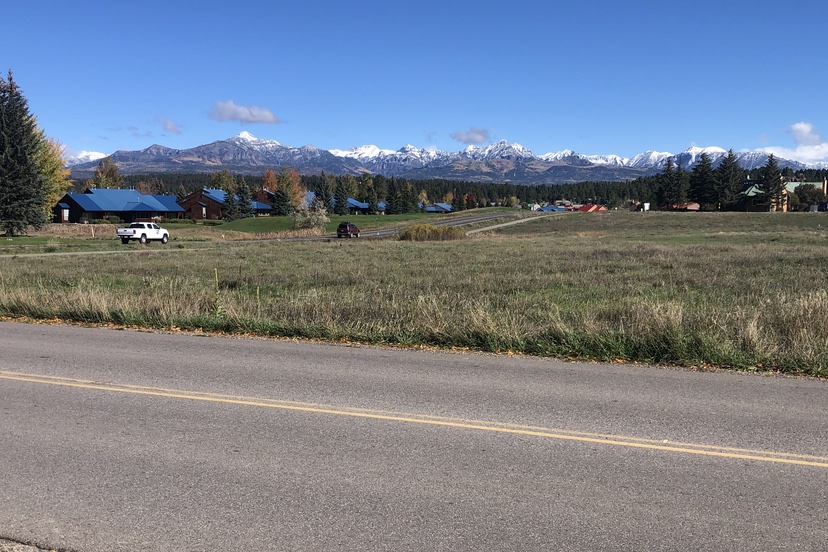
The photo above, taken on October 17, 2026, illustrates a couple of important things about Pagosa Springs.
One: We typically get winter snow up in the San Juan Mountains, and the mountains thus serve as the wintertime ‘water storage system’ for the local community — and for communities downstream — releasing water during the spring as the snow melts. (During the summer and fall, the community depends on rainfall for any additional water.)
Two: We can see, in the photo above, a large vacant field that might someday be covered with single-family homes or condos. This particular vacant parcel is located within the Pagosa Lakes Property Owner Association (PLPOA) and its future development is controlled mainly by PLPOA regulations. But the water and sewer service for any housing built there will be provided by the tax-supported government district known as Pagosa Area Water and Sanitation District (PAWSD).
As the community adds more people and more buildings, PAWSD must expand its services, whenever the development takes place within the district boundaries.
One rather expensive expansion project has been taking place northeast of downtown Pagosa, over the past three years.
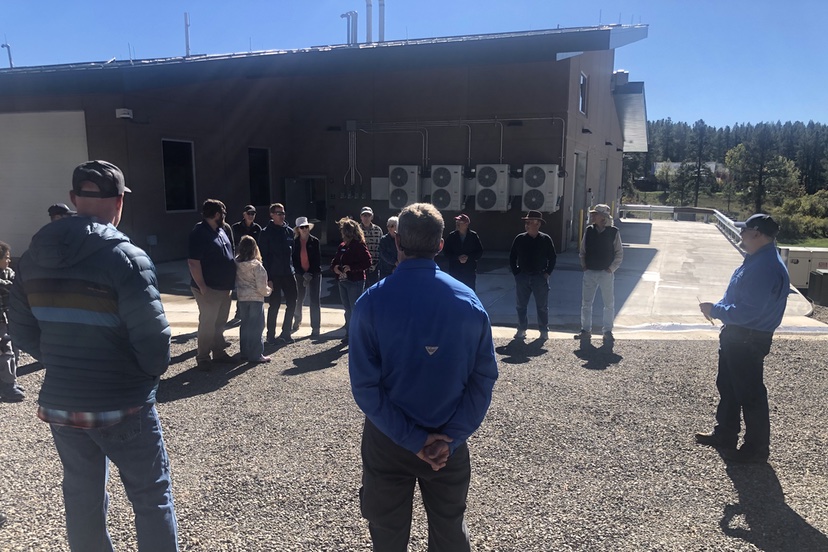
About 25 Pagosans toured the new $44 million Snowball water treatment plant on Saturday, following a ribbon cutting ceremony that included representatives from PCL — the construction company that built the impressive new facility.
I plan to write about that tour and the new plant later this week.
Pagosa water customers are paying for this new plant through monthly water fees — and other fees, including a $26,000-per-Equivalent-Unit Capital Investment Fee (CIF) paid by new homes and new commercial buildings in the Pagosa Lakes area for water and sewer service. (The PAWSD CIF is less in the downtown area, because the Town of Pagosa Springs runs the sewer collection in that district, so PAWSD charges only a water CIF there.)
The Pagosa Area Water and Sanitation District (PAWSD) has posted a draft budget for 2027, on its website. At last week’s meeting, the PAWSD board indicated that this draft version might not be the final version, which will be approved in December.
The district’s taxpayers might have questions about the proposed budget, because it indicates a 15% increase in monthly water and wastewater charges. Two of the five PAWSD board members have indicated they would like the fee increases to be even larger.
Disclosure: I currently serve as a volunteer member of the PAWSD Board of Directors, but this editorial expresses only by own opinions and not necessarily the opinions of the PAWSD Board or staff.
I’ve been pretty clear, in this editorial, that governments often encourage growth and new development, because growth generally increases tax revenues and other forms of revenue, like monthly fees.
But growth also demands an increase in government services.
In the case of PAWSD, according to the proposed 2027 budget, the district revenue — fees and taxes — have increased from $10.9 million in 2021 to a projected $15.8 million in 2027. (Not including grants and loans)
That’s a projected 45% increase in revenues.
Consumer prices in general have inflated, during that same period, by about 24%.
But PAWSD expenses have increased at a faster rate than revenues. The total district operational expenses in 2021 totaled $7.5 million. (This doesn’t include the district’s debt payments.)
The projected expenses in 2027?
$17.0 million. (Not including debt payments.) That’s a projected 127% increase in expenses since 2021. More than doubled.
Pagosa Springs saw a slight population increase between 2021 and 2023… but the Colorado State Demographer says our population dropped slightly from 2023 to 2024. Meanwhile, the cost of living here has been steadily increasing.
The Town Planning Department apparently wants to reduce the cost of living here, for people who earn more than the average wage. During their negotiations with Modern Community Builders LLC — the company proposing a new mixed-use subdivisions west of the Elementary School — the Planning Department agreed to present a Planned Development (PD) Agreement to the Town Council that would convert 70 acres zoned “rural” into a much more dense “R-22” zoning. (22 units per acre.) The Town Planning Commission then looked at the negotiated Agreement and recommended “R-12” zoning, to reduce the maximum density somewhat. (But still, six times the density of “Rural Transition.)
The proposed housing in the development would be unaffordable for the average worker in Pagosa Springs.
At the Council’s public hearing on October 6, every member of the public — except for the realtor representing the property owner — spoke in opposition to the Agreement. It became clear during the subsequent questioning and discussion by the Council that a majority of the Council as a whole leaned towards rejecting the proposed PD Agreement.
But Development Director James Dickhoff, who I presume had taken the lead on negotiating the proposed Agreement, asked the Council to give him clear reasons why they were voting ‘No’.
(Mr. Dickhoff also noted that, if the Council rejected the proposed Agreement, the developer would have to wait one year before bringing forward a revised proposal.)
Only one of the Council members — Leonard Martinez — seemed able to clearly articulate his reasons for rejecting the PD Agreement. He noted that the Town has been struggling for several years with a sewer system crisis, and this is the wrong time to approve an increase in the number of Town sewer customers by 25%-35%.
He also viewed the proposed mixed-use development as increasing the negative impacts created by too much tourism.

The vote of the Council was to ‘continue’ the consideration to a future meeting, to allow Council members to clearly formulate their reasons for denying approval of the PD Agreement.
Several segments of Archuleta County’s infrastructure have been impacted by the tripling of the county population since 1990, and by the simple fact that stuff starts breaking down as it gets older. Much of our infrastructure was still relatively new in 1990.
The county roads, for example.
But our water and sewer infrastructure has also been getting older, while state and federal regulations have gotten more strict, even onerous.
Our electrical grid is older, while demand for electricity continues to increase.
I proposed on Friday, in Part Three, that our local governments tend to encourage “growth” because their revenues increase when more people arrive. And I think most of our business leaders also want more “growth” and more customers. And more tourists. Typically, government and business are not satisfied with “the status quo”.
But the ordinary residents who live here? We tend to embrace less traffic, less noise, and more open space.
Bill Hudson began sharing his opinions in the Pagosa Daily Post in 2004 and can't seem to break the habit. He claims that, in Pagosa Springs, opinions are like pickup trucks: everybody has one.