
This story appeared on BigPivots.com on November 21, 2026. We’re sharing it in two parts.
Eight years ago, Xcel Energy rented the west side of the Denver Museum of Nature and Science. On that day in December 2018 company executives had come from their headquarters in Minneapolis to announce they were getting out of coal in Colorado and the seven other states where they operated.
Jared Polis had been elected Colorado governor the prior month after campaigning on a platform of 100% emissions-free energy by 2040. “Elections have consequences,” he said during his turn at the lectern.
Indeed they did. Democrats, in control of both branches of the Legislature for the first time in several years, set out to push the energy transition at a brisk pace. The pivot was already underway in 2019 but under Polis it has accelerated. The job won’t be completed for at least a few decades. But, in Colorado, these last years have been a remarkable run.
Will Toor has been at the center of this pivot. As director of the Colorado Energy Office, he takes orders from Polis, but he is a very big thinker in his own right. You might call him the architect-in-chief.
Toor also happens to be a very bright but also interesting individual. For example, he had dropped out of middle school in seventh grade and entered Stanford when he was 16 — to go to graduate school. He has a doctorate in physics. His career path for several decades, though, has revolved around public policy. He was mayor of Boulder and then a Boulder County commissioner before working with the advocacy group, Southwest Energy Efficiency Project, where he was in charge of that group’s advocacy of decarbonized transportation.
But here’s another item on his resume. When still young, he spent part of a winter herding sheep on Douglas Mountain, near Dinosaur National Monument, in far northwest Colorado. He’s physically robust, the sort of guy who will take a bus from Boulder, where he lives to the Eldora ski area and hoof it up to the Continental Divide crossing at Rollins Pass.
He’s still backpacking despite a mountaineering accident several years ago that caused him to tumble 1,000 feet down a steep snowfield, breaking his leg and leaving him with a permanent limp.
As for minimizing his carbon footprint, Toor has an EV but quite a lot of the time he gets around on a bicycle after catching a bus.
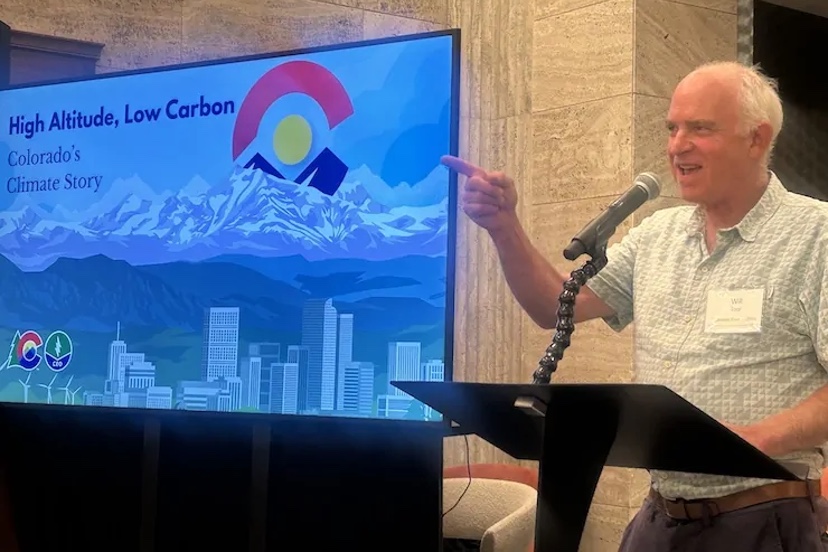
Toor spoke on Thursday evening at the Denver museum, this time on the east side. He is the central figure in a series of podcasts called High Altitude, Low Carbon: Colorado’s Climate Story.
The first hour-long podcast has Toor talking with two governors, Polis and former Colorado Gov. Bill Ritter, about Colorado’s energy transition. Seven more are to follow, each one dropping on a successive Wednesday until early January. Among those Toor interviews are at least three current or former state legislators, two people from transportation, a couple from energy utilities, somebody from the oil and gas sector, and somebody from the agriculture economic sector.
The podcasts have been produced by the Colorado Energy Office in conjunction with the museum-affiliated The Institute for Science & Policy. Kristen Uhlenbrock, the institute’s director, introduced him at the celebration, telling about their first meeting at a bar during a conference in 2018 and the story he shared with her.
“The story ended with a lot of interesting characters and some hitchhiking and some lack of clothes,” she said. “But it made me realize that he’s such a human. No matter how brilliant he is and how dedicated he is and how passionate he is to do things, he is very much a human. And he’s very good at storytelling.”
“In my defense,” said Toor when he took the microphone, “the lack of clothes was not voluntary. It was at gunpoint. If you would like a full story, it’s at the bar afterwards.”
Toor is uncommonly even-tempered, at least in my experience. Once I heard him get slightly grumpy in answering endless and repetitive questions during a legislative hearing. Another time, after a speaking engagement, he didn’t seem to welcome my question when I was at the end of a long line of inquisitors. Mostly, he’s quick with a smile or laugh. Given the enormous responsibilities of his work and the balancing act with family, that persistent good cheer is almost astonishing.
At the Denver museum, Toor described the public temperament in 2019 when he became the director of the energy office.
“It was kind of a moment in time when there were just real opportunity and real public support for getting a lot done. And then over the ensuing eight years, it’s just sometimes almost a blur.”
Toor seems to have initiated the idea of podcasts. His energy office then approached the institute, which has a mission statement to be a “catalyst for thoughtful dialogue, working toward solutions on society’s greatest challenges with scientific thinking, empathy, and inclusivity.”
He described the podcast conversations as an attempt to shed more light on the complicated behind-the-scenes work of policymaking that he said the public rarely gets to see or hear about. “Our goal with High Altitude, Low Carbon is to pull back the curtain through conversations with key elected officials and government, advocacy, utility and business leaders.”
Colorado should be regarded as a national leader in this transition. Ritter said research by the Center for the New Energy Economy, which he founded and then directed for many years, left no question about that. “Colorado would absolutely be considered somewhere in the top five, maybe even the top three” among states, he said.
For those engaged in this energy pivot in Colorado, much of what was explained during the first podcast is not new. Still, at times, there is likely to be new information, such as what Polis said about Colorado’s ability to meet to the 2040 decarbonization goal he had asserted in 2018. Others might be surprised to hear Toor and Ritter wish for more bipartisanship. It makes for better laws, said Toor.
The intended audience is not necessarily energy wonks. In doing podcasts, Toor and his team at the Colorado Energy Office believe they can gain a larger and perhaps younger audience.
With these podcasts, Toor also hopes to influence and inform other states in their energy transitions. In Toor’s eyes, Colorado is an interior state and one with a significant oil and gas sector. Even if the state’s politics have shifted from purple to solidly blue in the last decade, it could be seen as a place other states not on the East or West coasts will want to study and, at times emulate.
As for Colorado’s journey, Toor acknowledged being influenced by California but he also reported an effort to maintain a distance. “When we would steal a policy idea from California, we really usually tried not to tell anyone that that’s where it came from,” he said.
In the initial podcast, Toor talks first with Ritter, the governor of Colorado from 2007 to 2011. Toor acknowledges the building blocks in place before 2018. Most demonstrable was voter approval in 2004 of the citizen-initiated Amendment 34, which required Xcel Energy to get 10% of its electricity from renewable sources by 2015. Xcel fought it — then set out to comply. That vote, in turn, gave Ritter confidence to run on a platform emphasizing renewable energy. “It gave me a sense that people were ready for a different conversation about energy.” He bucked his campaign advisers and made renewable energy a central part of his TV advertising.
Among the 57 bills related to the energy transition passed by state legislators during Ritter’s four years as governor were steeper requirements for increasing levels of renewables for Xcel.
“And two different CEOs at Xcel have told me they would never have gotten to where they’re getting to without having a standard put in place of 30% by 2020,” Ritter tells Toor in the podcast.
Read Part Two… on Monday…
Allen Best publishes the e-journal Big Pivots, which chronicles the energy transition in Colorado and beyond.