
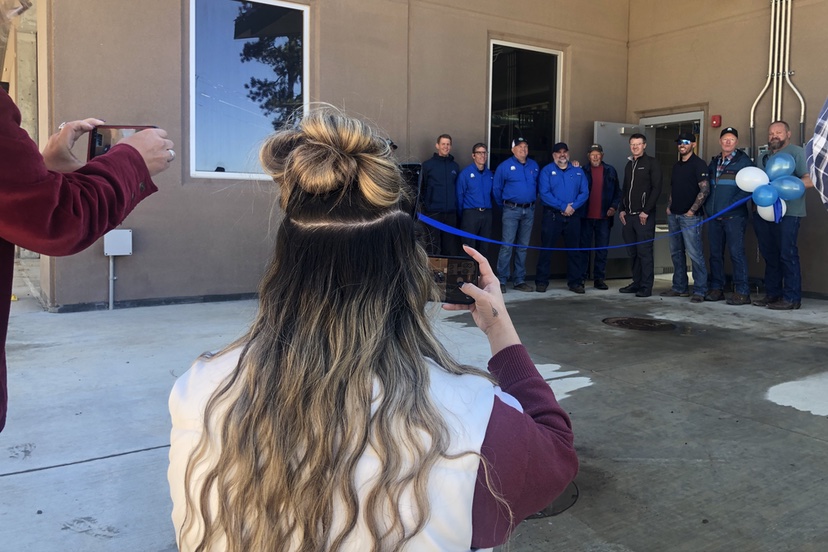
As Andy Connor — District Manager for Pagosa Area Water and Sanitation District (PAWSD) — prepared to cut the ribbon at the impressive new Snowball Water Treatment Plant northeast of downtown Pagosa Springs, he confessed that he had never tried cutting a “grand opening” ribbon before, and he hoped it went smoothly.
As it turned out, the scissors were insufficient to easily cut the blue fabric ribbon, and he had to struggle a little to complete the task. Naturally, the small crowd broke into applause as the ribbon finally fell in two pieces.
The $44 million treatment plant on Snowball Road also had a few struggles during construction, and a few “punch list” items still remained to be completed as of October 17, 2026, almost a year after the expected completion date. (The plant has, however, been successfully producing clean drinking water since last spring.)
But now was the right time for a grand opening celebration, now before the snow flies… and about two dozen Pagosans showed up to join the PAWSD staff and representatives from the project constructor, PCL, for a tour of the facility.
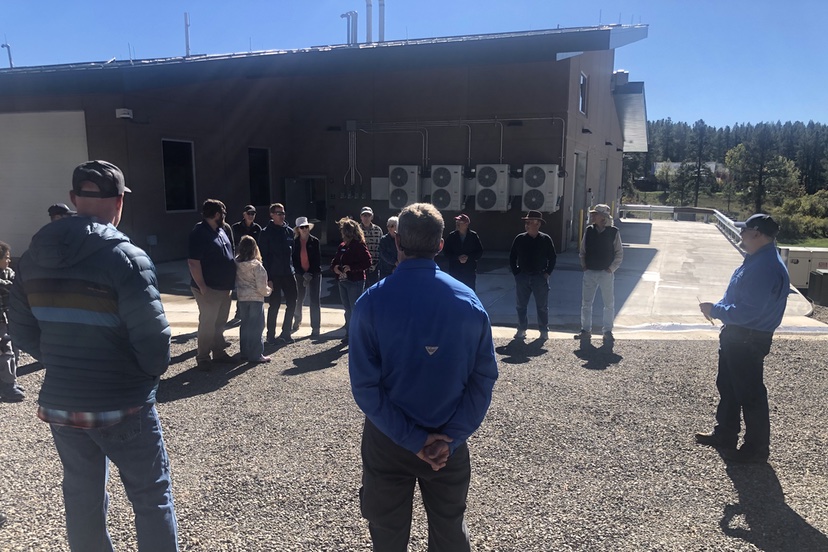
District Manager Connor welcomed the visitors. He began by noting that the facility has a special ‘pre-treatment’ feature that can handle the excessively polluted water that could result from a large wildfire in the San Juan Mountains.
“This is a 3-MGD plant… Three million gallons per day… and it’s built with 94% efficiency, meaning that we’re delivering almost every drop that goes into it, all but 6% of it…”
The old Snowball treatment plant, built in the 1970s, could produce about one million gallon per day and was about 60% efficient — “wasting” nearly half of its purified water to back-flush the treatment media.
Not only is the new plant more efficient — it’s also has built-in redundancy. Once the raw water enters the plant, it is split into two separate treatment paths, each pathway able to produce 1.5 million gallons a day.
Mr. Connor:
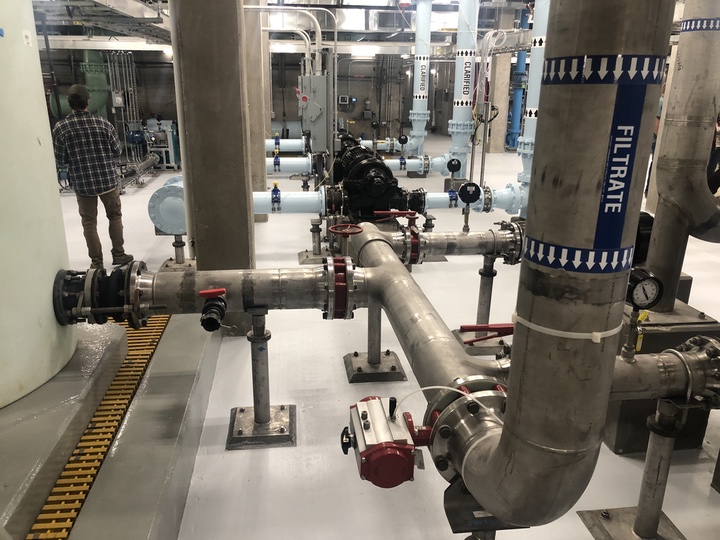
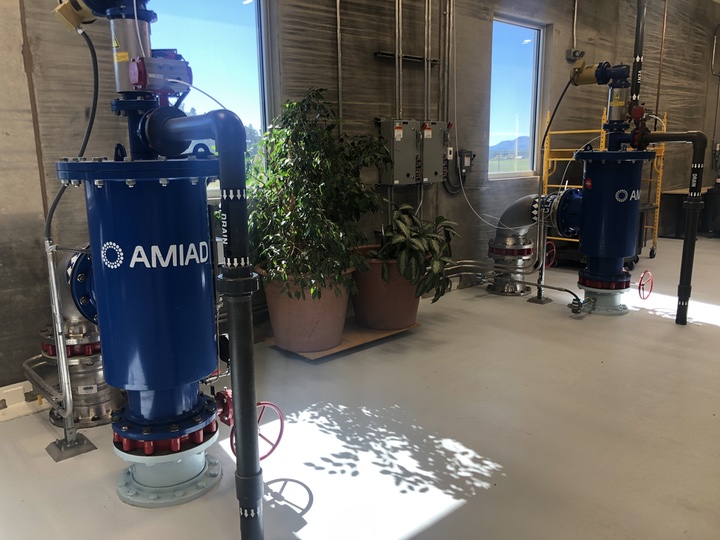
“As you walk through this facility, you will see that all the major components are double. We have double pumps, double electrical drives, double filter systems. That way — especially living in this part of the country — we can’t get replacement parts within hours like Denver might… so we have the redundancy, so we aren’t ‘down’ for any period of time.”
Being that Pagosa Springs is pretty much in the middle of nowhere, and may be days or weeks from getting replacement parts…
I’ve been attending Town Council meetings regularly, and have heard about constant struggles faced by the Town sanitation system in obtaining parts. During one recent discussion, it sounded like the turn-around time was in excess of six months, for obtaining replacements for the massive pumps needed to pump the Town’s sewage seven miles uphill to the Vista Wastewater Treatment Plant.
By building redundancy into the Snowball plant, PAWSD can assure the customers served by this plant of consistent drinking water supplies, even if one treatment pathway hits a snag.
Before we head off on a tour of the new Snowball plant, let’s put “three million gallons per day” into some perspective.
Disclosure: I currently serve as a volunteer member of the PAWSD Board of Directors, but this editorial reflects only my own opinions, and not the necessarily the opinions of the PAWSD Board or staff.
Municipal water is typically measured using three different units.
MGD, million gallons per day. One million gallons per day typically serves up to 15,000 American households. Almost all countries in the world use less water per household than the U.S.
AF, acre feet. One acre foot is the amount of water needed to cover one acre, one foot deep. 3 AF equals about 1 million gallons.
CFS, cubic feet per second. 1.5 CFS is roughly equal to 1 million gallons per day. PAWSD has a water right that allows it to divert up to 5 CFS from the West Fork of the San Juan to serve the Snowball Treatment Plant, but the new plant can normally process a little less… about 4.5 CFS.
Over the past decade, PAWSD has been producing around 2,500 AF (acre-feet) of drinking water per year, which is about 7 acre-feet per day — about 2.3 million gallons per day. On average. This implies that the new Snowball plant is now capable of producing all the water needed on an average day in Pagosa Springs. But due to residential irrigation and increased summertime population, PAWSD produces about twice as much water on an average day in July, as it does on an average day in January.
Most PAWSD customers live in the Pagosa Lakes area, and are served by the Hatcher Treatment Plant on the shores of Lake Hatcher. That is a 2 MGD plant, expandable to 4 MGD. PAWSD has a third treatment plant on Lyn Avenue capable of producing about 2 MGD.
Clearly, with three treatment plants, PAWSD is capable of producing more than enough water to serve the 14,500 full-time residents of Archuleta County — but directly serves only about 12,000 full-time residents; about 2,500 residents live outside the District.
However, PAWSD has been losing around 30%-40% of the water it produces to leaking pipes and production needs. So although 2,500 AF of drinking water gets produced, PAWSD sells only about 1,400 AF per year.
The new Snowball Plant pulls its raw water directly from the West Fork. It does not draw its water from a storage reservoir. Meanwhile, the demand on the old Snowball plant was much less than the 3 MGD that the new plant is capable of producing. Typically, the old Snowball plant had to produce only about 0.5 million gallons per day, on average. More in the summertime, of course. Less in the winter.
To produce 0.5 million gallons per day, the West Fork pipeline needs to deliver less than 1 CFS. PAWSD has a water right of 5 CFS from that source.
Theoretically, the new Snowball Plant, all by itself, could serve a population twice the size of Archuleta County’s current population.
Was the new plant “overkill”?
Read Part Two… tomorrow…
Bill Hudson began sharing his opinions in the Pagosa Daily Post in 2004 and can't seem to break the habit. He claims that, in Pagosa Springs, opinions are like pickup trucks: everybody has one.