
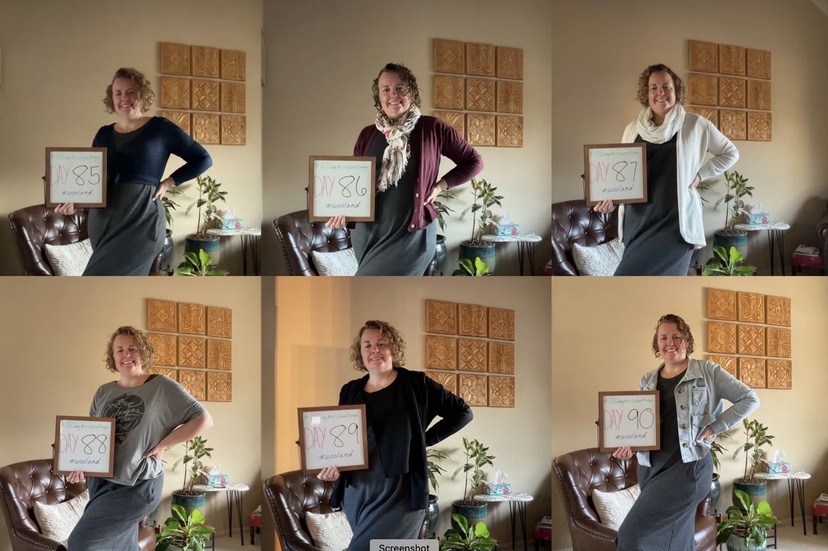
Olga Gintchin wore the same dark-gray wool dress for 100 days, from mid-January to the end of April 2026. (Provided by Olga Gintchin)
— from a story by Jennifer Brown on the Colorado Sun, May 26, 2025.
According to her online bio, Colorado Sun journalist Jennifer Brown normally “writes about mental health, the child welfare system, the disability community and homelessness.”
However, her 2,000-word article, last week, bore the headline:
How a Colorado woman is making a statement against fast fashion by wearing the same dress for 100 days
The article — which we might understand to involve mental health? — begins:
In a world of fast fashion, Olga Gintchin is a one-woman counterculture phenomenon, in understated gray.
The other Highlands Ranch moms on the soccer field probably didn’t notice. Fellow shoppers at the King Soopers most certainly did not. Some of her coworkers eventually caught on, but most likely because Gintchin told them. For 100 days in a row, she wore the same dress.
Ms. Gintchin reportedly bought the dress for $150 from Wool&, out of Portland, Oregon.
I would consider myself a counterculture phenomenon, as well, because I’ve been wearing an identical pair of jeans — also in understated gray — since October. Not the exact same pair of jeans… because I own two pair, same size, same color, same brand. When one pair go into the laundry basket, I wear the other pair for the next couple of weeks, until the laundry basket is full. (I don’t like doing laundry.)
$19 each, from Amazon, with free shipping. So, less than $40 total for both pairs. I wonder if fellow shoppers at City Market have noticed? No one has commented. (I’ve also been wearing the same baseball cap for two years. Again, no comments from friends.)
Ms. Gintchin, meanwhile, got her photo — actually, a whole series of photos — published in a popular news website, after a journalist heard about her unusual quest. Apparently, her $150 wool dress is comfortable in almost any temperature? And she easily “dressed it up” with a variety of tops and accessories.
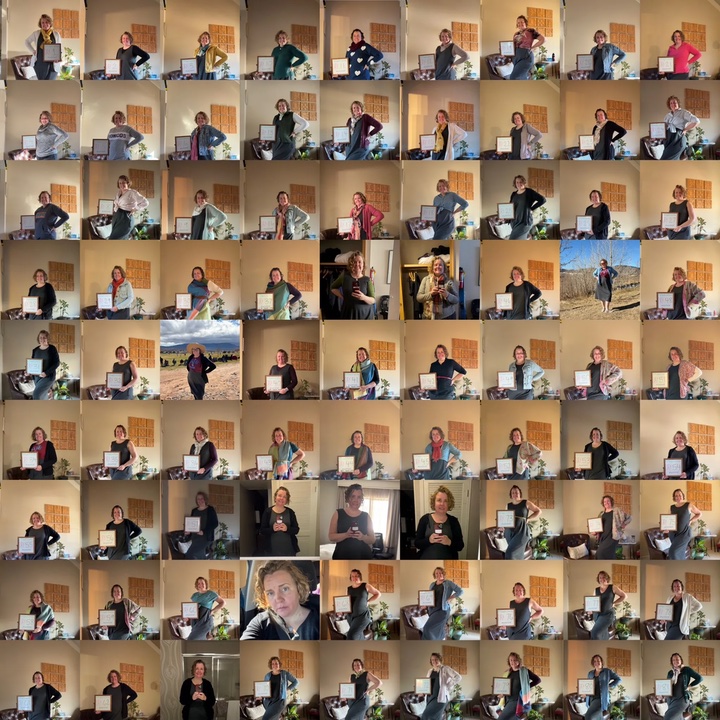
During the 100 days of the dress, she would wash it once every week or two in the washing machine, in cold water on the delicate cycle, and hang it up to dry overnight. If she spilled coffee on it, she would spot wash it in the sink.
I do the same with my jeans, when I spill coffee on them. That doesn’t happen too often, though. Usually, when I’m drinking coffee, I’m still in my pajamas. By the time I’m in my jeans, it’s more likely I will be spilling beer on them. Or salsa.
Journalist Jennifer Brown framed her Colorado Sun article as a missive about the ongoing and global rebellion against “fast fashion”. Her article also mentioned a clothing consultant — a “personal stylist” — named Helene Cardon, who, for a fee, helps women take control of their closets and learn to shop, tastefully, at second-hand consignment shops.
Cardon has helped 150 clients minimize their closets, often beginning with a $590 comprehensive session to declutter, organize and reduce the closet to the key pieces that the client loves and wears often.
“Women in general feel very overwhelmed and underwhelmed with the clothes these days,” she said. “They feel overwhelmed because there is too much in their closet, at the store, online, too much to choose from. And at the same time, they are underwhelmed, because the quality is not good, and when they put their clothes on, they feel like they don’t like what they’re wearing”…
…Slow fashion — the opposite of mass-produced, cheap clothing from fast-fashion companies like Shein — is growing in popularity among those who are grossed out by mass consumption of clothes that end up in landfills. Each year, the world throws away 92 million tons of textile waste, the equivalent of one garbage truck of clothing per second, according to Global Fashion Agenda.
I admit to throwing away a T-shirt last week. It had finally gotten too many holes. But we note that the “one garbage truck per second” of clothing waste is mainly coming from “women in general” who “feel very overwhelmed and underwhelmed” and find it easier to throw away clothes rather than renting a second storage unit for their ever-expanding wardrobe.
Reportedly, Ms. Cardon also tried a clothing challenge once too — not for 100 days, but for 10. She wore the same 10 items of clothing in different ways for 10 days.
“You realize, ‘Oh my God, I don’t need all these clothes. I can really do a lot with just 10 pieces,’” she said…
“People in Colorado already have this mindset that they don’t want to trash their trails… and slow fashion is extending the same mindset to your wardrobe…”
If you’re a woman, that is.
Forgive me if I propose that the existence of both ‘fast fashion’ and ‘slow fashion’ is clear evidence for biological differences between women and men.
Underrated writer Louis Cannon grew up in the vast American West, although his ex-wife, given the slightest opportunity, will deny that he ever grew up at all. You can read more stories on his Substack account.