
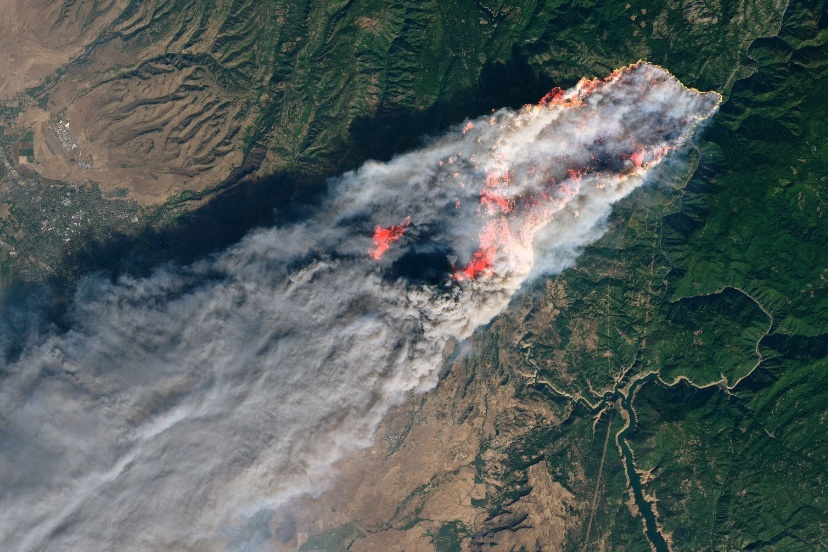
Photo: The Camp Fire erupted 90 miles north of Sacramento, California on the morning of November 8, 2018. By evening, the fast-moving fire had charred around 18,000 acres and remained zero percent contained, according to news reports. Officials evacuated several towns and also closed several major highways.
Shortly after I finished posting the Daily Post yesterday morning, my computer shut down suddenly, and the office lights blinked off.
Obviously, it was time for a nice walk, on a pleasant spring morning.
The funny thing for me was that I’ve been hearing, lately, about planned power cuts from La Plata Electric Association (LPEA), in case of wildfires threatening power lines and infrastructure, possibly this summer.
Just such an “Emergency Power Shutoff” had occurred last August in response to the 75-acre Oak Fire in Aspen Springs. Approximately 192 LPEA customer-members went without power when that fire threatened critical electric infrastructure in the area.
An Emergency Power Shutoff is a temporary, power outage intended to reduce the risk of electrical equipment igniting wildfires during high-risk conditions. Power lines have been blamed for wildfires in, for example, Lahaina, Hawaii in 2023. In February 2024, in the Texas Panhandle, a decayed utility pole fell on dry grass and sparked the largest wildfire in state history.
The 2018 Camp Fire, the deadliest and most destructive wildfire in California history, was caused by a single faulty hook on a Pacific Gas & Electric (PG&E) transmission line. The fire caused 85 fatalities, displaced more than 50,000 people and destroyed over 18,000 structures, causing an estimated $16.5 billion in damage.
PG&E filed for bankruptcy in January 2019, citing expected wildfire liabilities of $30 billion. On December 6, 2019, the utility made a settlement offer of $13.5 billion for wildfire victims as the offer covered several devastating fires caused by the utility, including the Camp Fire. On June 16, 2020, the utility pleaded guilty to 84 counts of involuntary manslaughter.
Another reason for my current interest in electricity: I attended an April 6 “Rural Energy Resiliency” forum hosted by the Colorado Energy Office and the Four Corners Office for Resource Efficiency, more affectionately known as 4CORE.
One of the main topics at that forum? Colorado’s ongoing transition away from fossil fuels and towards electrical energy.
More about that in a moment.
Reportedly, the LPEA electrical outage yesterday was caused by construction equipment that went through a transmission line south of Pagosa Springs, affecting approximately 7,692 meters. Crews worked diligently to repair the line.
8:26am: LPEA members are experiencing a power outage in the Pagosa Springs area. Crews are responding and will be working to restore power as soon as safely possible. Approximately 7,692 meters are out, and the details about the cause and length of the outage are unknown at this time. We will provide updates as they come.
Update at 9:15 AM: The cause has been determined to be construction equipment that went through a transmission line south of Pagosa. Crews are working to repair the line right now.
Update at 10:31am: We are down to 3,681 meters without power and are continuing work to restore power to the remaining meters.
Update at 10:36am: At this time, all meters are back in power! Thank you all for your understanding.
Obviously, this was an “unplanned” power outage, lasting about two hours. An Emergency Power Shutoff during a wildfire event has the potential to last much longer. Perhaps for several days?
But let’s get back to the Rural Energy Resilience conversation on April 6. About a dozen local residents and community leaders showed up at the forum to hear about Colorado’s electrical future from Will Toor, Director of the Colorado Energy Office. I recognized about half the participants from various other political activities — County Commissioner Veronica Medina… CSU Extension Director Cindi Galabota… Pagosa Springs Community Development Corporation (PSCDC) Executive Director Emily Lashbrooke… County Planning Commission member Mont McAlister… LPEA Board member Kirsten Skeehan… San Juan Water Conservancy District Board member Joe Tedder…
The usual suspects, in other words. (I include myself in that definition.)
Will Toor has been heading up the Colorado Energy Office (CEO) during the past seven years of the Jared Polis administration.
Although the name includes the word “Energy” — which might imply various sources of energy, including coal, oil, natural gas, and nuclear — in fact, the apparent goal of the CEO, under Governor Polis’ leadership and in line with energy goals defined by the Colorado legislature, is to transition Colorado to renewable forms of electrical energy over the next few decades.
The current Mission Statement:
Reduce greenhouse gas emissions and consumer energy costs by advancing clean energy, energy efficiency, and accessibility of zero emission vehicles to benefit all Coloradans.
Here’s a photo of the CEO staff, found on their website.
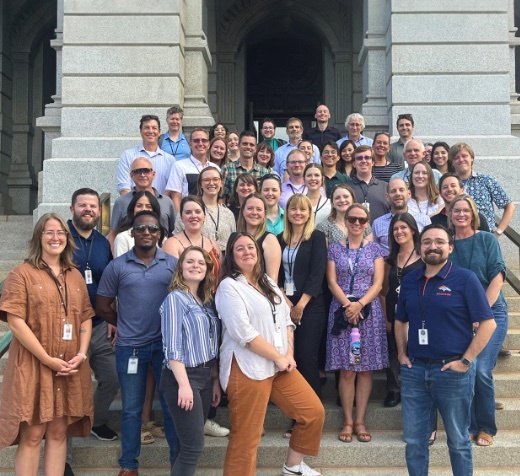
Counting the number of people in this photo with gray hair — three, by my count — I would classify this government agency as “youthful”.
And perhaps also, “hopeful”?
Here’s Mr. Toor, introducing the work of the CEO at the April 6 meeting in Pagosa Springs:
“Great to see everyone here today…
“So, to start, big picture. A lot of the work I do is helping the state meet its pollution reduction goals…”
The term “pollution” here meaning mainly GHG. Greenhouse gases.
Carbon dioxide. Methane. Nitrous oxide. The nasty stuff created when humans burn fossil fuels.
Also, created when forests burn.
If you visit the CEO website staff page, you might notice that a significant number of the staff positions include the words “Climate” or “Decarbonization”.
Mr. Toor:
“Back in 2019, the state legislature adopted statewide goals to reduce greenhouse gas pollution. To cut it in half by 2030, economy-wide, from a 2005 baseline, and to try and get to zero emissions by 2050.
“And the Governor asked the Energy Office to help answer the question, ‘How the heck are we going to do this?’
“With a particular focus on that 2030 time frame. It’s really easy to set time frames that are 30 years out and nobody who is here now is going to be accountable to them. 2030 is near enough so you can have some accountability…”
Indeed, it’s just four years away.