
Driving back from the Colorado League of Charter Schools’ annual conference in Denver last week, it was clear that most of southern Colorado had relatively little snow cover, as February came to a close. That might portend a drier-than-usual spring and summer, with a ‘more-flammable-than-usual’ landscape.
This isn’t the first time I’ve experienced southwest Colorado with a shortage of snow. I think back to the winter of 2001-2002, and the devastating Missionary Ridge Fire that erupted during the summer of 2002. That wildfire threatened to continue spreading into Archuleta County. It didn’t, but it could have.
The Missionary Ridge Fire began on June 9, 2002, northeast of Durango, and burned until July 15, destroying forty-six houses and cabins, and charring 73,000 acres of La Plata County forest. One firefighter died while fighting the blaze, which was, at the time, the seventh-largest wildfire in Colorado history.
In addition to death and destruction, the Missionary Ridge Fire caused widespread environmental degradation. Durango and its vicinity saw increased flood and mudslide risks in the aftermath, and these effects continue to be felt today, two decades after recovery teams began replanting the forest.
Since 2002, the Pagosa Springs community has been a bit more conscious of our forests and our watersheds. And maybe we’re even more conscious, this year, after witnessing January wildfires sweep through certain neighborhoods in Los Angeles County.
I wonder if our elected national leaders are also more conscious? Or it they are thinking only about tax cuts…?
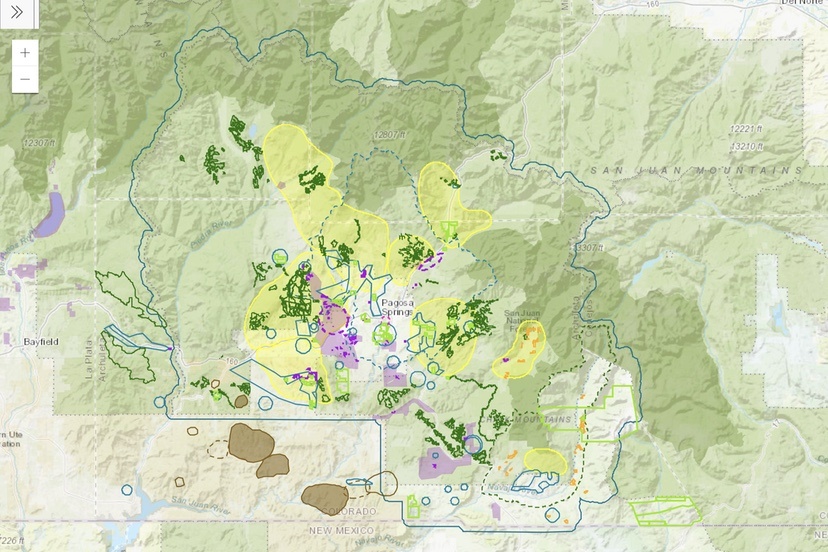
The San Juan Headwaters Forest Health Partnership — a group of volunteers and forestry professionals that have been collaborating together for the past decade or so around “forest health” issues — met at the Archuleta County administration building on February 21, and spent much of the meeting discussing the maps now available on their website.
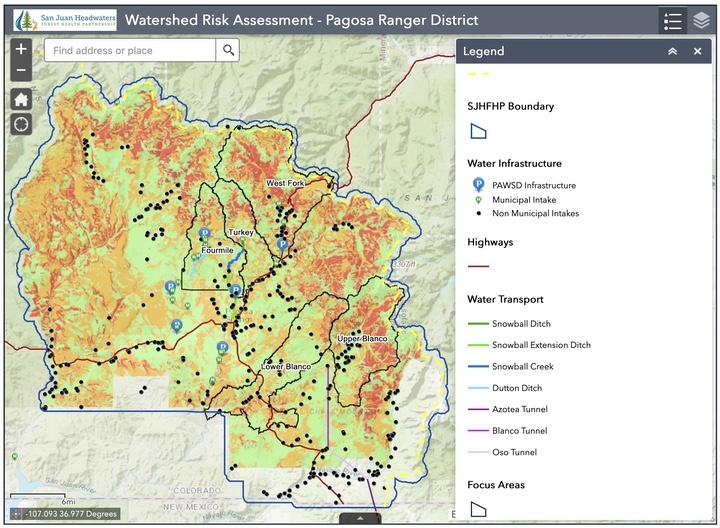
When we’re looking at making changes to the landscape, and to the way human treat the landscape, maps can be helpful. Helpful, when we want to consider the forest, rather than just the trees.
We also want to consider, of course, the people who have built their homes within, or adjacent to, the forest. Those homes and neighborhoods can also appear on the maps.
Here in Archuleta County, about 50% of the landscape is federal land, administered by the U.S. Forest Service. But even outside the Forest Service boundaries, a huge chunk of private and tribal lands are covered by flammable forests and grasslands.
All across the American Southwest, insurance companies have been increasing their premiums for homes built within, or adjacent to, forests — or canceling their coverage altogether. We wrote about that last year, here in the Daily Post.
At the conclusion of the February 21 Forest Health Partnership meeting, facilitator Alex Handloff asked the participants to give a quick summary of their recent work and concerns. When the conversation came around to Josh Peck, the District Ranger overseeing the Pagosa Ranger District, he gave a simple brief, about some prescribed burning near the Piedra River, that might send smoke into Archuleta County.
We then heard from Bill Trimarco, the Archuleta County Coordinator for Wildfire Adapted Partnership.
Some readers may be familiar with Wildfire Adapted Partnership. Their Defensible Space Cost Share Program has been providing financial incentives for homeowners to establish and maintain defensible space around their properties. In 2024, WAP successfully completed 131 projects, treating nearly 500 acres, and protecting over 438 structures. The program reimbursed $425,451 to homeowners. $147,791 in community cost share projects successfully treated around 134 acres, including roadside thinning, common area treatments, and the establishment of shaded fuel breaks around residential neighborhoods.
They’ve also been running a Chipper Rebate Program sthat upports homeowners by offsetting the cost of removing hazardous fuels from their properties. In 2024, a total of 74 rebates were issued, with $20,672 in reimbursements going to homeowners and communities. These efforts helped treat 317 acres and protect 427 structures.
WAP contributed to the revision of two Community Wildfire Protection Plans, completed one Community Wildfire Risk Assessment, and participated in 202 fire education meetings and events, engaging with over 3,800 residents.
This may seem like a drop in the wildfire protection bucket, considering the five counties served include about 100,000 full-time residents and maybe 50,000 flammable homes and businesses. Wildfire Adapted Partnership is doing the best they can with the resources they’ve been provided, and they are, for all practical purposes, the only agency supporting wildfire mitigation in Archuleta County.
Or at least… they were supporting wildfire mitigation, last year…
Here’s Bill Trimarco at the February 21 meeting:
“Wildfire Adapted is on its last legs, quite honestly.
“We’re a 501c3. Most of our funding comes from federal grants, from various sources. Our big grant for Archuleta County was about $1 million, that we are owed on that, and that has been frozen.
“Talking to insiders in DC, in various offices, what we’ve heard is that on this [Congressional] budget hearing, they’re probably going to try and do a reconciliation budget, which cannot be filibustered, and that can totally renege all those grants.
“Where we stand right now, there are two federal court orders to release those funds, and — according to credible sources — the people who are signing the checks have been told, ‘If you send those checks out, you’re out of a job.’
“So, pretty much, Wildfire Adapted is trying to restructure right now. We’ve approached some groups to get some emergency funding, to get us through the next month or two. As far as how this will affect Archuleta County, last year we were involved with about $350,000 worth of projects that protected a couple hundred homes here. All that money went to local contractors.
“Those funds are all cut off.
“So we’re going to try and continue our education and outreach. I can only speak for Archuleta County, because the rest of it in a big state of flux right now. We’ll try and do education and outreach, but there will be no on-the-ground treatments here… other than, we think we can continue with the Pagosa Lakes greenbelts, using a much older grant…”