

Photo: Pagosa Springs Elementary School.
Americans have grown accustomed to living with consumer debt. According to a report from CNBC, the average American household owes about $154,000 including credit card bills, auto loans and mortgages. Making the payments on those debts has become more of a strain on family finances, I hear, as the American economy struggles.
We’re also quite accustomed to having our taxes used to pay off government debt. At the federal level, about 40% of what we pay to the government goes to financing debt.
Our local governments also carry debt, typically. And seemingly, more debt with each passing year.
I assume that Archuleta County voters will approve a November ballot measure proposed by the Pagosa Springs Medical Center, to continue allowing the Upper San Juan Health Services District to retain annual property tax revenues even when the revenues exceed Taxpayer Bill of Rights (TABOR) limits. Property tax revenues constitute only a small part of PSMC revenues — about $2.4 million, in a $50 million annual budget — but without those tax revenues, the hospital would struggle to keep its doors open.
Even with property tax support, it’s a struggle.
The Archuleta Board of County Commissioners met yesterday morning for their weekly work session, and I did not hear any discussion about a potential Lodgers Tax ballot measure. Instead, much of the conversation dealt with the ongoing Rio Blanco Fire, on one hand, and on the other, with confusion within the community about the County’s obligations concerning road maintenance. (More about that road conversation in a future editorial.)
Tonight at 6pm, the Archuleta School District (ASD) Board of Education will discuss plans for layering additional government debt on local property owners, if voters choose to approve it.
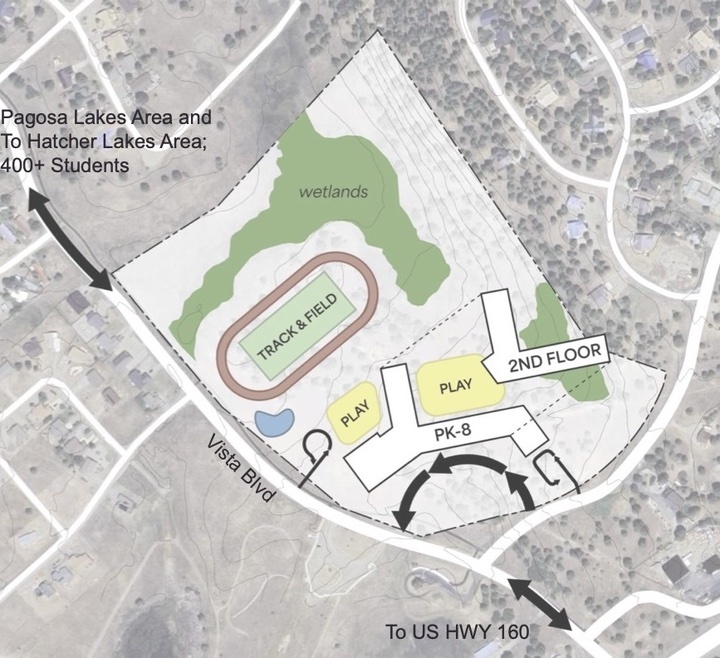
Tentatively, ASD might ask for permission to create $122 million in new bonded debt to help finance a PreK-8 school facility on Vista Boulevard. Additional funding of $50 million might potentially be provided by the Colorado Department of Education ‘BEST’ grant program. It appears that the $122 million in bonds would be issued only if the BEST grant were approved.
The presentation by the New Bridge Strategy consultants last month quantified the potential property tax increase as a minimal amount.
If voters approve this proposal, it would raise taxes per month by approximately $5.65 per $100,000 in home value.
Looking at my own situation — in a home assessed at $620,000 — my annual property taxes would increase by about $420. This would be on top of the $1,400 property tax I already pay to the school district each year. So then, a 30% increase in my school taxes.
The New Bridge consultants were directed to test voter temperatures on other ASD facility needs — which costs could potentially be bundled into the ballot measure, but would not be eligible for the same BEST grant.
The question posed:
In addition to building the new K-8 school, there are a number of potential investments which could be added to the school district’s project plan. These would only be included if voters are willing to fund them. Knowing that not everything can be equally important, please indicate for each one of the following, how important it is to you that this particular item be funded by the District?…
Many people seemed to feel an update to the High School’s HVAC system was important.
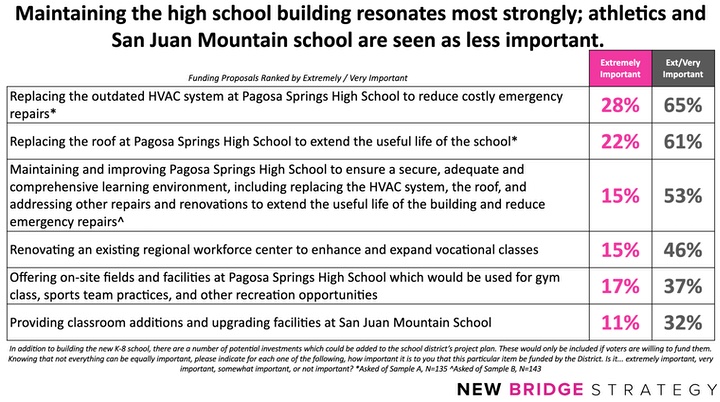
However, it’s not clear from the PowerPoint slides whether the survey respondents were provided an estimated cost for these upgrades? For example, cost of the High School HVAC upgrade has been estimated at $10 million.
The entire Pagosa Springs High School, with its community auditorium and its athletic fields, was built in 1997 for $12 million.
As a volunteer member of the Pagosa Peak Open School board of directors, I was disappointed that New Bridge apparently did not ask survey respondents about potential upgrades at PPOS, which is independently governed, but financially part of the School District.
PPOS is a tuition-free, district-authorized charter school that serves about 15% of the K-8 students in the district.
As a PPOS board member, I’m interested in excellent educational programs for our children, and I’m pleased with the support given to PPOS by the District.
But I like to point out that — while the Pagosa Springs Elementary School and Pagosa Springs Middle School definitely have deferred-maintenance issues — PPOS operates, by comparison, in a former office building that was never designed as a school, and yet produces academic and social outcomes commensurate with, or superior to, our conventional K-8 schools.
As has been documented in study after study, the only variables proven to affect student academic and social outcomes is the quality of the teachers and the curriculum.
Over the past 7 years, the Archuleta County property owners have contributed about $12 million in additional “Mill Levy Override” taxes to ASD, which have been used to increase teacher salaries, and to improve facility safety and security.
All the current school buildings and playgrounds continue to function successfully as learning environments, as evidenced by ASD’s respectable academic test scores.
I suspect, if ASD came to the voters with a list of much-needed facility upgrades for our existing school buildings — to bring them up to prime operating condition — the total would be considerably less than the cost of a brand new facility.
Maybe $100 a year added to my taxes? Instead of $420?
Would property owners embrace that kind of proposal, as an acceptable compromise? In a time of economic stress?
That’s been my repeated appeal to the School Board, over the past two years:
“Give us a ballot measure we can feel good about approving.”
Bill Hudson began sharing his opinions in the Pagosa Daily Post in 2004 and can't seem to break the habit. He claims that, in Pagosa Springs, opinions are like pickup trucks: everybody has one.