
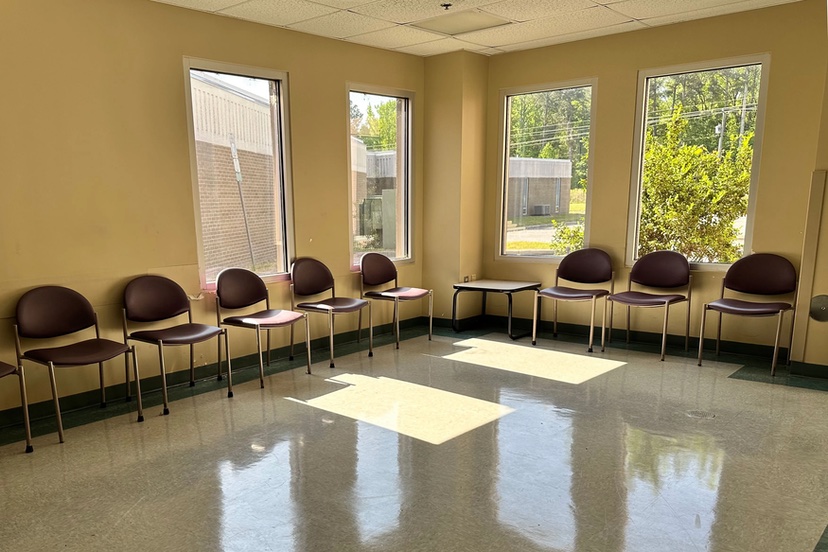
Photo: An empty waiting room inside the shuttered Martin General Hospital. The hospital’s closure in 2023 surprised employees and patients, who had to be wheeled out on stretchers and transported elsewhere to finish treatment. (Sarah Jane Tribble/KFF Health News)
This story by Sarah Jane Tribble and Amanda Seitz appeared on KFF Health News on May 22, 2026. We are sharing it in two parts.
The lack of emergency care in the North Carolina region has emerged as a top talking point in a close U.S. House race between Rep. Don Davis, a Democrat who represented the district when Martin General closed and is seeking his third term, and Republican Laurie Buckhout.
The rural health fund was added at the last minute in 2025 to win votes for the One Big Beautiful Bill Act, which is expected to reduce federal Medicaid spending by more than $900 billion over a decade — cuts that are projected to hit rural hospitals and clinics especially hard.
Rural health executives say the fund won’t come close to offsetting those losses.
Matt Mercer, a spokesperson for the North Carolina Republican Party, called the rural fund a “once in-a-generation opportunity” for the state.
But U.S. Sen. Thom Tillis, who was one of three Republican senators to vote against the bill — and who announced shortly before the final vote that he planned to retire from Congress — warned of devastating consequences ahead for healthcare in his state.
Buckhout, who declined an interview, plans to attack Davis — a vulnerable incumbent whose district was recently redrawn to favor GOP candidates — for voting against the bill.
“Martin County lost its hospital on his watch, and he still opposed the funding meant to help communities like it,” Buckhout campaign spokesperson Stephen Gallagher said in a statement to KFF Health News. The campaign did not respond to additional queries about her plans for healthcare access, if elected.
Davis, who signed a letter from lawmakers in support of North Carolina’s rural health fund application, said the money “is essentially putting a band-aid on a much, much broader situation that needs dire help.” He has introduced legislation that would increase Medicaid reimbursements for rural hospitals, though it has not moved forward.
During recent testimony on Capitol Hill in Washington, ECU Health CEO Michael Waldrum said his system expects to lose a billion dollars over the next 10 years from the looming Medicaid cuts.
Overnight Waits for Emergency Care
The region’s emergency rooms offer a stark glimpse of a healthcare system in crisis.
Martin General’s ER treated about 11,000 patients annually before it closed, according to state data. A sign still hangs in the staff break room showing that 23 patients were seen in the ER the day it closed.
ECU Health, which owns all but one of the rural hospitals around Martin General, reported a 132% increase in its daily ER visits since the hospital’s closure. The company’s nearly 1,000-bed hospital in Greenville, about 40 minutes from Williamston, is the state’s only Level 1 trauma center east of Raleigh.
The Greenville hospital’s median patient ER wait and treatment time was nearly 4 1/2 hours, according to the most recent federal data. That’s longer than 96% of thousands of hospitals reporting nationwide. The wait times “don’t reflect poor care,” ECU Health spokesperson Brian Wudkwych said in an emailed statement. He said the system’s ERs treat nearly 300,000 patients annually.
While the system has seen an increase in Martin County patients, the wait times primarily stem from shortages of inpatient and behavioral health beds, Wudkwych said.
Floyd, the ECU Health chief operating officer, said many rural patients who arrive at the system’s ERs have multiple chronic conditions that require longer visits. Often doctors start treating one problem and then find the patient’s “blood sugar is out of control, your hypertension is far out of control,” he said.
ECU staff encourage people who are not too sick to skip Greenville and, instead, seek care at one of the system’s community hospitals, which aren’t as busy, Floyd said.
A security officer guarded the Greenville emergency department’s doors on two nights in April. The “capacity notice” sign near the entrance meant family members of patients had to wait in cars or on benches outside.
“We’ve only been here six hours,” Tonya Miles said after bringing her mother for a potential blood clot in her leg. The family had left the day before after waiting for two hours, because her mom “wasn’t prepared” for such a delay in treatment, Miles said.
On another evening, Olivia Lewis said she had brought her mother two nights previously and left without care after their wait stretched from 10:30pm to 7am.
“She tore off her hospital bracelet and said: ‘I’m out. I’m done,’” she said. Now, they were back.
On a recent Friday in Martin County, Vannessa Little was sitting at a McDonald’s with her kids just down the street from the closed hospital. Little pointed to one of her girls and wondered how her care would have been different if the hospital had been open.
Her daughter, then 6, suffered severe burns over 30% of her body in 2024, and the journey to treatment was “just crazy,” Little said. An ambulance arrived at her Williamston home from neighboring Bertie County to transport them to ECU’s Greenville ER.
“That was a long time,” Little said of the 30-mile drive. The girl was ultimately airlifted more than 100 miles to Chapel Hill. Little said she hadn’t heard of Trump’s rural health investment. “The only changes that people are making is they’re taking away everything.”
She voted against Trump in 2024 and said she didn’t think she would vote this year.
“It’s a waste of my time.”
KFF Health News is a national newsroom that produces in-depth journalism about health issues and is one of the core operating programs at KFF — an independent source of health policy research, polling, and journalism. Subscribe to KFF Health News' free Morning Briefing.