
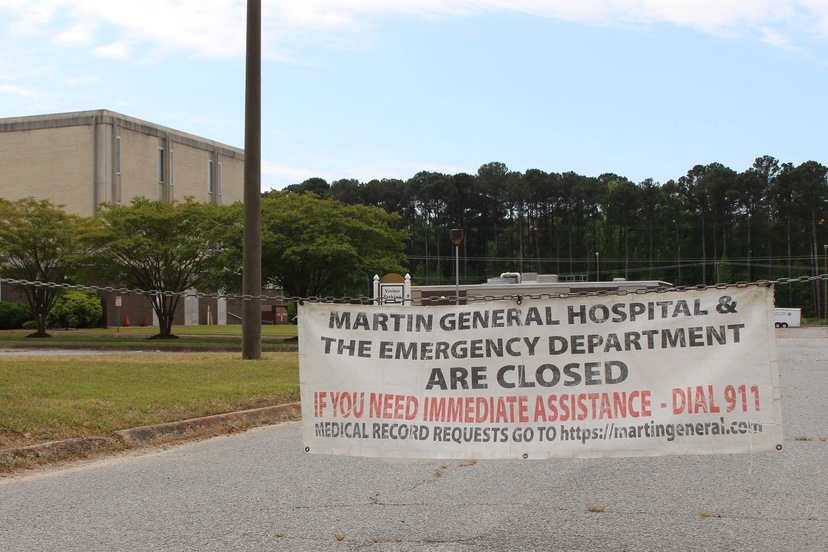
Photo: A weathered sign hangs across the drive to the shuttered Martin General Hospital in Williamston, North Carolina. The hospital, the only one in Martin County, closed abruptly in August 2023. (Sarah Jane Tribble/KFF Health News).
This story by Sarah Jane Tribble and Amanda Seitz appeared on KFF Health News on May 22, 2026. We are sharing it in two parts.
Two years after her brother’s death, Debra Pierce still wonders whether the 50-year-old would have survived his heart attack if her local hospital hadn’t closed.
“The sad thing is we’ll never know if he could have been saved that night or not, because we don’t have a higher level of care in this county,” Pierce said as she stood outside the mobile home where she last hugged her brother.
Emergency crews from a neighboring town worked on Stanley Sears for a half hour but couldn’t revive him for the long drive to the closest hospital, records show.
In the tall grass — which would be mowed if Sears were still alive — Pierce swiped through the photos on her phone. She stopped at a picture that showed Sears smiling. Pierce chuckled and then sighed: “Bless him.”
The local hospital had closed a year before Sears’ death, leaving behind a gutted healthcare system. Martin County does not have paramedics on its ambulances, and it can be 20 miles or more to the closest — and often overcrowded — emergency rooms.
The healthcare gaps in Martin County illustrate the finite reach of a $50 billion rural health fund that Republicans crafted to strengthen support for President Donald Trump’s signature tax and spending measure, the One Big Beautiful Bill Act, last year. Though the cash has not been doled out, Republican candidates in competitive midterm elections — including the closely watched battle for the congressional district that encompasses Martin County — are casting the fund as a lifeline that will shore up critical rural health services across America.
The money has been highly anticipated in North Carolina, where most residents live in rural counties. Pierce, a Republican who blames county officials for the hospital closure, said she has faith Trump will help them.
“Old man’s doing his job up in there,” she said.
On paper, Martin County — home to about 22,000 people — looks like a top contender to receive at least some of the $213 million that’s been earmarked for North Carolina.
Yet County Manager Drew Batts said it won’t be the answer for his residents.
“The $50 billion is not something that is specifically going to help our situation,” Batts said as he walked into the shuttered hospital in April. “It’s not going to help us get this place reopened.”
Martin County won’t get direct relief from Trump’s rural health fund — because its hospital isn’t open. North Carolina is distributing the money among existing health and social service organizations. Plus, federal regulators set limits on how much can be spent on construction and building renovations.

‘We Can Only Pray’
Martin General Hospital closed abruptly in 2023, surprising employees and shocking patients, who had to be wheeled out on stretchers and transported elsewhere to finish treatment. The closure even stunned local elected leaders, who say the company operating the county-owned hospital, Quorum Health, did not notify them it intended to shut down operations and file for bankruptcy. Quorum spokesperson Lisa Anderson said the company had told county commissioners of the hospital’s ongoing financial challenges.
Politicians have spent the years since trying to reopen the hospital, with county taxpayers pouring an estimated $2.9 million into maintenance, utilities, and other costs in the hopes of resuming operations, Batts said.
The county is now considering spending at least $1.5 million, he said, to create two higher-level paramedic units with quick-response vehicles, specially equipped with electrocardiogram equipment or other “advanced lifesaving support.”
Pierce said she is praying the county can add paramedics and reopen the hospital.
“There’s some answered prayers happening every day,” she said. “So, we can only pray and hope, you know?”
‘They Just Want To Not Die’
With its nine hospitals, the region’s largest health system is ECU Health, connected to East Carolina University. The system has become a de facto safety net for 29 counties. Batts and Brian Floyd, the Greenville-based system’s chief operating officer, have lobbied state and federal lawmakers, walking them through the shuttered hospital and asking for help.
“It’s a real healthcare crisis that has already proven itself to have lost lives that perhaps didn’t have to be lost,” Floyd said. “They just want to not die because there’s nowhere to go when you have an emergency.”
With Martin General gone, all the surrounding counties are “also in jeopardy,” Floyd said. “No one knows what to do” with that large of a healthcare “desert,” he said.
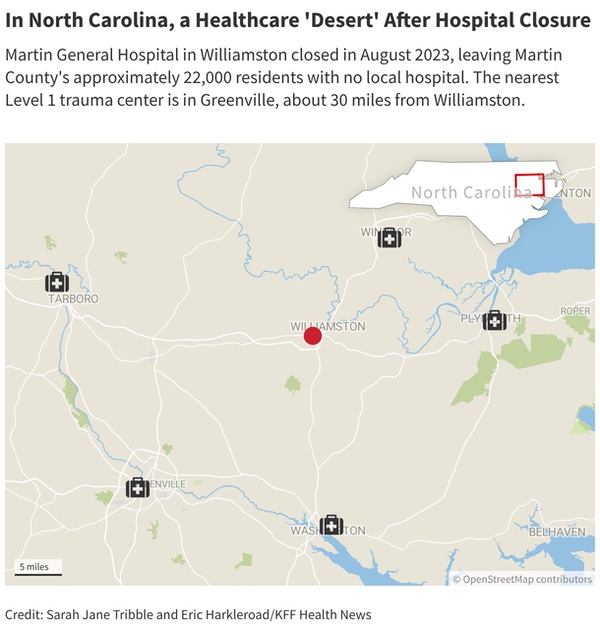
What healthcare is left in the county includes one urgent care center, run by a private company, and a nonprofit health clinic, operated by Agape Health Services, which accepts patients from five counties and plans to build another primary care clinic to meet demand.
ECU Health signed a letter of intent last year to reopen Martin General as a rural emergency hospital that would provide outpatient care as well as an ER. Under the terms of the deal, Martin County would pay to refurbish the hospital, and the North Carolina General Assembly would have to give ECU Health $210 million, of which $150 million would pay for the construction of a new inpatient tower at ECU’s Beaufort Hospital.
The health system, through its affiliate Access East, won a portion of North Carolina’s $213 million first-year payout from the rural fund. But the federal money can’t be used to reopen Martin General, Floyd said.
The five-year Rural Health Transformation Program is slated to be delivered in $10 billion annual increments to states, which applied and competed for the money.
North Carolina’s plan creates a hub-and-spoke model that allots money to six large regional leads, including nonprofits such as Access East. Those hubs will distribute money to local entities and coordinate broad initiatives such as improving primary care and fortifying the healthcare workforce, as well as developing “digital solutions,” according to the state’s hub application.
KFF Health News is a national newsroom that produces in-depth journalism about health issues and is one of the core operating programs at KFF — an independent source of health policy research, polling, and journalism. Subscribe to KFF Health News' free Morning Briefing.