
Yesterday in Part Two, we briefly discussed the ‘Forest Legacy Program’ operated by the federal government, and the fact that the Town of Pagosa Springs has been tentatively awarded — tentatively — a $5.9 million grant to purchase some property adjacent to, and south of, our existing Reservoir Hill Park. Potentially.
This proposal was discussed in a Council work session on April 7. More about that discussion in a moment.
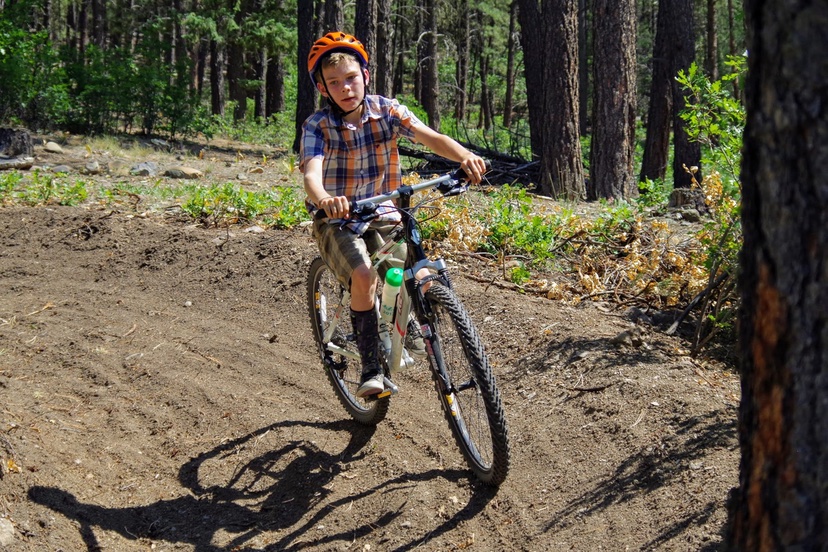
Reservoir Hill Park is basically a ‘wilderness park’. Mostly undeveloped open space. A quiet place to ride your mountain bike, or play disc golf, or just take a pleasant hike.
If I’m not mistaken… (and I could be mistaken, because the Archuleta County Assessor records provide information that doesn’t fully align with what I heard on April 7)… the 163 acres (?) parcel immediately south of the existing Reservoir Hill Park was purchased by the Fairway Land Trust in 1999, from the Lynn family for about $1.8 million.
As mentioned yesterday, that parcel is classified by the County Assessor as ‘agricultural’ because it includes a ‘tree farm’. On the County Assessor mapping website, it appears to be a bit more than 50% ‘forested’ land.
That percentage may prove important.

According to the Town’s 2020 Zoning Map, only the northern portion of this parcel — about 56 acres? — has been annexed into the Town of Pagosa Springs.
Fairway Land Trust belongs to the Levine family. Their late father, Sidney Levine, was a wealthy philanthropist who supported especially the arts, in Pagosa Springs, as well as in Florida.
In 2007, Fairway Land Trust purchased 284 additional acres south and east of the Lynn property, from the Catchpole family, for about $2.6 million, and began developing plans for a 491-acre residential subdivision that would have included luxury homes, as well as workforce housing along Highway 84. When the Great Recession hit Archuleta County’s real estate and construction industries in 2008, those plans were shelved.
The map below shows the entire 491 acres discussed at the April 7 Town Council work session. Based on this map, it would appear that less than half the total property is forested.

Town Parks & Recreation Director Darren Lewis had briefly outlined the potential for a $5.9 million grant from the federal Forest Legacy Program through USDA. Although Fairway Land Trust owns (and appears willing to sell?) 491 acres south of Reservoir Hill Park, the Forest Legacy grant requires the purchased land to be 75% forested. It appears from the County map that only certain areas of the Fairway property are forested — mainly the higher elevations. Mr. Lewis stated that the Town had “carved out” 300 acres from the total 491 acres, which we can assume are mainly tree-covered portions of the subject property?
That is to say, the most attractive and valuable portions of the property, perhaps?
Recreation Supervisor Amanda Gadomski gave a 10-minute slide show, highlighting what the Town has done over the past three decades regarding recreation investments, and a few vague ideas about future directions. The presentation did not, however, tell us anything about why the Town government might want to spend $7.5 million enlarging the existing Reservoir Hill Park.
I’m throwing out this $7.5 million number because the Forest legacy grant will require the Town — or the community as a whole — to provide a 25% match for the $5.9 million grant. According to what I heard at the April 7 meeting, it sounded like that match would amount to maybe $1.5 million? Or $2 million?
Mayor Shari Pierce addressed Mr. Lewis and Ms. Gadomski:
“Do you have a cost on just the 300 acres?”
Mr. Lewis:
“So… negotiations will now start taking place with the landowners. But we don’t have a total price yet. I can tell you that the amount we were awarded… I can tell you, it’s not going to cover the 300 acres. But that difference is still out there. Anticipating maybe one to two more million. But we don’t know that. We don’t know where the landowners stand with this.
“But this certainly shows an incredible first step and… in a sense, a significant step forward.”
Admittedly, people typically form opinions based on what they know, even if we don’t know the whole story — and then, like Mr. Lewis, we express those opinions based on wishful thinking. Often, questions remain to be answered.
It appears that Fairway Land Trust purchased the 491 acres through two separate transactions… one in 1999 for $1.8 million and one in 2007 for $2.6 million. That totals about $4.4 million. Mr. Lewis had suggested that the 300 acres under consideration might cost between $7 million and $8 million, once negotiations are completed.
The Town Council work session discussion continued for over an hour after that price estimate was offered, and during that hour, no one on the Council expressed any surprise that the price for just a portion of the property — 300 acres — might cost American taxpayers almost twice what Fairway Land Trust paid for the entire 491 acres.
Nor did anyone on the Council seem curious about how much money the Town might spend, following such a purchase, to convert the 300 acres into a useful park.
I’ve often taken relaxing walks on the trails through our existing Reservoir Hill Park, and can’t for the life of me remember coming across more than a half dozen other people. Many times, I’ve come across maybe a couple of hikers, or disc golfers, or mountain bikers… or no one at all.
Do we really need an additional 300 acres for very few people to use? For $8 million?
Are we dealing with a Town government obsessed with recreation, at all costs?
A couple of other questions. Does the Town have a plan for our recreational future? And does this purchase agree with that plan?
The Town already has 12 downtown parks, but not a single park serving the Uptown area where 70% of the population lives. Does that make sense?
And one more question: Is there actually a better use for the Fairway Land Trust property than a wilderness park?