
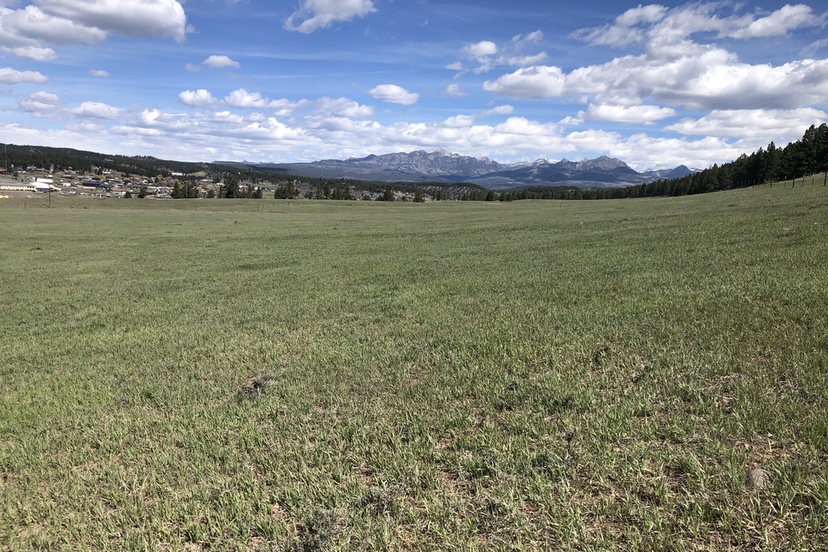
The photo above shows a vast, grassy meadow — perhaps 70 acres in size? — located immediately south of the Reservoir Hill Park in Pagosa Springs, with spectacular views of the northern San Juan Mountains.
Although I’ve lived in Pagosa Springs for more than 30 years, I had no idea that this meadow — owned by the Fairway Land Trust — existed.
Nor had I ever toured the roughly 180-acre forest immediately to the east, also owned by the Fairway Land Trust.
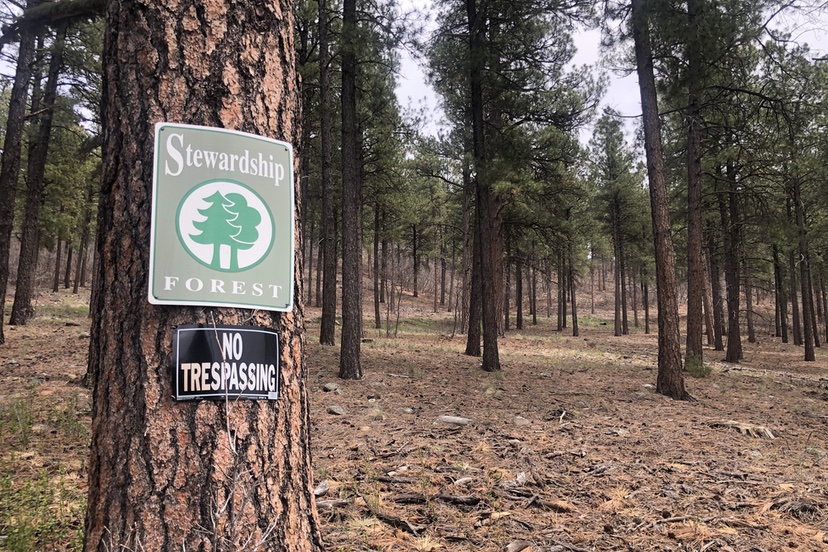
So I was delighted to receive a phone call on Friday from Ken Levine, one of the four siblings who own the Fairway Land Trust property. Mr. Levine and his family have been stewards of nearly 500 acres of mostly-undeveloped property south of Reservoir Hill Park since 2007, and a jeep tour of the property — courtesy of Mr. Levine’s jeep — took us a little over an hour on Saturday. The tour included a handful of stops to snap photos.
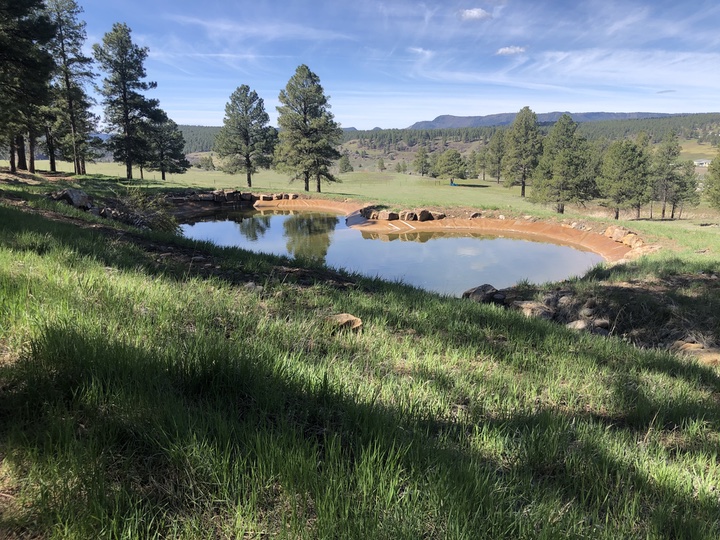
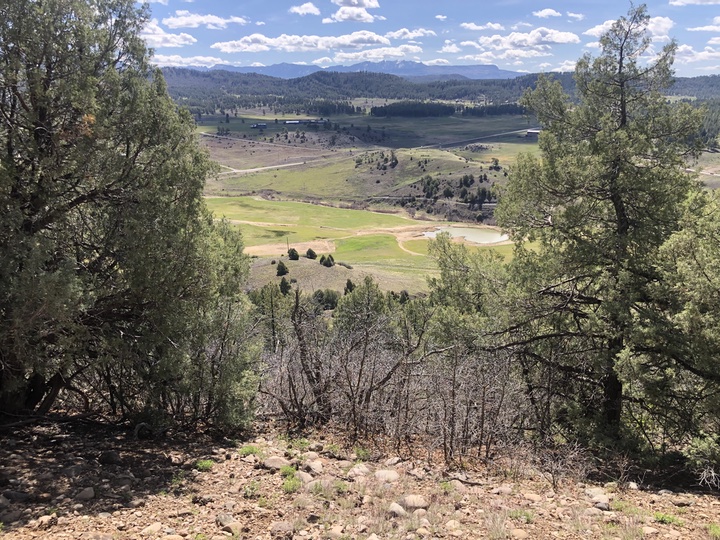
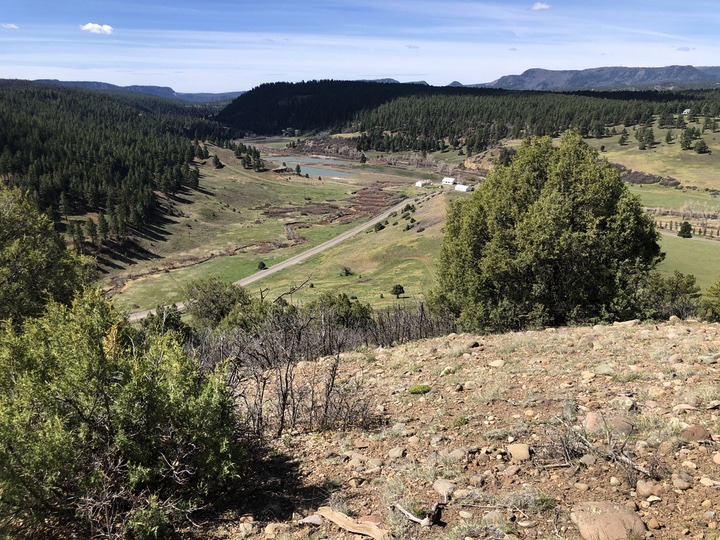
According to Mr. Levine, the Fairway Land Trust has invested a great deal of money — millions of dollars? — into stewardship of the forested portions of the property, and their forestry work was honored with a stewardship award in 2009, recognizing the extensive mitigation work done on the property. Many of the mixed-conifer forests surrounding Pagosa Springs have become ‘overgrown’ during the past century, thanks in part to the fire-suppression policies and techniques developed during the 20th century.
According to Mr. Levine, the entire Fairway Land Trust forest has been thinned to resemble a healthy, productive forest similar to the Old Growth forests that existed in southwest Colorado prior to settlement by Europeans.
When the U.S. Forest Service was established in 1905, it became the primary task of the Forest Service to suppress all fires on the forest reserves it administered, and that policy was followed by all federal land management agencies until the late 1960s.
As early as 1924, however, environmentalist Aldo Leopold and others argued that wildfires were beneficial to ecosystems, and were necessary for the natural propagation of numerous tree and plant species. Nevertheless, by 1934 a policy of extinguishing all fires by 10:00am of the next burning period was implemented. This policy ultimately led to a dangerous buildup of fuels, particularly in Ponderosa pine and Douglas fir forests.
The National Park Service changed its policy in 1968 to recognize fire as an ecological process, and determined that wildfires should be allowed to run their course so long as they could be contained within fire management units. The U.S.Forest Service enacted similar measures in 1974, and in 1978, the Forest Service abandoned the 10:00am policy in favor of a new policy that encouraged the use of wildland fire by prescription.
I recall an educational tour of Reservoir Hill Park, about 15 years ago, led by USFS forester Steve Hartvigsen. According to studies of Reservoir Hill and similar forested areas, the Forest Service had determined that Colorado’s Ponderosa pine forests typically experienced low-intensity wildfires about every 12 years. These low-intensity fires were, according to Mr. Hartvigsen, essential to forest health.
My Saturday tour with Ken Levine covered almost all of the 491 acres owned by Fairway Land Trust. As mentioned previously in this editorial series, Fairway had, back in 1999, purchased about 160 hill-top acres immediately south of Reservoir Hill Park and had begun mechanical thinning of the forest there, hoping to eventually sell the property at a profit to a subdivision developer.

Later, in 2007, Fairway purchased 280 adjoining acres to the south and east. Based on my impressions of the landscape, the forest and the adjoining meadows— with spectacular views of the San Juan Mountains — could have provided unusually attractive home sites. But no developer came forward to purchase, and develop, the property. The meadows remained meadows; the forest remained an (expertly-thinned) forest.

Let’s be honest. In the overall scheme of things, and in comparison to certain other cities and towns, the community of Pagosa Springs does not have a lot to offer. But it has mountain views. It has geothermal water. It has recreational opportunities. It has forests.
And let’s be honest… it has the potential for devastating forest fires. Given the right wind conditions following a lightning strike — or should I say, the “wrong” wind conditions — entire neighborhoods could be wiped off the map, as we’ve seen happen in various places across the American West.
As mentioned in Part Three on Friday, the Town of Pagosa Springs is currently a finalist for a $5.9 million ‘Forest Legacy Program’ grant from the U.S. Department of Agriculture. The final award depends on Congressional action, I understand.
Forest Legacy grants are intended to preserve outstanding forests in pristine condition, presumably for future generations to enjoy, and perhaps also as a ‘carbon sink’. In order to qualify for the grant, at least 75% of the property in question must be “forested”. Additional grant funding could conceivably be requested through the Great Outdoors Colorado (GOCO) program.
I found the Town Council discussion on April 7, about the potential purchase of 300 partly-forested acres from Fairway Land Trust, to be somewhat confusing. At one point, Council member Brooks Lindner asked Town Parks & Recreation Director Darren Lewis and Recreation Supervisor Amanda Gadomski if the Town has a long-range “recreation plan” that calls for the purchase of additional land south of the existing Reservoir Hill Park. Mr. Lindner has reportedly been the Council member “leading the charge” to purchase the Fairway property.
Mr. Lindner was reacting to a comment by fellow Council member Maddie Bergon, who had just noted that the Town has surveyed its residents about their recreation needs, and had concluded that “open space” was high on the community’s list of priorities.
Brooks Lindner:
“Is there some type of a Master Plan that… is there a binder somewhere, already, that exists?”
Good question.