
As mentioned at the conclusion to Part Four, I had found the April 7 Town Council discussion, about the potential purchase of 300 partly-forested acres from Fairway Land Trust, to be somewhat confusing.
Following a summary of existing and possible future Town recreation infrastructure presented by Recreation Supervisor Amanda Gadomski, Council member Maddie Bergon wondered if recent acquisitions and projects have been aligned with the documented desires of the Pagosa community and with the Town’s Master Plans.
Ms. Gadomski:
“Yeah, I mean, those are the common trends that have showed up over 20 years of planning. Which is amazing to me, that we still have the same trends, like open space acquisition, community rec center, trail connectivity. All those are, like I mentioned, the same. Pickleball is one that we got to check off the list. The dog park is another one… Having shade structures and restrooms. Water access. Improved signage… There’s a lot that we really have done in the parks, and really followed in all these plans.
“But as far as land acquisition, I didn’t really have those specifics in some of these surveys.”
Council member Bergon:
“Well, it’s good to know that trends are.. trending.” Polite laughter. “Yeah, and that the decisions we are making are based on years of input from the community. I think that’s really important for us to remember and keep in the forefront.”
I have been following. fairly closely, the Town and County processes for gathering “input from the community” as to what we, the taxpayers, feel is most important. My ears perked up at the term “Master Plan”. The only “Master Plan” I personally was familiar with, was an Archuleta County “Regional Master Plan” produced in 2007, written by North-Carolina-based Greenways Inc. You can download that plan here.
Council member Brooks Lindner had a question about the “Master Plan”:
“Well, I have a follow-up to that. So, is there some type of Master Plan that… is there a binder somewhere that… or a document that already exists?”
Ms. Gadomski:
“Yes, there are a couple.”
Mr. Lindner:
“I know we have the East End Multi-Modal Plan, but there are plans more specific to Parks & Rec?”
Ms. Gadomski:
“Yes.”
Town Parks & Rec Director Darren Lewis:
“And we’re actually working right now on a 2026 Plan…”
Mr. Lindner:
“Cool… and when is the old one from?”
Ms. Gadomski:
“2016.”
Mr. Lewis then repeated the alleged date of an existing Master Plan: “2016”
This response from Ms. Gadomski and Mr. Lewis confused me, because I was not aware of “2016 Town of Pagosa Springs Recreation Master Plan” of the type that Council member Lindner was obviously asking about. Maybe I hadn’t been paying attention? According to Ms. Gadomski, there were “a couple” of such plans.
I reached out to Ms. Gadomski by email a few days later, asking for a copy of the “2016 Master Plan”, and she sent me links to three documents, none of which was a 2016 Town Recreation Master Plan.
One was the 2007 Archuleta County Master Plan by Greenways Inc. mentioned above. One was a 2006 survey of local residents asking them about their recreation preferences. And one was a plan for Yamaguchi Park, from 2021.
Yet at the April 7 work session, the Town Council was told that the Town Parks & Rec Department had a “Parks & Recreation Master Plan” dated 2016.
Forgive me if I seem confused, when government staff tells one of our government boards that certain documents exist, when they apparently do not, in fact, exist.
Council member Leonard Martinez has consistently been the Council’s leading proponent of strategic planning, and he responded to Mr. Lewis and Ms. Gadomski, expressing his belief that the Master Plan was “really important.”
Mr. Lewis replied that, in his opinion, a Town Master Plan — which apparently doesn’t exist? — wasn’t an important consideration.
Mr. Lewis:
“In referring to Reservoir Hill, even without the Master Plan, in staff’s opinion — and in my opinion — that’s an asset that currently already has trails, that can be used. It’s an asset that… if the 300 acres can be acquired through grant funding only, it’s a no brainer. Without the strategic plan, even. Because…”
Mr. Martinez:
“I would argue that, without that context, there are things that are going to be happening that are going to take priority, that are going to take funding way from other things at the wrong time. So I think it has to be in context…”
Mr. Lewis:
“The strategic plan for that property… I think the first step in the strategic plan for that property is acquiring the property.”
Obviously, Mr. Lewis did not understand Council member Martinez’ comment. Every new project that the Town takes on, requires development and more importantly, continuous maintenance — and inevitably redirects energy and funding away from other community needs, even if the initial purchase is supported by a grant.
It’s a simple idea. When you buy something, you then have to maintain it. And the taxpayers pay for that maintenance.
I own a downtown house on slightly more than a half acre, and it takes three adults to keep the property well maintained. I cannot imagine what kind of effort is required to maintain 300 acres of public forest property in a condition that protects the public from hazards, and the community from wildfire danger.
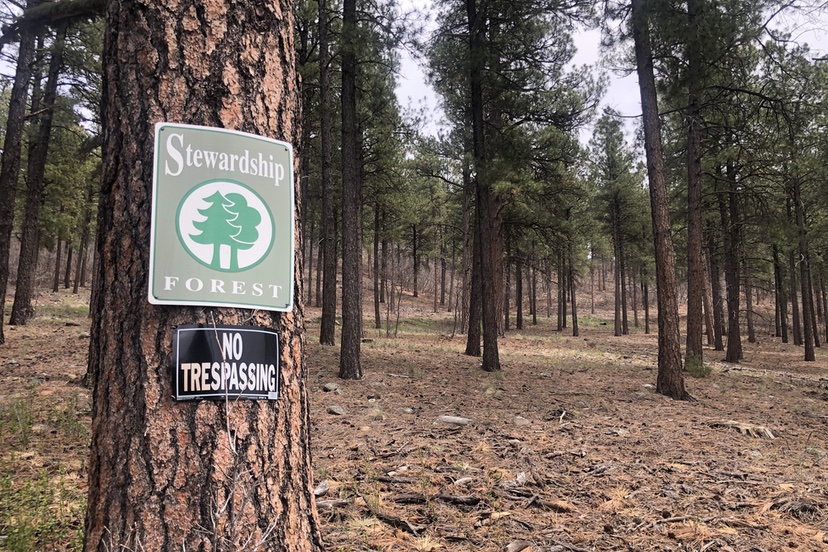
When I toured the 300 acres owned by Fairway Land Trust with Ken Levine on Saturday, it was obvious to me that Mr. Levine was proud of what his family has done to the enhance the value of the property, at a cost of millions of dollars beyond the initial purchase price of $4.4 million. Some of that pride no doubt derives from the selection of his family’s forest for a Colorado Forest Service Stewardship Award in 2009.
It was also obvious to me that Mr. Levine was excited by the possibility that a federal grant might allow the Town government to take the property off his hands, and let him get on with his life, so to speak.