
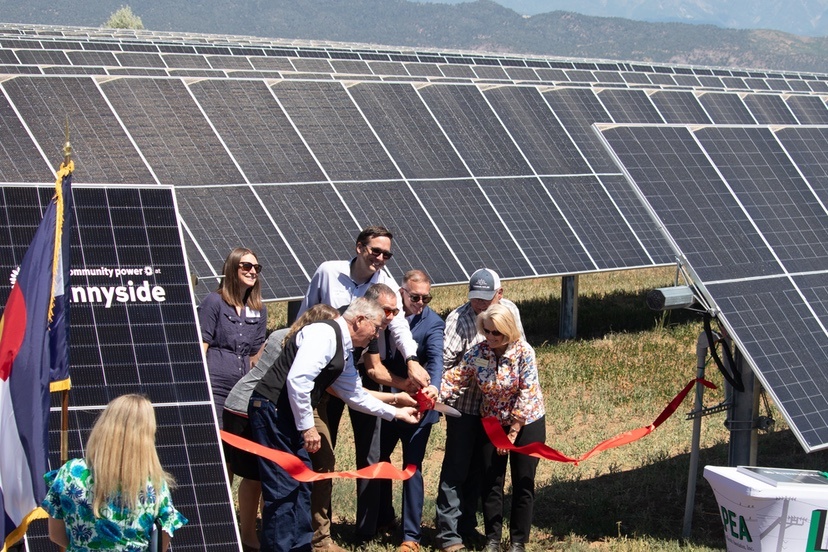
Photo: Ribbon-cutting for the Sunnyside community solar project in Durango, Colorado.
By the end of his presentation on April 6, Colorado Energy Office Director Will Toor had covered a number of energy issues, including Colorado’s leadership in the transition to electric vehicles and efficient electrical heating via heat pumps.
“Colorado has historically had relatively affordable electricity, and as of 2024, we had on average the 3rd lowest household energy bills in the country, through a combination of relatively low rates compared to any state, and we actually have more energy-efficient buildings than most states.
“When you combine them, we see some of the lowest energy costs in the nation…”
This is not to imply, however, that Colorado has the lowest “per kilowatt hour” pricing in the country. Not by a long shot. That honor goes to Louisiana, with an average per kWh cost of about 13 cents… or maybe, the honor goes to North Dakota, at 10 cents per kWh… or possibly to Idaho, at 8.2 cents per… ?
I found a wide range of reported price comparisons online yesterday. They generally disagreed on the average electricity costs in each state, but none of them indicated that Colorado’s average electricity rates were anything but ‘middle of the road’ among the U.S. states. One website had us in 26th position, one had us in 28th position, and another had us in 19th place.
It’s possible that ‘energy-efficient buildings’ are the reason for Mr. Toor’s claim of low household bills? Or maybe you can find statistics to prove anything you want to prove, if you look hard enough.
One pertinent fact about Pagosa Springs in particular: the vast majority of homes and buildings here were constructed after 1980, during a population boom lasting from about 1980 through about 2008. That means most of the buildings, especially residential homes, are relatively energy efficient — like most American buildings constructed after the energy crises of the late 1970s.
At the conclusion of Mr. Toor’s presentation — which was quite interesting — a member of the audience, Archuleta County Commissioner Veronica Medina, asked if Mr. Toor could address the local issues we are facing in Southwest Colorado.
Commissioner Medina:
“A lot of what you’re talking about is great, and informative, but it doesn’t mean a whole lot to us here in rural Colorado. So I’d like to know, what can you do for us here in rural Colorado? What do you have to offer us? … A lot of what you’ve talked about so far, yes, it has a direct impact on the Front Range… but what can we expect, here?”
Mr. Toor mentioned the rural funding available through the HEAR program — the Home Electrification and Appliance Rebate program that is providing income-qualified households with rebates, to help cover the costs of energy-efficient upgrades such as heat pumps and electrical panel improvements. Eligible households can receive up to $14,000 in rebates, depending on their income level and the type of upgrades made. A portion of the funding has been specifically earmarked for rural counties, but apparently the program is not yet familiar to people living in rural Colorado, because few households have applied for the rebates.
Commissioner Medina:
“Well, I think one of the challenges is our grid. We don’t have the capacity to be able to support… if say 100 households wanted to switch over to all-electric, I don’t know if we could handle it. I mean, we’re pretty maxed out right now. Is there money available to rural communities to expand? I know we’re working on it… but our capacity is limited.”
Two of the audience members — Emily Missildine and Brandon Carlisle — were La Plata Electric Association (LPEA) employees, and Ms. Missildine responded to the commissioner.
“I think there’s been a little bit of a misconception about how much electricity is available [from LPEA]. 100 households, switching over to all-electric? The grid can very much support that. We’re absolutely able to support that. It’s the really large-load manufacturing in certain areas that can be challenging. And we’re obviously building a whole new substation. But do have a lot electrical capacity here, and especially on the individual residential and small commercial basis…
“Some of our larger capacity constraints are more around redundancy. Right? There are three substations that serve all of Archuleta County. So if one or two of them went down, in certain locations… can we back-feed them?”
Like so many of the homes in Archuleta County, the LPEA substations are located within the Wildland Urban Interface — adjacent to flammable forests. A large wildfire event, in the wrong place, could easily affect the community’s electricity access.
Ms. Missildine:
“We feel very confident that we have the overarching electrical capacity to serve this community. The challenges are extremely large manufacturing in certain areas, that need to have that three-phase capacity brought to it. Households upgrading to electric vehicles? Not a problem.”
As noted in Part Three, Archuleta County recently accepted a state grant to run three-phase electrical power to Forest Health Timber Products, located near the County airport. Not an inexpensive proposition, as Ms. Missildine implied.
Three-phase electrical power was first developed in the 1880s by several inventors and remains the backbone of modern electrical grid systems, but it’s not typically delivered to individual homes or small businesses.
Mr. Toor mentioned a current piece of legislation in Colorado that might — if passed — help provide financing for “energy upgrades”.
A term that we understand to mean, “conversions to all-electric”. If you don’t mind increasing your debt portfolio?
It’s simply the way of the future.