
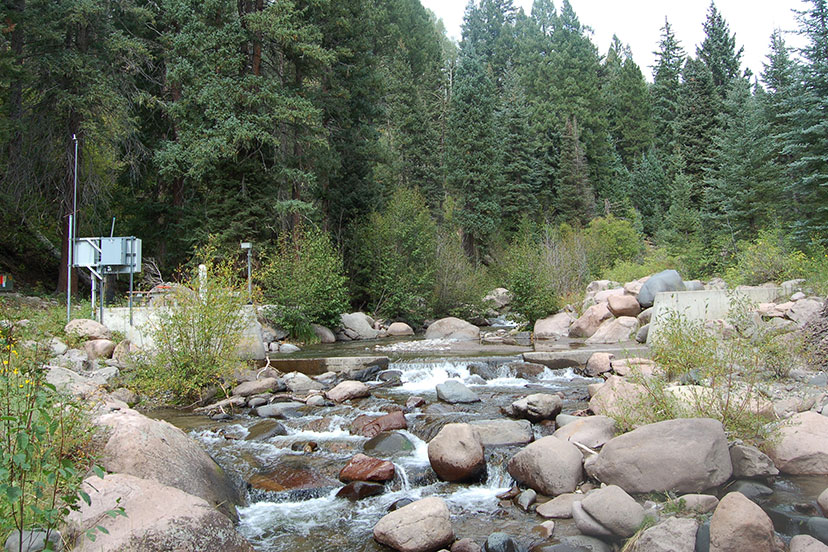
Photo: Site of the PAWSD drinking water diversion on Fourmile Creek.
The Pagosa Area Water and Sanitation District (PAWSD) will hold a Board of Directors meeting tonight, starting at 4pm with a closed-door executive session. The regular meeting will begin at 5pm.
A couple of items on the agenda ought to be of interest to the community.
Disclosure: I currently serve as a volunteer on the PAWSD Board of Directors, but this editorial reflects only my own opinions, and not necessarily the opinions of the PAWSD Board and staff.
The item of greatest community interest might be a draft 2026 update to the 2020 PAWSD Drought Management Plan. You can download the proposed 2026 update here. And here is the 2020 version, for comparison. (Large files, may take some time to download.)
The main change to the Plan for 2026 is to move the “trigger dates” for each of the five Drought Stages about one week later in the calendar year, to better align with PAWSD operations. PAWSD has already announced Voluntary Drought Stage for 2026, which is meant to encourage voluntary water conservation. Later stages involve mandatory limits on outdoor irrigation, and in some cases, increased fees.
Steven’s Reservoir and Hatcher Lake are full, as of this week.
There are a couple of general concepts behind the Plan. The raw water that supplies PAWSD comes from the snow pack in the San Juan Mountains, flowing in the San Juan River and one of its tributaries, Fourmile Creek, and is stored for summer use in five local reservoirs. When the snow pack is below average, and when the diversion from Fourmile Creek is shut off by the State Water Commissioner, PAWSD begins to draw down the reservoirs through the summer tourist season. The five Drought Stages are intended to progressively reduce water use as the season progresses, as needed to protect water quality.
When customers use less water, the revenues to support PAWSD operations will naturally decrease, because PAWSD sells less water. But the overall cost of operating the District does not necessarily decrease. Thus, customer fees increase as the drought becomes more serious.
Here is a chart that shows the restrictions and fee increases through the five Stages. PAWSD is currently in Voluntary Drought Stage. (You can click the chart for a larger view.)
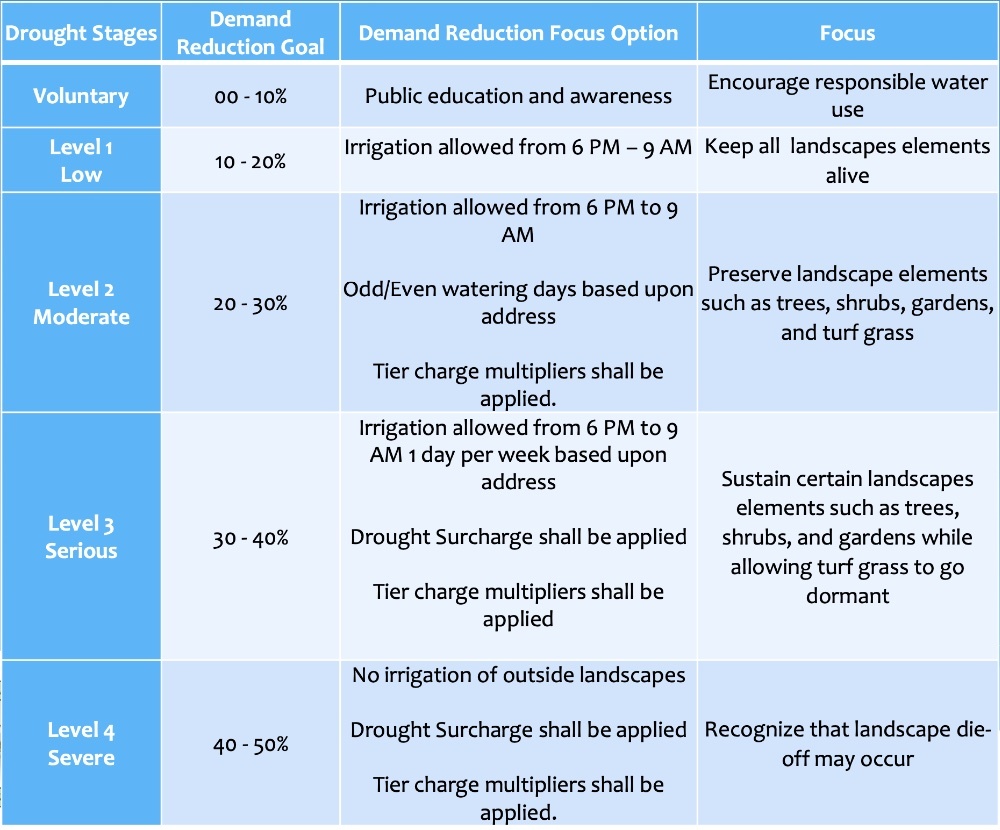
When PAWSD customers are diligent about reducing water consumption during the Voluntary Stage, it can delay the progression into the more restrictive and expensive stages.
At tonight’s Board meeting, the staff will discuss plans to enter Drought Stage Level 1.
Also on the agenda will be a discussion of Capital Investment Fee waivers for the Pagosa Springs Community Development Corporation (PSCDC), the nonprofit organization that built ten “workforce” homes in 2024 and was granted fee waivers by the PAWSD Board. PSCDC was supposed to sell eight of the homes to households earning 80% or less of the Area Median Income (AMI) and sell two of the homes to households earning between 80% and 100% AMI. The waivers granted by the PAWSD Board amounted to about $260,000.
The aim of the waiver policy was to help facilitate new homes at a price point that is increasingly difficult to meet by the Pagosa Springs construction industry.
When the homes were actually sold, however, only one of the homes was sold to a household earning less than 80% AMI. The PSCDC staff claimed that they had never committed to selling the homes at below 80% AMI.
Naturally, this caused a controversy at PAWSD. Should the District enforce its published waiver policy, and “claw back” a portion of the $260,000 that did not align with the allotted waivers?
The situation was made more complicated by the fact that the ten PSCDC homes — and future homes yet to be built — were tied to a state affordable housing grant obtained by the Archuleta Board of County Commissioners, and also by the fact that one of the County Commissioners, Warren Brown, serves on the PSCDC Board of Directors. The BOCC had additionally donated 35 vacant “tax lien” parcels in the Trails/Chris Mountain subdivisions to PSCDC.
Back in 2024, when PAWSD granted waivers for the first ten PSCDC homes, the announced plan was for PSCDC to built ten more homes in 2025, and additional homes in 2026 and 2027, all aimed at households earning less than Archuleta County’s average median income. That is to say, households earning 100% or less of the AMI. But when PSCDC was unable to find qualified buyers for all its first ten subsidized homes, they canceled the 2025 build. They are now building five homes in 2026, but apparently have no hope that any of the buyers will have incomes at 80% AMI or below.
When PSCDC approached PAWSD asking for Capital Investment Fee waivers for the five 2026 homes — a request totaling about $130,000 — the PAWSD Board approved the waivers, but only for homes sold to households earning 80% AMI or less.
At their BOCC meeting this week, the County commissioners voted to subsidize the five 2026 PSCDC homes with a $40,000 donation, to help the PSCDC cover PAWSD tap fees, regardless of the sales price of the homes. Two additional donations — from the Town of Pagosa Springs and from the Colorado Department of Local Affairs — are expected to help cover the fees.
Over the past year, the PSCDC has been lobbying the state legislature for permission to receive grant subsidies for homes sold to households earning more than average income. As a result of that lobbying, it appears that the state legislature might amend its housing grant policies to allow for “rural resort communities” to provide wealthier households with subsidized homes.
I’m personally opposed to using tax revenues to subsidize new homes for the best-paid workers in the community. Apparently, other local government leaders feel differently.
One more interesting thing on tonight’s PAWSD agenda: a possible decision to hire a consulting firm to recalculate PAWSD fees, to spread the rising cost of government more equitably across the community.
None of our governments are going to get cheaper. The main question will be: should wealthier households and businesses shoulder more of the burden?
Related to that question: do we want to keep Pagosa Springs reasonably affordable for the folks who work at our generally-low-wage jobs… and who keep the economy functioning?
Bill Hudson began sharing his opinions in the Pagosa Daily Post in 2004 and can't seem to break the habit. He claims that, in Pagosa Springs, opinions are like pickup trucks: everybody has one.