
Well, it looks like the tariffs that were going to make America great again, have been run through the Supreme Court ringer. Six of the nine justices told President Trump that his use of the 1977 International Emergency Economic Powers Act to charge tariffs on imported goods was illegal.
They told the President that Congress had not granted him the authority to institute tariffs… which might be true, but when has that ever stopped him?
The other three justices thought the IEEPA tariffs were just dandy, but they got outvoted. I know, from personal experience, how crappy it feels to get outvoted. But I have no idea how it feels to be told your tariffs are illegal.
In a weird twist, one of the three dissenting justices, Brett Kavanaugh, wrote:
“The United States may be required to refund billions of dollars to importers who paid the IEEPA tariffs, even though some importers may have already passed on costs to consumers or others.”
I don’t fully understand the meaning of the phrase “may be required” in this context. Obviously, the federal government illegally collected $150 billion from businesses over the past year, and normally, when someone collects money illegally, the courts make they pay it back.
And we know that a lot of that money is due to toy companies in particular. In fact, the recently decided Supreme Court case is known as Learning Resources, Inc. v. Trump.
Learning Resources Inc. makes toys. Or rather, they sell toys. The toys are actually made in Asia, and to get them into the U.S., Learning Resources was paying tariffs of up to 145%.
Toy companies were doing just fine in 2024, and the future looked bright, in spite of the falling birth rate in America. Then Donald Trump arrived in the White House, and everything started going to hell.
In an interview with CBS News, Learning Resources and its fellow plaintiff, toy company ‘hand2mind’, estimated that the tariffs would cost them $100 million in 2025. They’d paid about $2 million in tariffs in 2024.
44 companies and organizations filed amicus briefs with the Supreme Court, in support of the two toy companies.
That’s how strongly Americans feel about toys. Especially, plastic toys.

American children didn’t always have plastic toys made in Asia. American toys used to be made of wood, fabric, tin, steel, rubber — American materials — and they were made here in America, by Americans. Or by immigrants hoping to become Americans.
Last week, I came across a fascinating story about American toys in The New Yorker, written by Alexandra Schwartz. She told the story of the first “Teddy Bear”. In 1902, an immigrant named Morris Michtom, who owned a candy store in New York City, had been touched by a cartoon drawing by Clifford Berryman. Berryman had illustrated a story about President Teddy Roosevelt hunting bear in Mississippi. A tracker had captured a bear and tied it to a tree, and invited the President to shoot it. Teddy was not pleased. What talent and courage did it take to kill a bear tied to a tree?
Out of what was likely a patriotic instinct, Mr. Michtom had his wife create a small stuffed bear based on the Berryman’s drawing, and he placed “Teddy’s Bear” in his store window as a decoration.
The bear ignited a craze. He hadn’t intended to sell it, but everyone, it seemed, wanted one.
From Ms. Schwartz’s article:
At first, he got some neighborhood [Talmud students] to help him sew more of them. When they couldn’t keep up with demand, he took a prototype to a textile factory…
…Children loved the Teddies. So did fashionable women, who toted them around town as a chic accessory…
The Teddy craze was followed by a moral panic… Students in a New York University sewing class were forbidden to make Teddy bears, lest they “breed idleness among children.” A Catholic priest in Michigan went further, preaching that if little girls were allowed to play with “the horrible monstrosity” instead of dolls, they would fail to develop their maternal instincts, and doom the race to suicide.
As it turned out, the Teddy Bear was not only good for the doll industry, it opened the door to the idea that toys should be mass produced and available to children everywhere, rich and poor.
The American toy business today is valued at roughly forty-two billion dollars, and the variety of toys is truly breathtaking.
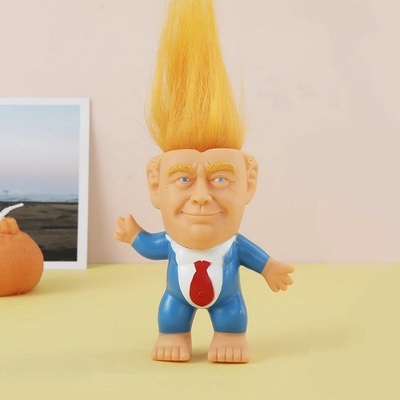
Last April, President Trump admitted that his tariffs — being a necessary economic tool — would make toys a bit more expensive, but suggested that little girls could be satisfied with “two dolls instead of 30”.
Apparently, the Supreme Court disagrees.
Underrated writer Louis Cannon grew up in the vast American West, although his ex-wife, given the slightest opportunity, will deny that he ever grew up at all. You can read more stories on his Substack account.