

The Monday meeting of the San Juan Water Conservancy District (SJWCD) Board took place in their new office at 4670 West Highway 160 — in a room not much larger than a big walk-in closet. The Board’s single staff member, Sally High, was on vacation, and Board President Candace Jones struggled a bit, trying to operate the Zoom interface while also referring to her meeting notes on the same laptop computer.
I confess I felt some sympathy for the Board’s current situation, even though I’ve long been opposed to SJWCD’s decades-long quest to get the Dry Gulch Reservoir constructed.
As indicated in Part One, the 32,000 acre-foot Dry Gulch Reservoir water rights approved in 2004 by District Court Judge Greg Lyman were appealed to — and rejected by — the Colorado Supreme Court. Actually, the Court rejected those water rights twice, in historic rulings now generally known as Pagosa I and Pagosa II.
Since those Supreme Court rulings in 2007 and 2009, the customers served by Pagosa Area Water and Sanitation District (PAWSD) have consistently elected Board members who are skeptical of the proposed reservoir — both as unnecessary and as unaffordable.
Disclosure: I currently serve on the Pagosa Area Water and Sanitation District (PAWSD) Board of Directors, but this editorial series reflects only my own opinions, and not necessarily the options of the PAWSD Board as a whole, or the PAWSD staff. PAWSD is currently involved in a lawsuit with SJWCD, related to the Running Iron Ranch and the proposed Dry Gulch Reservoir.
At their Monday meeting on February 2, the SJWCD Board voted unanimously to submit a grant application to the U.S. Bureau of Reclamation (BOR). The public still has no knowledge as to what, exactly, this grant would be used for. SJWCD has consistently claimed that Pagosa Springs desperately needs to build the Dry Gulch Reservoir on the Running Iron Ranch, north of downtown Pagosa Springs, but the Board has yet to define, for the public, exactly how the reservoir would serve the community.
The BOR no longer funds massive projects like the Hoover Dam and Glen Canyon Dam, but it has recently funded smaller projects in the $200-$500 million price range. We may find out, someday, whether the Dry Gulch Reservoir project meets the current funding criteria.
At the Monday meeting, PAWSD Board President Gene Tautges was in attendance, and near the conclusion of the meeting, he posed a question to the gathered SJWCD Board members.
“A quick question, if possible? Has it ever been found out, or determined, what the percentages are? For instance, it’s been talked about, that the reservoir will be for fishing, agriculture, recreation, municipal. Do we know how each of those might fit into the planning for the size of the reservoir? Or is it too early to even ask that question?”
We hope and pray that it’s not too early to ask that question — about the proper size for a reservoir — when the tax-funded SJWCD is preparing to apply for a federal grant related to the proposed project.
Apparently, it’s not too early to ask the question, but it’s too early to get a coherent answer.
SJWCD President Candace Jones responded:
“So, that’s… I don’t think it’s not too early to ask the question. I think it kind of goes to the point that I’ve been trying to make for some time, about the lack of planning, and the need for planning, and doing a robust… you know… kind of planning effort. So I’m glad you’re asking that question.
“We can’t sit here today and answer that question, but it’s absolutely a question that additional planning would target…”
SJWCD Board member Rob Hagberg then suggested that the actual need is for “a study” rather than “planning”.
With that, the SJWCD voted to enter executive session and meet behind closed doors to discuss their ongoing legal problems surrounding the Running Iron Ranch and the Dry Gulch Reservoir.
Presumably, the SJWCD Board has been “planning” and “studying” the Dry Gulch Reservoir project since 2004, when Judge Lyman first granted water rights for a 32,000 acre-foot project. But in 2026, the SJWCD Board was not yet able to tell PAWSD President Tautges what percentage of the water in their proposed reservoir would accrue to PAWSD’s municipal customers.
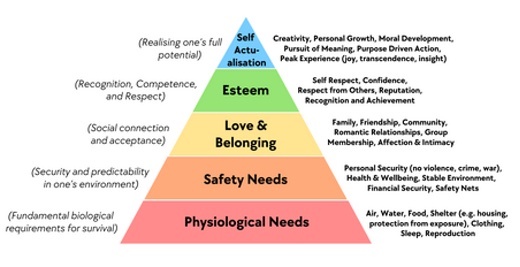
Human beings are complex creatures, with many different motivations from various levels of Dr. Abraham Maslow’s hierarchy occurring at the same time. Instead of stating that an individual focuses on “one particular need” at any given time, Dr. Maslow stated that a certain need “dominates” the individual’s thoughts and actions. Dr. Maslow tried to identify the basic types of motivation and the order in which they would tend to be met.
In addition to his anthropological studies, Dr. Maslow drew on animal data that “studied and observed monkeys […] noticing their unusual pattern of behavior that addressed priorities based on individual needs”.
As a journalist concerned about the behavior of politicians and community leaders, I’ve not had a chance to study monkeys, but I’ve nevertheless come to the conclusion that one of the most powerful human desires is the desire to be “right”.
The desire to win the argument; the desire to be acknowledged as wise and perceptive by fellow board members or professional colleagues. It’s a desire that can cause humans to make dumb decisions.
To achieve this desired recognition, an individual typically chooses which facts and evidence to regard as important and valid, and which facts and evidence they should ignore, or dispute. There’s hardly a better example of this human tendency, locally, than the current conflict between PAWSD and SJWCD.
Of course, in 2026, there are even better examples at the federal government level.
Curiously enough, the two water districts recently agreed to engage in mediation and make an attempt to come to a legal settlement concerning the Running Iron Ranch and the Dry Gulch Reservoir, prior to a scheduled District Court hearing in May.
It least, I find it curious.
What might be the outcome, of such a mediation?
Bill Hudson began sharing his opinions in the Pagosa Daily Post in 2004 and can't seem to break the habit. He claims that, in Pagosa Springs, opinions are like pickup trucks: everybody has one.