
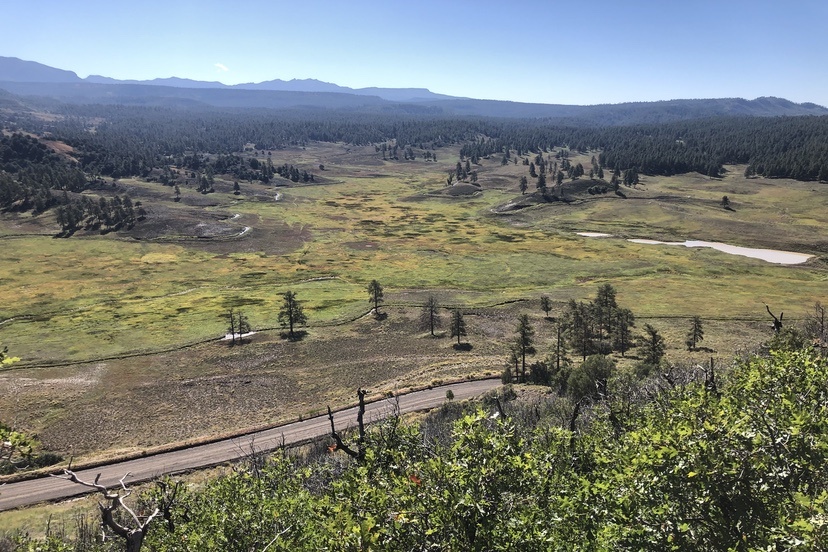
Photo: A portion of the scenic Running Iron Ranch, September 2024.
The San Juan Water Conservancy District board is scheduled to meet today, Monday February 2, at 4pm at their new, rather cozy office location — 4670 W Highway 160, Suite A2, across the highway from Terry’s ACE Hardware. On the agenda are a couple of items related to the Running Iron Ranch and the proposed Dry Gulch Reservoir. The meeting is open to the public, and is also accessible via Zoom, although a portion of the meeting will likely be a non-public, closed-door executive session.
Well… it’s been a relatively warm and dry winter thus far in Pagosa Springs and the rest of southwestern Colorado. No doubt some folks are looking up at the clear blue sky and wondering whether we’re experiencing the results of ‘climate change’.
The folks in the eastern part of the country, meanwhile, are digging themselves out of record-breaking snowstorms. The first storm moved across the Midwest and East Coast over the weekend of January 24-26 and a second storm swept through this past weekend.
In Dayton, Ohio. 12.4 inches of snow fell in one day, breaking the record established during the Blizzard of 1978. Pittsburgh and Philadelphia received 11.2 and 9.3 inches of snow respectively, breaking one-day snowfall records set in 2014 and 2000.
But in the San Juan Mountains east of Pagosa Springs, the snowfall has been somewhat disappointing at the Wolf Creek Ski Area, which regularly boasts “The Most Snow in Colorado” — averaging over 400 inches annually.

So far this winter, the Ski Area has received just 94 inches.
People in Pagosa have begun making comments about a possible water shortage this summer. Practically all the water consumed in Archuleta County comes from San Juan Mountains snow melt.
If a shortage does occur, this will be the second year in a row that Pagosa Area Water and Sanitation District (PAWSD) limits outdoor watering, and charges higher rates for excessive water usage. It could even result in higher rates for everyone, depending on how serious the shortage is.
A similarly dry weather pattern hit southwest Colorado during the 2001-2002 winter season, and outdoor watering in Pagosa was limited to “odd or even days” all that summer.
The summer of 2002 continued to be relatively dry, and the drought caused the community to cut way back on its water consumption. During 2001, PAWSD had sold about 510 million gallons of water (about 1,820 acre-feet). Consumption in 2002 fell to 362 million gallons (1,290 acre-feet).
The drought also led to several remarkable things taking place in 2003 and over the following decade.
First off, PAWSD requested a report from two respected water engineers — John Davis and Steve Harris — to clarify the best infrastructure investments PAWSD could make in the near future to ensure access to sufficient water resources.
Mr. Davis and Mr. Harris looked at seven proposed infrastructure improvements and highlighted two of them: the enlargement of the Stevens Reservoir, and a Dutton Ditch pipeline to enclose the main water source that feeds Lake Hatcher.
Here’s the chart that came with that report:
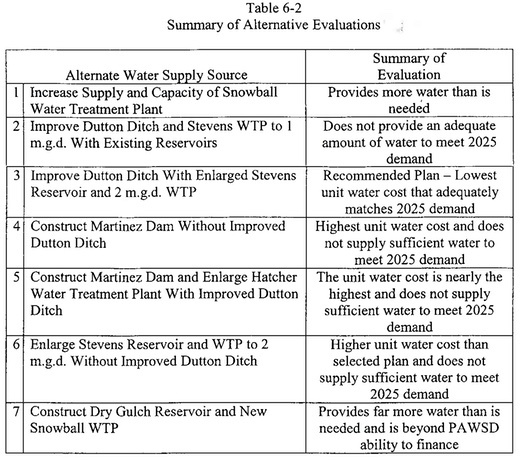
As we see, the engineers saw problems with six of the proposals, and picked “Improve Dutton Ditch With Enlarged Stevens Reservoir and 2 m.g.d WTP” That would include a 2 million gallons per day Water Treatment Plant at Lake Hatcher.
We might also note one unsuitable project that was “beyond PAWSD ability to finance”: a Dry Gulch Reservoir and replacement of the Snowball Treatment Plant.
Over the next decade, PAWSD did in fact enclose the Dutton Ditch and did in fact enlarge Stevens Reservoir, as recommended by Mr. Harris and Mr. Davis.
But something rather remarkable took place shortly after this January report was delivered.
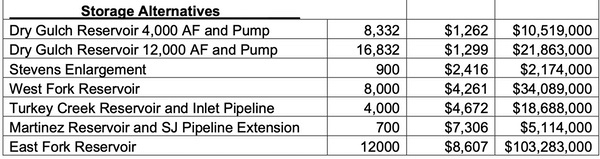
The San Juan Water Conservancy District (SJWCD) — a separate district created by the voters to increase water storage in Archuleta County — hired Steve Harris to write a separate report concerning the best location for a future water reservoir. Mr. Harris looked at six reservoir sites that could ostensibly provide water for PAWSD customers in the future. His report was delivered in March, 2003.
His conclusion: Of the six reservoir sites, a 4,000 acre-foot Dry Gulch Reservoir and its necessary pump station was the most affordable alternative based on the “cost per acre foot” of storage. The primary location for this future reservoir site was a 660-acre ranch north of downtown Pagosa Springs.
We note that this report by Mr. Harris came out in March, just two months after the previous report — co-written by Mr. Harris — which stated that the Archuleta Community did not need a Dry Gulch reservoir, and could not afford it.
We can also note something else interesting that took place in March.
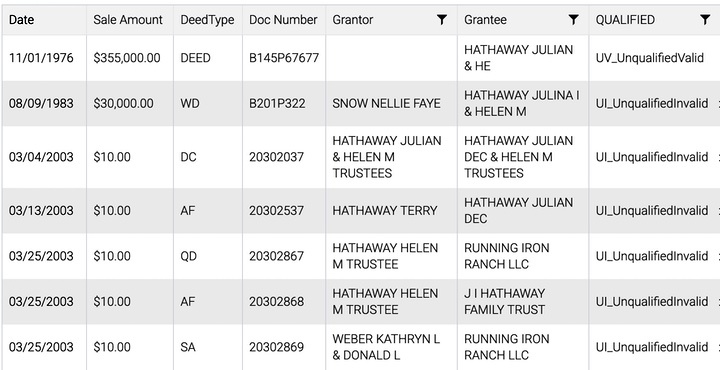
The same month that the new Harris report arrived — designating the Dry Gulch reservoir as a preferred reservoir site — a flurry of five real estate filings took place, concerning the ownership of the 660-acre “Dry Gulch” ranch, including a Quit Claim Deed issued to a limited liability company called “Running Iron Ranch LLC”.
From the Archuleta County Assessor’s website:
Following the designation of the Running Iron Ranch as the best location for a future reservoir — in spite of the fact that it would provide “far more water than is needed and is beyond PAWSD ability to finance” — the SJWCD Board and the PAWSD Board collaborated on a water rights filing, asking District Court Judge Greg Lyman to approve enough water rights to facilitate a 32,000-acre-foot reservoir.
Which the judge was willing to approve.
We might note that this was somewhat larger than the 4,000-acre-foot reservoir suggested by Steve Harris as the most affordable option…
…a 4,000-acre-foot reservoir that Mr. Davis and Mr. Harris had found, in January, to be beyond PAWSD ability to finance.
Disclosure: I currently serve on the Pagosa Area Water and Sanitation District (PAWSD) Board of Directors, but this editorial reflects only my own opinions, and not necessarily the options of the PAWSD Board as a whole, or the PAWSD staff. PAWSD is currently in a lawsuit with SJWCD, related to the Running Iron Ranch and the proposed Dry Gulch Reservoir.
Eventually, a previous PAWSD Board agreed to put its water customers $10.2 million in debt, by taking out a loan to purchase the Running Iron Ranch from ‘Running Iron Ranch LLC’. (The taxpayers never had a chance to approve this debt.) PAWSD and SJWCD then hired a different set of engineers to find out just how unaffordable a 32,000-acre-foot reservoir and pump station might be.
The 2009 estimate came in at $357 million.
Like the man said: “beyond PAWSD ability to finance.”
Then the Colorado Supreme Court stepped in.
Bill Hudson began sharing his opinions in the Pagosa Daily Post in 2004 and can't seem to break the habit. He claims that, in Pagosa Springs, opinions are like pickup trucks: everybody has one.