
As Colorado continues to suffer through harsh drought conditions, the Colorado legislature passed a bill seeking to remove barriers for some residents to save water on lawn watering.
Around 60% of Coloradans live under a homeowner association. If signed into law, Senate Bill 178 would allow those homeowners to swap their grass lawns for landscaping that needs less water to maintain, forcing HOAs to accept the alternative landscaping.
The bill passed its final legislative vote on Wednesday, now only needing the governor’s signature to become law.
— from a story by Hannah Metzger in Colorado Politics, April 26, 2023
I enjoy reading news stories, especially when they involve suffering. Does that make me a masochist? I don’t think it does. I think it makes me a normal person.
But the fact that the entire state of Colorado has been suffering (myself included) from “harsh drought conditions” probably makes my enjoyment more acceptable.
Except that I didn’t actually notice that I was suffering.
The Colorado legislature apparently thinks I was, however, and I’m not going to try and disabuse them of that belief. Lawmakers need to feel like they are doing something important, and relieving suffering is certainly important.
Thus, we have Senate Bill 178. Setting our residential landscaping free from the requirement to have a lawn. Under current law, homeowners associations can’t prohibit low-water landscaping, but, in practice, “such proposals are often rejected for subjective aesthetic reasons, bill sponsors said…” according to Ms. Metzger’s article in Colorado Politics, mentioned above. So some Colorado HOAs are essentially forcing people to have lawns. And water them regularly.
This is the source of the suffering.
She writes:
Current law does not require the landscaping review process to be transparent, fair, or timely. Because of this, [SB 178] sponsors said homeowners often don’t know how the process works or what landscaping will be accepted.
SB 178 would require HOAs to pre-approve at least three water-saving landscaping designs that homeowners could choose to implement. It would also prohibit HOAs from banning vegetable gardens in front and side yards. These changes would only apply to single-family detached homes.
Where I live in Pagosa Lakes, the subdivisions are governed by certain regulations, but I can’t find any regulations that require me to have a lawn. I have to have “vegetation or landscaping”… but I’m not required to have a lawn.
I do, in fact, have a lawn, because my ancestors always had lawns. But it’s a really small lawn, because I don’t like paying a lot of money for a big water bill. I feel sorry for my neighbors who have big lawns. Those are the people who are really suffering.
The suffering can now be relieved, thanks not only to the Colorado General Assembly, but also to the manufacturers of artificial lawns, such as EasyTurf, headquartered in San Diego.
An artificial lawn can be installed using glue, or you can simply nail the sucker down.

David Chaney, who later served as Dean of the North Carolina State University College of Textiles, headed the team of researchers who created the first commercially-viable artificial turf. That accomplishment led Sports Illustrated to declare Chaney as the man “responsible for indoor major league baseball and millions of welcome mats.”
The main problem with an artificial lawn (and there are, in fact, many problems) is that you will be starving the earthworms and insects who used to live among the roots. So the suffering is merely being transferred. Not eliminated.
From what I can discover, Colorado Governor Jared Polis has not yet signed SB 178 into law.
The Governor maintains a smallish lawn in his back yard in Denver, but we can also see evidence of xeriscaping. Hard to let go of the whole lawn. I know how that feels.
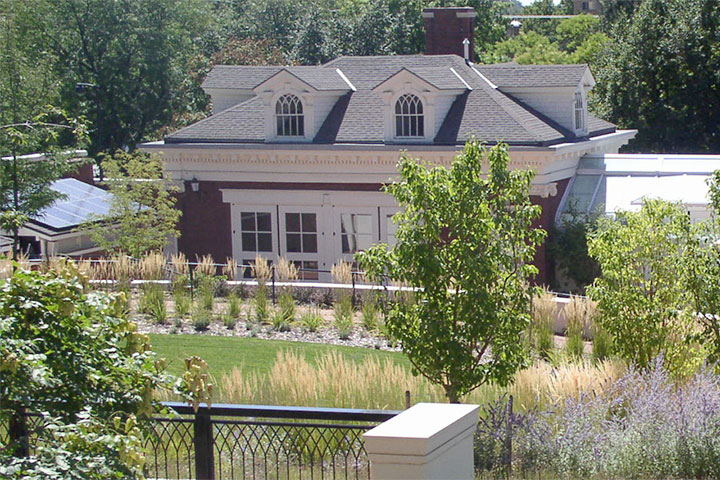
Las Vegas, NV, passed a law last year that requires homeowners to get rid of their ‘non-functional lawns’ by 2027, and some cities in California are even paying residents to rip up their lawns and replace them with xeriscaping. Or EasyTurf.
The Colorado General Assembly is concerned about water, of course, even after a year of near-record snowfall. Which would explain why the bill submitted just prior to SB 178 — numbered SB 177 — allocated $103 million to the Colorado Water Conservancy Board, for various projects. I looked through the list of projects, and found myself wondering… how many artificial lawns could Colorado install, for $103 million?
Underrated writer Louis Cannon grew up in the vast American West, although his ex-wife, given the slightest opportunity, will deny that he ever grew up at all. You can read more stories on his Substack account.