
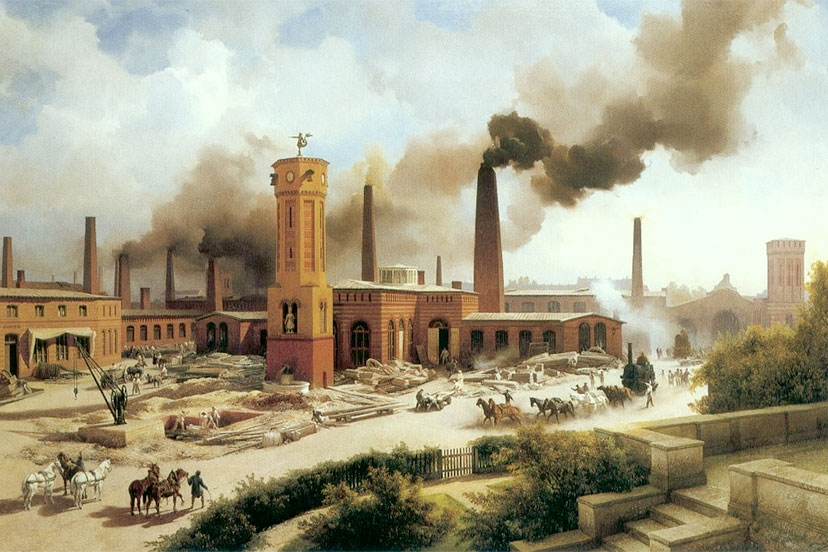
IMAGE: A painting of Ironworks Borsig in Berlin by Karl Eduard Biermann, during the Industrial Revolution in 1847.
I’ve heard a few horror stories, over the years, about homeowners here in Pagosa who watched their homes deteriorate — often, due to water damage from poorly constructed roofs or poorly drained foundations. In some cases, the home was damaged by fire, or by an explosion.
But considering we have about 10,000 homes in our community, the horror stories are relatively few and far between.
To minimize the potential for damage or harm, the Town of Pagosa Springs has adopted the International Residential Code for homes… and for commercial buildings, the International Building Code. These codes are “International” because they’re also sometimes adopted in Canada.
Archuleta County has also adopted these codes, which are written by a private non-profit, the International Code Council (ICC). Neither of our local governments are required to adopt these model codes; we could write our own codes. But it’s an awful lot of work to write building codes, so adoption of the ICC codes is an economical way to proceed.
Originally, the International Codes were aimed at safety and durability. But over the years — especially, since the Arab oil embargoes during the 1970s — the ICC has included more and more rules aimed at reducing energy requirements in buildings, presumably with the goal of ‘national energy security’. But since about the start of the 1990s, the energy codes have also tried to address the threat of climate change.
These building codes apply specifically to an individual building.
But then we have neighborhoods. How to control neighborhoods?
There’s no “International Code” available for neighborhoods.
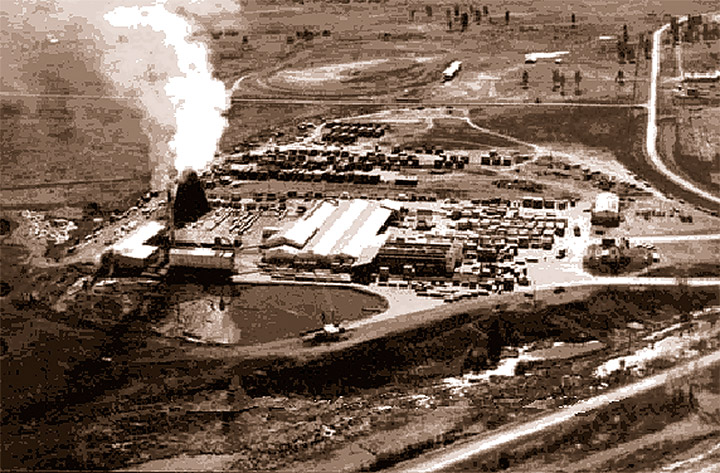
So our local governments have to write their own codes, if they want to control overall community growth and development. As I’ve noted in past Daily Post editorials, the Town government did not try to control neighborhoods prior to about 1970. For one thing, people are not stupid, and they generally made reasonable decisions about where to place their homes or businesses. Homes were most often located in residential neighborhoods, sized to the needs and financial means of whatever family was building the home. Businesses were located in business districts, near main thoroughfares. Industrial uses were located in the outskirts. (I understand that the San Juan Lumber Company sawmill, located for many years at the intersection of Highways 160 and 84, generated some air pollution that affected downtown Pagosa. The mill was abandoned a decade or so before I arrived in 1993.)
At some point, our local leaders looked around at surrounding communities and noticed that Colorado governments had decided to control how neighborhoods grew, or didn’t grow. Here in Archuleta County, developers were buying up large ranches and turning them into suburban subdivisions. This was supposedly ‘good’ for the community. More people meant more money flowing, and more money was supposedly a ‘good’ thing, so the Archuleta County commissioners happily rubber stamped every new subdivision that came before them for approval.
Pagosa Springs slowly became a relatively popular tourism destination. But by the early 2000s, local leaders noticed that working families were struggling to find housing they could afford. The roads were getting beaten up. ‘More money’ was actually causing more problems in the community.
With those thoughts in mind, we can look at one more aspect to the proposed Land Use and Development Code (LUDC) updates discussed by the Town Council and Town Planning Commission on April 27.
Sustainability Standards
Intent of the Section
- To accelerate the installation and implementation of sustainability techniques to lower carbon footprints, lower energy costs, and add energy resiliency throughout the community.
Proposed amendments
- New section with a menu of sustainability options.
- Requirements are met through a point system.
We cannot doubt that requiring residential and commercial development to become more “sustainable” will also make development more expensive. The belief among the Town’s Community Development staff appears to be that “sustainable” homes and business will, over the long haul, save us all from even more expensive problems.
But it might mean some short-term financial pain.
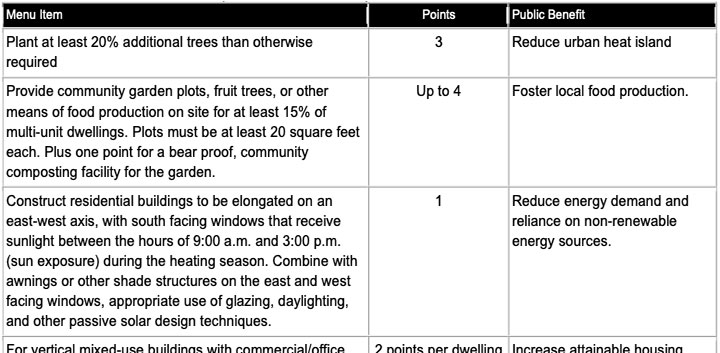
You can click here to download a 2-page menu of potential ‘sustainability’ enhancements that might be added to the Town’s LUDC in the near future. As presented last week, a new home or commercial building would be required to add “sustainable site improvements” worth a total of 5 or 6 ‘points’. The suggested improvements include solar enhancements, bicycle racks, clustered buildings, mixed use buildings, electric vehicle charging stations, landscaping options, or — if push comes to shove — “Alternative sustainability technology and innovation not listed.”
Here’s a sample section of the menu of choices:
At this point, these new requirements are merely in the discussion phase.
At the top of this page, I included a painting of the Ironworks Borsig in Berlin, from 1847, to reference the idea that industrialization has utterly changed our world, contributing to previously unthinkable population growth and mass consumption. Some people have been arguing that the survival of the human race is threatened by continued technological progress.
The word “sustainable” — as used in the Town’s proposed menu, for example — found its first usage in an article titled “Blueprint for Survival” in The Ecologist magazine in January 1972. From a story about that magazine issue:
‘Radical change is both necessary and inevitable because the present increases in human numbers and per capita consumption, by disrupting ecosystems and depleting resources, are undermining the very foundations of survival,’ wrote Ecologist founder Edward Goldsmith, Robert Allen and a team of colleagues, who named self-sufficient smaller communities, like those of native societies, as a model for sustainable living.
Pagosa might be classified as a “smaller community”, but probably not as a “native society”. Nevertheless, we could become a model for ‘slightly-more-sustainable living’, if our Town government decides to add “sustainable site improvements” to the many requirements already contained in the LUDC.
We either pay now, or our children and grandchildren pay later.
Bill Hudson began sharing his opinions in the Pagosa Daily Post in 2004 and can't seem to break the habit. He claims that, in Pagosa Springs, opinions are like pickup trucks: everybody has one.