
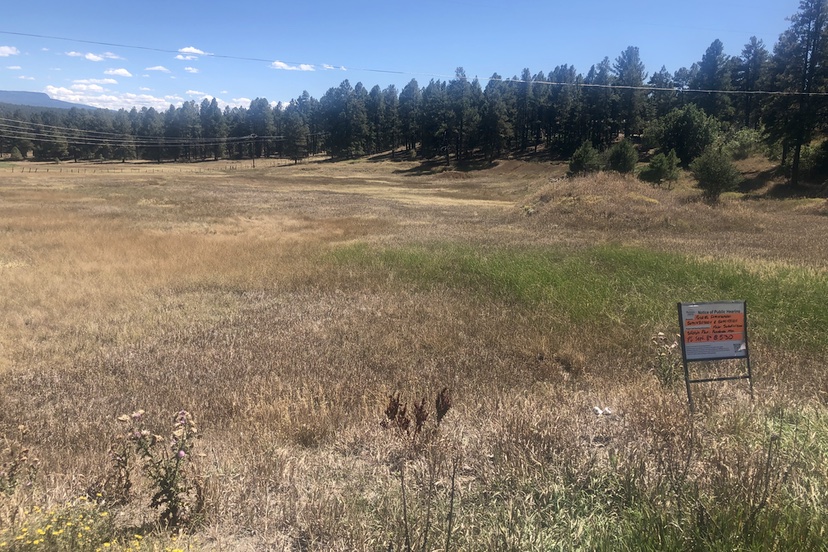
Photo: A view of the meadow adjacent to Highway 160 that forms part of the proposed 70-acre Ponderosa Mountain subdivision, viewed from Great West Avenue, September 2026.
How to summarize a contentious four-hour discussion at a Town Planning Commission meeting, so that it makes sense of the complex goals of the Pagosa Springs town government?
Not an easy task.
First of all, we need to admit that the Town government, philosophically and historically, has bent over backwards to promote development, believing that “growth” will benefit the entire community.
Next, we need to admit that the majority of the residents who already live in Pagosa Springs do not want to see unfettered growth take place here.
We can also admit that the gradual gentrification of Pagosa Springs continues to drive working families and individuals, and senior citizens, out of the community.
Which is to say: the Town Development Department is sometimes at odds with the very people it was created to serve, in terms of how it views the best possible outcomes for the community.
That’s understandable. If you work in a “Development Department”, it’s no doubt tempting to believe that “development” is your end goal.
At the Tuesday, September 8 Town Planning Commission meeting — during the discussion about the proposed 70-acre Ponderosa Mountain subdivision adjacent to Great West Avenue and the Alpha/Rock Ridge subdivision — Pagosa Springs Development Director James Dickhoff most openly displayed the “pro-growth” mentality of the Town government. Nearly all of his comments and arguments during Tuesday’s lengthy meeting were aimed at encouraging the Planning Commission to approve the two proposals for the proposed Ponderosa Mountain subdivision.
Meanwhile, 90% of the public testimony at the meeting expressed opposition to the development.
Stuck in the middle was Town Planning Manager Owen O’Dell — who took a generally neutral position on the two related agenda items:
1. Ponderosa Major Subdivision, Sketch Plan Review
2. Ponderosa Mountain Planned Development Agreement
Also trying to carefully weigh the pros and cons of the proposal were the five Planning Commissioners: Chris Pitcher, Julie Gurule, Mont McCallister, Brian Reid, and Mike Torres.
Not an easy task.
When a developer comes to town — presumably in the quest for financial gain — and proposes to chop up a large, perhaps wild and scenic, parcel into smaller lots, we don’t always know what the developer’s true intentions are.
Some developers actually intend to build useful buildings on those lots.
Some developers are simply seeking government approvals for projects they never intend to build, because those approvals, all by themselves, increase the value of the property. The so-called developer then flips the property, at a profit. The next developer benefits from the now-existing approvals and property rights.
How about the Town government’s intentions? Those are somewhat more transparent.
One piece of the Town government’s current development philosophy could be summarized this way.:
“Development is going to happen. People want to live in Pagosa Springs, and we can’t stop them from coming, nor is it our job to stop them from coming. But the ‘suburban sprawl’ type of development that took place here between 1968 and 2008 has produced a community that cannot afford to maintain its own infrastructure. It’s also produced a community that’s generally unaffordable for working families. Additionally, the community became overly dependent upon automobiles, when a pedestrian-based lifestyle is healthier, more popular with young families, and ultimately more sustainable.
“To address these problems, we will, whenever possible, compel future development to happen close to the historic downtown core, where infrastructure already exists, where businesses and services are within walking distance, and where we can encourage or compel developers to create a mix of housing types, to include so-called ‘affordable’ and ‘attainable’ housing types.”
That philosophy had obviously driven some of the negotiations between Modern Community Builders LLC and the Town Development Department.
Developer Jonathan Fink told us:
“We kinda felt there was an opportunity, based on this parcel of land, the 70 acres, that we had the opportunity to actually build a unique neighborhood, that was designed from the very beginning to be a very terrific place to live.
“Where all the streets are designed properly, where the houses are placed property, has all the utilities, there’s a playground areas, there’s gathering areas…
“And walking distance to the downtown area…”
He stated that his team had worked to accommodate the suggestions coming from the Town planners. One of the suggestions from the Development Department was to create a ‘Planned Development Overlay’ that would override the existing ‘Rural Transitional’ zoning and allow 22 dwelling units per acre — the highest possible density allowed in the town limits.
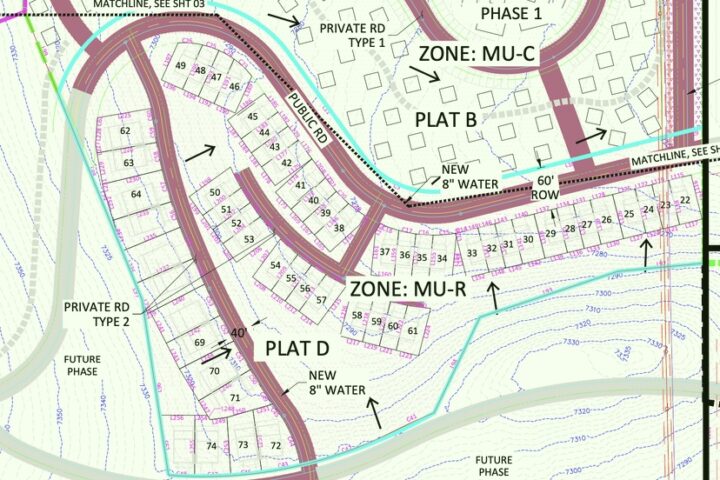
As we learned later in the discussion, the developers had never wanted that kind of high density; this “R-22” density was being pushed by the Town Development Department, and had been negotiated into the proposed Planned Development Agreement.
I happen to live in a part of downtown that is zoned “R-22” and there are a few parcels in my neighborhood that have been built to that density. It’s not an oppressively high density, in my estimation, although most of the people who have moved to Pagosa Springs since about 1970 have chosen to live in suburban neighborhoods that have a density closer to 4 dwellings per acre, or even 1 dwelling per acre.
If I were a developer looking to make a nice profit, and hoping to appeal to the typical homebuyer moving to Pagosa or buying a second home here, I would certainly not be building 22 units per acre.
This push by the Town Development Department to enforce a zoning density of 22 units per acre proved to be one of the main controversies on Tuesday. We often heard references, from the audience and from the Planning Commission, to the fact that the property is currently zoned “Rural Transitional”, a zoning that would allow perhaps 140 lots and homes on the 70 acres. I would think a developer could make a nice neighborhood in such a zoning district… and a nice profit if he built more than a hundred homes priced at, say, $1 million each. And maybe Modern Community Builders felt the same way, coming into the subdivision negotiations process earlier this year.
But the Town Development Department obviously wanted to push ‘high density’ onto this parcel, guided by its own aspirations.
The funny thing about this planning contest:
The Town can set the zoning for a district at “R-22”. But that’s only a “maximum” density. The developer can still choose to build at a lower density, once he’s been approved.
Read Part Four… tomorrow…