
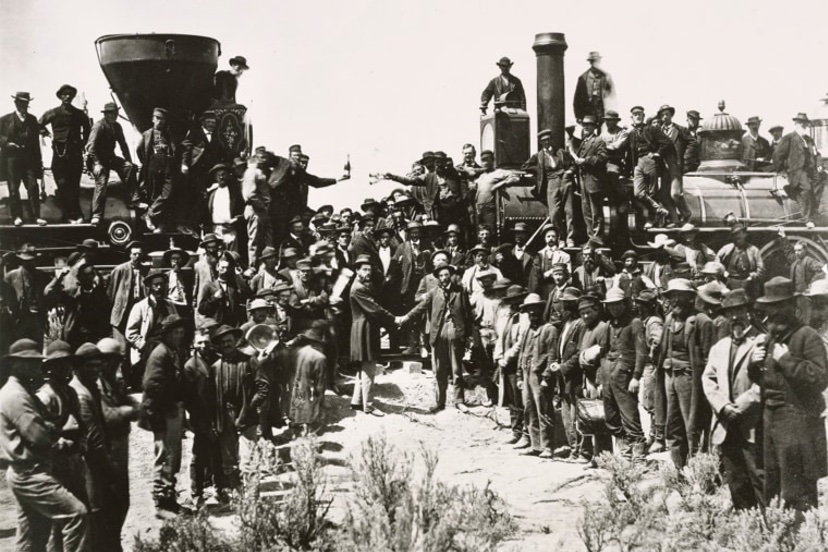
The 20th century saw a dramatic increase in railroad labor productivity. In 1916, the peak year for U.S. Class I railroad route-miles, those 100-plus carriers employed 1,559,000 people…
— from a story by Jerry A Pinkepank on Trains.com, August 13, 2022,
One of my family’s favorite campfire songs:
I’ve been working on the railroad,
All the live-long day
I’ve been working on the railroad,
Just to pass the time away
Can’t you hear the whistle blowing
Rise up so early in the morn
Can’t you hear the captain shouting
Dinah blow your horn…
The popularity of this particular song among my family members may have been partly due to the fact that my great-grandfather had been a railroad engineer. That’s not who this song is about, of course. Engineers had it relatively easy. The song is about the men who rose up so early in the morn to build the railroads… and about Dinah.
But just lately, railroads have appeared in the news — specifically, in reference to the massive effort during the 19th and 20th centuries to connect America’s cities and towns by rail.
Most of us give little thought to railroads these days, even though about 40 percent of long-distance freight is transported by train. (We also give little thought to Dinah, but that’s a story for another day.)
There’s a good reason why 10% of the squares on a Monopoly game board refer to railroads.

At its height in 1916, the American rail industry employed about 1.56 million employees, about 4% of the total U.S. workforce, and maintained over 250,000 miles of track… roughly the distance from the Earth to the Moon, but a more practical and useful distance.
Many routes have been abandoned over the past 110 years — the tracks that served Pagosa Springs, Colorado, for example, were torn up in 1936 — and it’s hard of a modern person nowadays to imagine the amount of human sweat that went into building this massive transportation system mainly with picks and shovels.
For that matter, a modern person nowadays can hardly imagine a pick or a shovel.
Here’s a typical reference to America’s historic railroad build-out, in a recent news article by on Stateline,org, :
Until now, no industry had driven the U.S. economy with such force since the railroad expansion of the late 1800s, when titans battled one another to lay the transcontinental tracks that would connect America from coast to coast.
Railroads in the 19th century… created more than 2% of the nation’s annual economic output (GDP) over 20 years.
Today’s data center build-out will dwarf that amount, with $10 trillion in investment, [and will] have almost twice the economic impact … That’s according to a report created by a Columbia Business School professor, Stijn Van Nieuwerburgh.
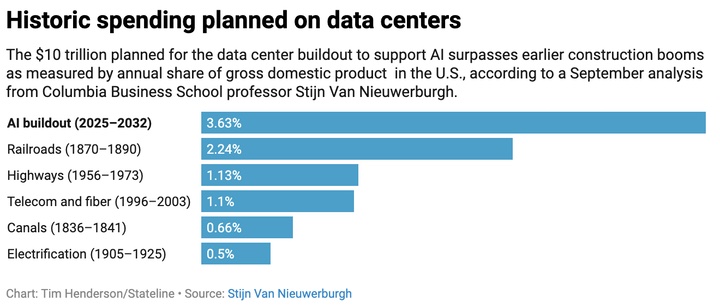
The railroad build-out was pretty damned expensive, and it wasn’t cheap paying those 1.56 million employees — including my great-grandfather — many of whom were union members.
But our current “American Railroad” project — the potential construction of more than $10 trillion worth of data centers over the next five or six years — is not likely to hire, in total, more than a few thousand employees. All the real “work” is done by electronic devices which do not pay union dues.
Nor are data centers likely to deliver any useful products, as railroads continue to do.
By “useful products”, I mean: food, fuel, clothing, lumber, steel pipe, TVs, and laundry soap, among other essentials of modern life.
Data centers also deliver things, but not useful things. Spam, mostly. Social media posts from people I haven’t spoken to in 30 years. Ads for Liberty Mutual. Deep fakes. Lies from politicians.
Railroads in 1916 earned about $3.4 billion in operating revenue. That is to say, the industry actually made money.
From an article by Joshua Hong in Forbes magazine, October 2026:
Data-center owners need to generate $8.5 trillion in cumulative revenue by the end of the decade to justify their investments, according to a press release last week by global research and advisory firm Gartner. But the firm forecasts that no more than $3.6 trillion of enterprise and consumer AI revenue can be attributed to those data centers over the same period — leaving a $4.9 trillion gap.
According to a 2026 market study by trade association BOMA, data centers accounted for approximately $41.2 billion — or nearly 46% — of private office construction in the country in 2025. A decade earlier, data centers represented less than 5%.
I guess, to be fair, I shouldn’t be comparing the economic peak of the U.S. railroad industry, in 1916, to the very early beginnings of the data center debacle, in 2026.
But I just can’t help myself.
Underrated writer Louis Cannon grew up in the vast American West, although his ex-wife, given the slightest opportunity, will deny that he ever grew up at all. You can read more stories on his Substack account.