

One of my very first interviews, when I began writing for the Pagosa Daily Post in 2004, was with Pagosa’s then-mayor, Ross Aragon. During the interview, the Mayor showed me a baseball cap he’d been given by a local business owner, emblazoned with the message that said…
I’m Progressive!
…or something along those lines. I clearing recall the word “Progressive” being in the message.
The hat was not meant to indicate that the Mayor was “a progressive” in the current meaning of “leaning to the left” — but rather, that the Mayor constantly strove, in his important political position, to make sure that Pagosa was making “progress”…
That businesses were thriving and growing. That tourism traffic was increasing. That more homes were getting built. That existing buildings were getting remodeled and upgraded. That the Town government was expanding.
Mayor Aragon had grown up in Pagosa Springs during years when the economy was stagnant and families struggled to put food on the table. Many of the policies put in place during his 32 years as mayor did indeed result in expanded Town government, and thriving businesses, and increased tourism, and homes getting built, and existing buildings getting remodeled. Progress, in other words.
There’s another word to describe the changes:
‘Gentrification’.
The community became less and less affordable for working families, as local leaders and real estate brokers rolled out the red carpet for wealthier second-home owners and vacation rental investors. Although government planning documents professed a desire for a “diverse” community, and for preserving a valued “small town character” and an “authentic” lifestyle, in fact, the community was heading in an unexpected — and unwanted — direction.
Two years ago, Region 9 Economic Development District identified Archuleta County as the most expensive place to live in southwest Colorado. Shockingly, more expensive than Durango.
Things have only gotten worse.
The main driver of financial stress for families? Housing.
Now, some government leaders and nonprofit organizations are scrambling to address the dysfunction.
For example: The five members of the Town Planning Commission, on Tuesday, were faced with a proposal from the Town Development Department to convert 70 acres of pristine forest and meadows, west of the Elementary School into a high-density residential neighborhood.
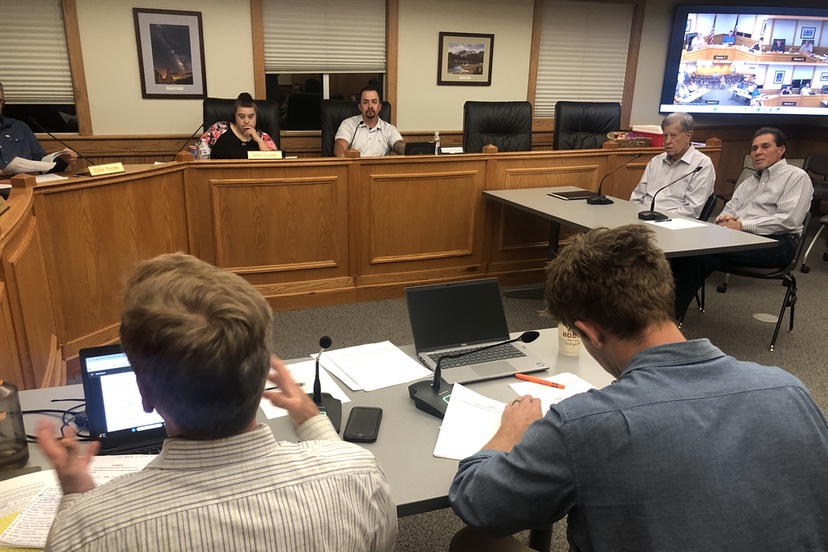
I’m stating that the proposal came from the Town government, even though the name on the “Sketch Plan” was Modern Community Builders LLC, based in Los Angeles. As questions were raised by the Planning Commissioners and by the packed audience, it became clear that what the developers originally intended to build was not necessarily what the Planning Commission was presented at the Tuesday presentation… and that the Town government had negotiated important concessions aimed at producing considerably more housing density — and perhaps more ‘attainable housing’ — than the developers had initially proposed.
Modern Community Builders does not currently own the 70 acres in question, and it’s typical for developers to acquire necessary government approvals prior to making the actual purchase of vacant land.
It looked, for a moment — about halfway through the four-hour discussion — like a majority of the Planning Commission was set to ‘table’ the approval, in order to have the developer provide clear evidence that other governments and utilities would provide their own approvals. PAWSD. LPEA. CDOT. Black Hills. Fire District. None of these agencies had yet provided conclusive proof that they could, or would, service such a 70-acre development, if it were built out at the Town-requested density of 22 dwelling units per acre.
Not only had the Development Department negotiated a high residential density — they had obtained an agreement from the developer to ensure that 12% of the housing to be built in the subdivision would be ‘attainable.’ In the Town’s parlance, ‘attainable’ means, roughly, “can be afforded by households earning more than the community’s average income.”
Years of studies in Archuleta County have failed to provide any significant evidence that households earning more than our average income are struggling to find housing in Pagosa. There’s plenty of evidence, meanwhile, that families earning less than the average income are leaving the community because they cannot afford housing here.
But government leaders protest that “developers cannot build homes affordable to our typical workers.” So they use subsidies and policies to increase housing for upper-middle-class households. This strikes me as crazy — to prioritize housing for families with above average incomes… and allow your workforce to move away.
What our community desperately needs is apartments. But we’ve not developed any local companies specializing in apartment construction, and local government doesn’t seem interested in trying to help develop those companies.
At the conclusion of Tuesday’s public hearing on the Ponderosa Mountain project, the Planning Commission realized that they would not get any detailed information about the project’s feasibility. from utility companies, unless they went first ahead and approved the ‘Sketch Plan’ and the ‘Planned Development Agreement’. But as a compromise, they modified the Agreement to set the density at “R-12” — 12 dwelling units per acre — instead of “R-22”.
Theoretically, this would allow about 600 dwelling units on the 70 acres, with some areas dedicated as ‘open space’. About half of the units planned for Phase 1 are shown as “commercial lodging”. (As if we need more housing for tourists?)
The next step: The subdivision now needs to present a fully-designed, fully-engineered plan, within the next 12 months, and obtain a ‘Preliminary Plan’ approval from the Planning Commission and Town Council.
At one point in the discussion, Commission Chair Chris Pitcher asked the developer about how many employees would be needed to run the proposed commercial lodging operation, and was told “about 40”.
But there’s no evidence that the planned project will include any housing affordable to workers earning hospitality industry wages.
As Mr. Pitcher noted, this entire, ambitious project will simply make our housing problem worse.
Bill Hudson began sharing his opinions in the Pagosa Daily Post in 2004 and can't seem to break the habit. He claims that, in Pagosa Springs, opinions are like pickup trucks: everybody has one.