
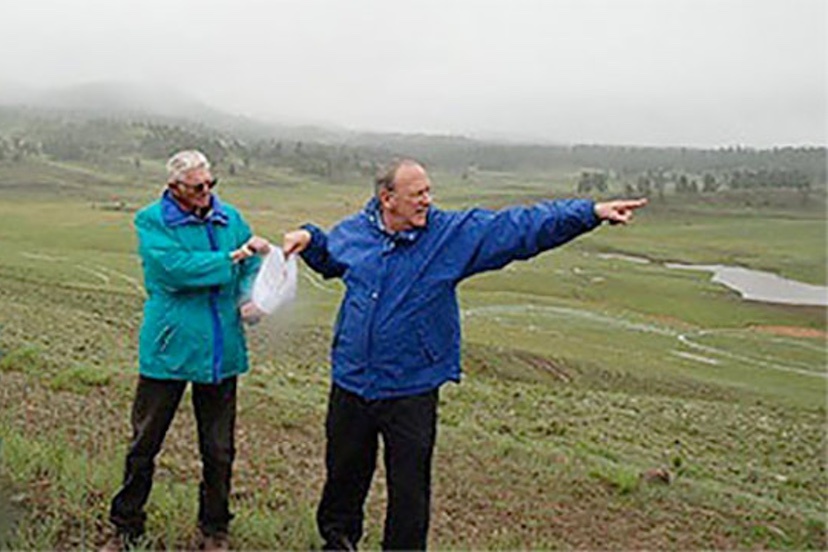
San Juan Water Conservancy District President Fred Schmidt points out a landscape detail of the planned Dry Gulch Reservoir in 2007.
As mentioned in Part Three yesterday, Archuleta County’s two very different water districts, Pagosa Area Water and Sanitation District (PAWSD) and San Juan Water Conservancy District (SJWCD) entered into a legal dispute two years ago.
In 2008, the two districts jointly purchased the Running Iron Ranch, two miles northeast of downtown Pagosa Springs, with plans to jointly build an 32,000 acre-foot reservoir to be called the Dry Gulch Reservoir.
To put 32,000 acre-feet in perspective, PAWSD sells about 1,400 acre-feet of water annually. (SJWCD does not treat or deliver water; they only support water-related planning and studies.) A 32,000 acre-foot reservoir would theoretically be able to supply all the water needed by PAWSD customers for 20 years — without a single drop of rain or flake of snow falling, for 20 years.
In other words, “too much water”.

The water rights needed for this massive reservoir were rejected by the Colorado Supreme Court — twice — and a subsequent legal settlement established storage water rights at 11,000 acre-feet. That is, enough water to serve PAWSD customers for about 7 years without single a drop of rain.
In 2012, a newly-elected PAWSD Board determined that an 11,000 acre-foot reservoir was unnecessary and too expensive, and they removed the Dry Gulch Reservoir from the district’s long-range planning documents. But the SJWCD Board determined that the reservoir was both necessary and feasible, and an ugly divorce took place between the two districts, after two decades of agreeable joint cooperation.
We’re talking this week about “too much water.” After 20 years of reporting on the Dry Gulch Reservoir, it’s my opinion that an 11,000 acre-foot reservoir is indeed unnecessary and too expensive for a little community of 14,000 residents. The current PAWSD Board generally agrees with that perspective.
The volunteers serving on the SJWCD Board disagree with that opinion, and they have been willing to fight PAWSD in court to hold onto their 11,000 acre-foot reservoir dream.
The taxpaying public, meanwhile, has not been provided with the details of the legal battle, because both district have been hearing from and advising their attorneys in closed-door executive session.
Finally, last week, the results of seven months of negotiations between PAWSD and SJWCD attorneys became available in a public document.
Disclosure: I currently serve as a volunteer member of the PAWSD Board of Directors, but this editorial series reflects only my own opinions and not necessarily the opinions of the PAWSD Board and staff.
Last March, representatives from PAWSD and SJWCD met with a Grand Junction-based mediator, Gene Dackonish, and agreed to pause their court battle and try a different approach to settling the Dry Gulch Reservoir conflict. You can read about that event here.
According to a previous three-way agreement signed in 2016 between PAWSD, SJWCD and the Colorado Water Conservation Board (CWCB), SJWCD was given 20 years to build a reservoir on the Running Iron Ranch. During those 20 years, PAWSD agreed to dedicate a portion of its customer revenue to making the necessary payments on a $9.2 million loan from CWCB used to purchase the Ranch, plus many millions in interest on the loan, plus take responsibility for repaying a $1 million CWCB grant if a reservoir was not built. (That grant had been awarded to SJWCD in 2008.)
SJWCD did not have to make any payments on the loan or grant.
Fast forward to 2026.
The agreement negotiated by PAWSD and SJWCD attorneys over the past seven months was approved by the SJWCD Board on November 6. You can download the agreement here.
Although this version of the proposal was sent to SJWCD by the PAWSD Board, the PAWSD Board has not yet voted to approve and sign the agreement. The consideration of an approval vote by the PAWSD Board is scheduled to take place on Monday, November 16, at an open public meeting. PAWSD customers opposed to the agreement may wish to attend that meeting.
Briefly, here are the basics of the agreement as approved by SJWCD:
SJWCD must enter into negotiations with CWCB and come up with a plan for assuming the annual loan payments, which currently total about $10 million over the next couple of decades. Because SJWCD is supported only by a relatively small property tax mill levy, their total district budget is only about $170,000 a year… which is not enough to make the $250,000 to $320,000 payments that PAWSD would be making according to the 2016 agreement.
To address their lack of funds, SJWCD would need permission from CWCB to sell part of the Running Iron Ranch and use the proceeds to immediately pay off a large chunk of the loan. SJWCD would also have to repay PAWSD for a portion of its 2026 and 2027 loans payments to CWCB.
The agreement, as approved by SJWCD, requires SJWCD to have a new loan agreement with CWCB by December 31, 2027, and also have a contract to sell the necessary parcels.
If SJWCD can achieve those goals by that date, PAWSD would sign over its ownership stake in the Ranch and PAWSD customers would be free from future debt payments totally about $10 million.
SJWCD would then own the remaining parts of the Ranch and could move ahead with planning a reservoir of 11,000 acre-feet or less.
SJWCD released a public statement concerning the agreement on November 6:
November 6, 2026
Today, the San Juan Water Conservancy District voted to enter into a settlement agreement with the Pagosa Area Water and Sanitation District. Finishing the settlement agreement is an important step toward a final resolution of litigation PAWSD started in December 2024.
Getting from terms outlined by the Districts in March to today’s vote has been a long process. The Conservancy District accepted a revision of the settlement agreement PAWSD proposed yesterday. We look forward to the PAWSD board acting at its Monday, November 16 meeting to formally approve the settlement agreement.
Failure to complete the settlement agreement would likely return the Districts to active litigation. That outcome is not in the best interest of either District or the community.
As indicated in the above statement, the PAWSD Board has not yet approved the proposed agreement. And yes, reaching this point has indeed been a lengthy process, and has cost both districts a substantial amount in attorney fees.
A failure by the PAWSD Board to approve the agreement at its November 16 meeting “would likely return the Districts to active litigation.” Expensive litigation, we might add.
Are there reasons why PAWSD might decide not to approve the agreement on November 16?
Read Part Five… on Monday…
Bill Hudson began sharing his opinions in the Pagosa Daily Post in 2004 and can't seem to break the habit. He claims that, in Pagosa Springs, opinions are like pickup trucks: everybody has one.