
Too much water has passed through Archuleta County since October 22. Too much, in the sense of its damaging effects on buildings, and infrastructure, and expectations.
Nature herself probably saw the floods as a necessary 100-year cleansing ritual. But ritual or not, to us humans, it was simply too much.
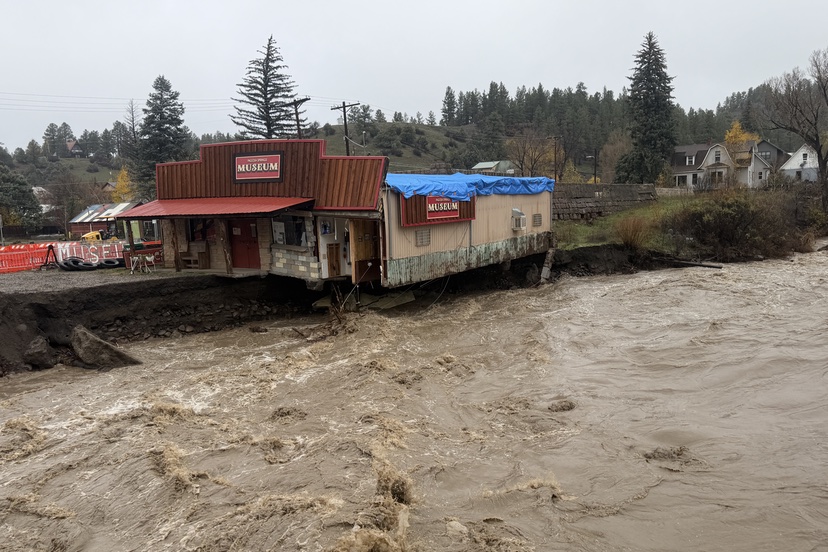
Volunteers were able to salvage some — perhaps most? — of the objects from the Pagosa Springs History Museum and move them to a mini-storage for the time being. A story in the weekly Pagosa Springs SUN quoted Museum president David Hamilton:
“I’m really pleased with what we’ve been able to save… Back in the 1970s, our forefathers thought that it would be valuable to have a museum. With their sweat labor, they put together that museum. I feel like we need to continue in their footsteps and make sure we get this rebuilt somewhere, somehow, so that we can continue the legacy they set before us…”
From the Museum website:
We are in the process of saving as much of the museum contents before the museum falls into the San Juan River. We are also planning to rebuild the museum and would appreciate donations of any monetary value. Donations can be sent directly to our PO Box 1711, Pagosa Springs, CO 81147.
You can also click the ‘Donate Here’ button on their website.
The Pagosa Springs community made it through a dry summer in 2026 with relatively little snow melt coming out of the mountains. Pagosa Area Water and Sanitation District (PAWSD) had imposed restrictions on outdoor watering, partly to keep the water level up in Lake Hatcher. Hatcher is the community’s primary water reservoir as well as being a popular recreational amenity for residents living within the Pagosa Lakes Property Owners Association (PLPOA), so it’s a balancing act — drinking water? recreation? — when drought conditions set in.
Lake Hatcher is not our largest reservoir. That honor goes to Stevens Reservoir, but Stevens is not directly connected to any PAWSD treatment plant. PAWSD is currently working on plans to connect Stevens Reservoir to Lake Hatcher with a pipeline that will triple the amount of stored water available at the Hatcher treatment plant.

Reportedly, the local water reservoirs are now full, thanks to a rainy autumn. We didn’t really need them full at this point, however, because PAWSD water demand is much lower during the winter months. Even without excessive autumn rains, the reservoirs are typically full by May or June from spring runoff.
But what we experienced in Pagosa Springs as “too much water” did not solve the water problems elsewhere in the American Southwest.
From a New York Times article by Scott Dance, November 4, 2026.
Floods have overwhelmed parts of the parched American Southwest in recent days and weeks, pouring water into critically low reservoirs.
But the deluge did little to ease worries over the water crisis that required significant limits on usage across the Colorado River basin earlier this year.
Instead, it exemplified a sort of weather whiplash that is becoming more common as the climate warms, making it harder to maintain a stable water supply for the West…
Water levels have risen sharply in Lake Powell, the nation’s second-largest reservoir, which straddles the Utah-Arizona border. The lake’s surface rose by nearly 16 feet from mid-September through the end of October. Lake Powell is expected to continue to rise once floods that hit parts of Colorado and Arizona last weekend flow downstream…
However, Lake Powell remains less than 26 percent full. It will take years of rainy and snowy weather, along with continuing water conservation measures, to replenish it to the high levels seen back during the 1980s.
The Colorado River’s flow has diminished by about 20 percent over the past two decades.
Maybe we can put “20 percent” into some kind of perspective, considering the central importance of water in Colorado and the Southwest…
…beginning with a personal story. Our house in downtown Pagosa Springs was impacted in a relatively minor way by the November 1-2 flood event. Although a good number of homes experienced major or minor water damage from the flood, the impact at my house was limited to loss of PAWSD drinking water service from about three days. We had been warned, however, about the possible shutoff, and we’d filled the bathtub and various large containers with drinking water before the flood peak hit on November 1.
Naturally, we were limited in our use of water. No showers. No laundry. Dishes were washed using as little water as possible.
I was shocked by how little water a household actually needs to stay reasonably clean and nourished over a three-day period. When water was restored, we still had a dozen full water containers. We could easily have gone a week without running water and still felt like reasonably civilized people.
About 25% of Archuleta County residents are not connected to the municipal PAWSD water system. Many have wells; many more truck in water from PAWSD fill stations.
My family has always lived downtown and always been served by PAWSD water, so I don’t have much experience with depending on a water cistern and how people might ration water in that situation. My three days of carefully rationing water helped me appreciate water conservation and how folks might be practicing it already, in many Archuleta County households.
Which brings me to a question I’ve posed before here in the Daily Post:
How much water do Americans really need?
That’s an important question right now. Although the record floods in the Southwest this year have partically made up for the shortage of snow last winter, and have boosted reservoir storage downstream at Lake Power and Lake Mead and Navajo Lake, and in other reservoirs across the Southwest… the folks who study climate trends continue to warn us about a lack of water in the Colorado River Basin.
How much water… do we need?
Read Part Two… tomorrow…
Bill Hudson began sharing his opinions in the Pagosa Daily Post in 2004 and can't seem to break the habit. He claims that, in Pagosa Springs, opinions are like pickup trucks: everybody has one.