
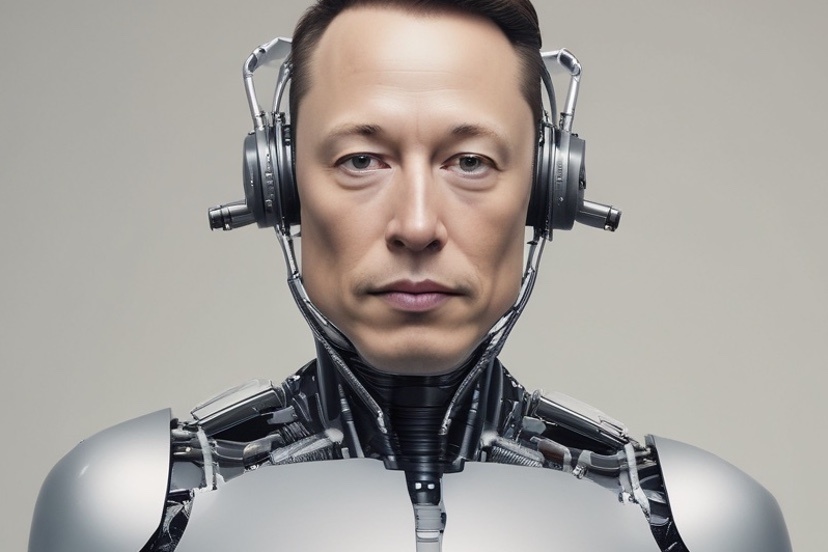
I used to be something of a ‘collector of books’. There was a period when I bought a book or two, every week. It’s probably not a coincidence that, during this period of exorbitant literary consumption, my marriage to Darlene was coming to a messy end.
Whether the dissolving marriage was the cause of my obsessive book buying, or whether the lavish book purchases were negatively affecting the marriage, I can’t rightly say.
Along the way, however, I collected nearly all the stories written by famed science fiction writer Isaac Asimov.
I no longer buy books obsessively. So far this year, I’ve bought just one book. “Healing Back Pain Naturally”. One of the leading causes of back pain, I learned, is prolonged sitting, and reading.
In fact, I’ve been cutting back on all types of consumption. For one thing, everything has gotten so damned expensive. But also, unbridled consumption is ruining the planet. As we all know.
Maybe it’s actually a good thing that stuff is getting more expensive? I make fewer trips to the store, that’s for sure. Saves on gas. I only had to fill my tank once last month.
And I’ve actually started a savings account. At the rate things are going, my children might inherit several hundred dollars each, when I die.
Which brings us around to the subject at hand. Robots.
Isaac Asimov arrived in America, from Petrovichi, Russia, in 1923 as a three-year-old, and was introduced to science fiction at age 9, thanks to the fact that his parents’ candy store in Brooklyn sold various newspapers and magazines, including the pulp science fiction magazines that had become popular during the 1920s.
During his life, he wrote or edited over 500 books.
His second book, published in 1950, bore the title “I, Robot” — a collection of nine short stories about robots that had been published between 1940 and 1950 in Super Science Stories and Astounding Science Fiction.
Of course, robots did not yet exist in 1950, but everyone could see the writing on the wall.
Soon enough, we would be served by robotic vacuum cleaners and lawn mowers, and corporations would be assembling products using robots large and small.
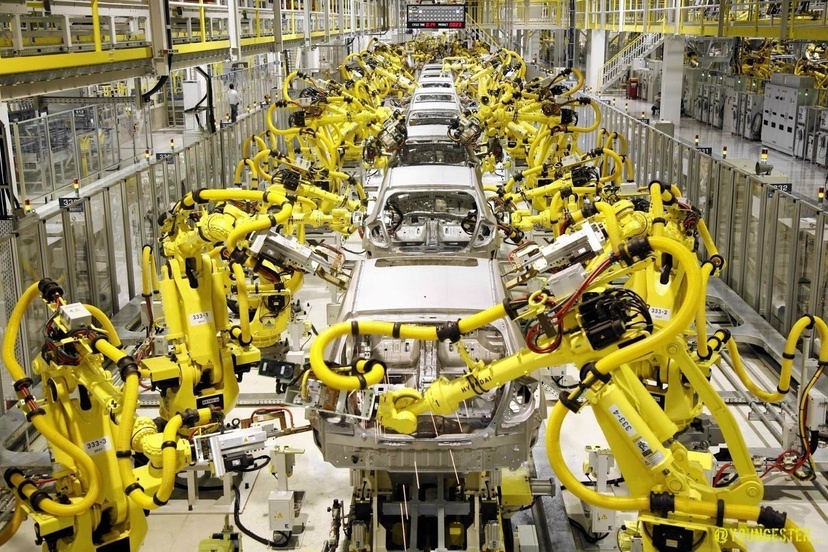
We’ve only recently, however, entered the phase where robots can walk and talk, like the robots portrayed in I, Robot.
So this is probably a good time to review the “Three Laws of Robotics” that Issac Asimov developed back in the 1940s. In “I, Robot” all the fictional robot characters had the three laws programmed into their positronic brains, as a safety feature.
The Three Laws, from the fictional “Handbook of Robotics, 56th Edition, 2058 A.D.”:
- A robot may not injure a human being or, through inaction, allow a human being to come to harm.
- A robot must obey the orders given it by human beings except where such orders would conflict with the First Law.
- A robot must protect its own existence as long as such protection does not conflict with the First or Second Law.
Law Number 1, we should all find welcome. It’s bad enough that we humans so often fail to follow this Law. We don’t need robots to go around injuring humans. We can do that on our own.
I also really liked Law Number 2, on first reading. I’d like to live in a world where every robot instantly obeyed my orders, just because I was a human. That certainly never happened with my own kids.
But then I thought about it some more, and realized that anybody could give a robot orders, and the robot would have to obey. But what if it were my robot? I can imagine situations — knowing humans as I do — where I would not want certain people to be giving orders to my robot.
Not to mention any names, but you know what I mean.
So we have to go back to Law Number 1. What exactly does it mean when we program the robot to “not injure a human being”? Obviously, the robot is not allowed to step on my toe, or slam me against the wall, or push me out a third-story window.
But “injury” doesn’t necessarily mean “bodily injury”. Like… what if I were, say, a columnist for an online news magazine… and a robot came along and took my job?
Or say I was married, and a robot took my wife?
That would not be pleasant. I would, in fact, put it in the category of “injury”.
I haven’t heard any stories of robots taking people’s wives, but I’ve sure seen news stories where robots have taken people’s jobs.
It’s been going on for a while now. And it’s getting worse.
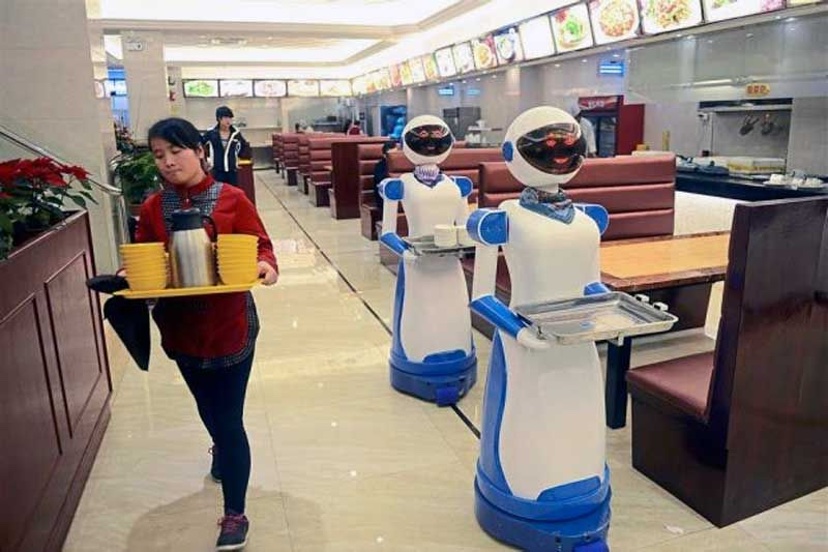
When you lose your job to a robot, I imagine it would affect your income. You might not be able to buy as many books, for example. Or clothes. Or consumer electronics.
Maybe you can see where I’m going with this.
As we humans become increasingly impoverished — having lost our jobs to robots — we will no longer be able to support the consumption-driven capitalist economy in which we live.
So, seems to me, there’s only one feasible solution to keeping the wheels of industry turning.
They will have to start teaching robots to consume.
Some day, fairly soon, there will be robots with book collections that put my personal library to shame.
Underrated writer Louis Cannon grew up in the vast American West, although his ex-wife, given the slightest opportunity, will deny that he ever grew up at all. You can read more stories on his Substack account.