
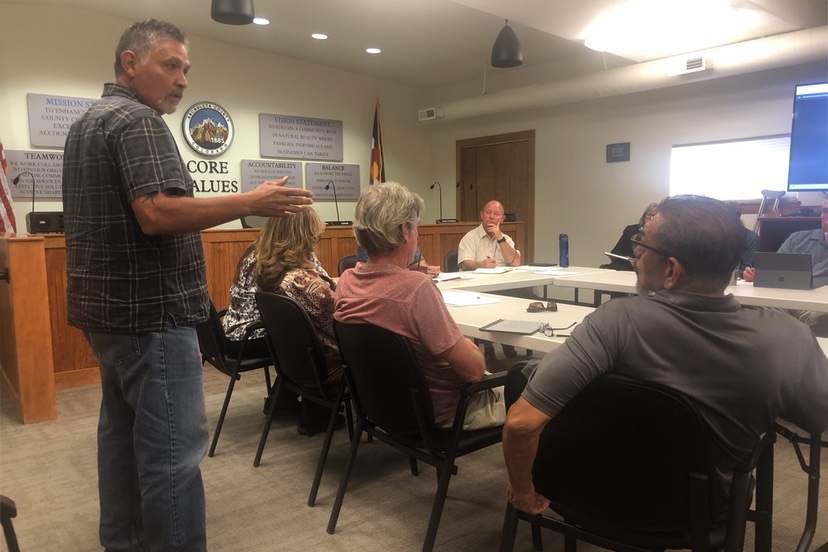
Photo: Archuleta County Housing Authority president Clifford Lucero addresses a joint meeting of the Board of County Commissioners and the Town Council, August 24, 2026.
If we want the community to be “educated” about the housing crisis and possible solutions, one way to attract their attention might be through open and honest controversy.
For example, by engaging in reasonable public debates?
Debates can be an incidental form of entertainment, as well as being an exploration of possible options.
While County Commissioners Veronica Medina and Warren Brown exchanged differing views about one of the 22 “actions” suggested in the draft Housing Action Plan, the members of the Pagosa Springs Town Council who attended the joint work session were generally just listening politely.
The HAP draft had been written by consultants from ECOnorthwest and Western Spaces LLC — which you can download here.
The disagreement seemed mainly to be between commissioners Brown and Medina:
4.2 Create a multi-jurisdictional housing authority and fund a formal housing coordinator.
Timeline: Short, 1-3 years
Housing Needs Addressed: A multi-jurisdictional housing authority could focus on the gap for households between 60-120% of AMI, and additional resources not currently covered by existing organizations.
Commissioner Medina contended vigorously that the existing Archuleta County Housing Authority is able to effectively handle this job — or is already handling it.
The fact is, however, that ACHA has focused all of its efforts on housing for household earning less than 60% of the AMI (Area Median Income). The HAP consultants are talking about ‘missing middle” housing — projects for households earning between 60% and 120% AMI that do not qualify for most state and federal subsidies.
That fact did not prevent ACHA board president Clifford Lucero from requesting permission to speak, and defend the work being done by ACHA. Normally, joint Town-County work session do not allow time for comments from the public, but Commissioner John Ranson said he wanted to hear from Mr. Lucero.
Clifford Lucero addressed the implication that ACHA does not have the staff capacity to handle the job suggested in the draft HAP.
“We’ve talked about ‘capacity’ and [ACHA] does have the capacity to do these things [in the HAP]. Some of the prjects we’ve done… obviously, we’ve done Rose Mountain, we just did a $1 million remodel at Casa de los Arcos facility, we helped with the project near Walmart, we’re working on a project near the McDonald’s — we’re trying to help a group purchase that building.
“We’ve got a non-profit management company now — 8th Street Management…
“We have the capacity. I mean, you guys are more than welcome to sit down with us and talk about what we can do… see what we can do…
“$400,000 homes — I consider those to be ‘spec homes’… and that’s what [Pagosa Springs Community Development Corporation] is doing, and that’s great. That Prop 123 money they got, that’s wonderful. I’m thankful we have some more homes in the community.
“There are other builders in the community building homes in that price range. A lot bigger, and for a lot cheaper, too. So we’ve got to realize that.
“But does the Housing Authority have the capacity? We absolutely have the capacity…”
Some folks may be able to read between the lines and understand that ACHA and PSCDC are in a competition to see who can most successfully support the local housing effort.
While I was serving on the HAP advisory committee this past year, I argued that housing for households earning 120% AMI — that is to say, households that earn 20% more than the average Archuleta County households — ought not be a priority for government subsidized programs.
Wealthy families already have advantages that workers in our low-wage tourism economy do not have.
A worker earning a typical tourism industry wage — $29,000 a year — who is also paying 50% of their income for housing, cannot easily afford a visit to the doctor, or childcare, or other advantages that wealthy families may enjoy. If we are going to spend tax money on housing programs — I argued — let’s help the folks who really need the help.
Most of the HAP advisory committee did not agree with my perspective, arguing that subsidy programs — like LIHTC (Low Income Housing Tax Credit) programs and Section 8 Vouchers —already exist for households earning less than 60% AMI but not for folks who earn more than the average local income. So local efforts ought to aim at higher income levels.
A difference of opinions, obviously, about who ought to receive government subsidies, and where we ought to focus our energies and priorities.
In my humble opinion, part of this disagreement about who needs our help, and where our priorities ought to lie, derives from a shift in what might be called “philosophy of life.”
Basically, there are two very different reasons for helping a person, less fortunate than myself, obtain safe, secure, affordable shelter. One reason is altruistic; the other is essentially self-serving.
1. I care about people who are struggling.
2. I will help ensure that my community has enough employees to serve my personal needs.
Often, the arguments I hear coming from housing advocates in Pagosa Springs focus on the second of those reasons. That is to say, the “self-serving economic argument.”
“We need housing for doctors, teachers, police officers, firemen… to serve us…”
In other words, let’s take care of the “higher status” employees.
Almost never do I hear housing advocates mention short-order cooks or motel housekeepers or the folks who work the evening shift stocking grocery store shelves.
But it remains an “economic” argument, no matter what type of workers you want the housing programs to serve. Due to this trend, the term “affordable housing” has gone out of fashion, and been replaced by “workforce housing”.
I believe there’s a “non-economic” reason for helping your neighbors.
A powerful non-economic reason. Simply, because you love your neighbor as yourself.
Bill Hudson began sharing his opinions in the Pagosa Daily Post in 2004 and can't seem to break the habit. He claims that, in Pagosa Springs, opinions are like pickup trucks: everybody has one.