
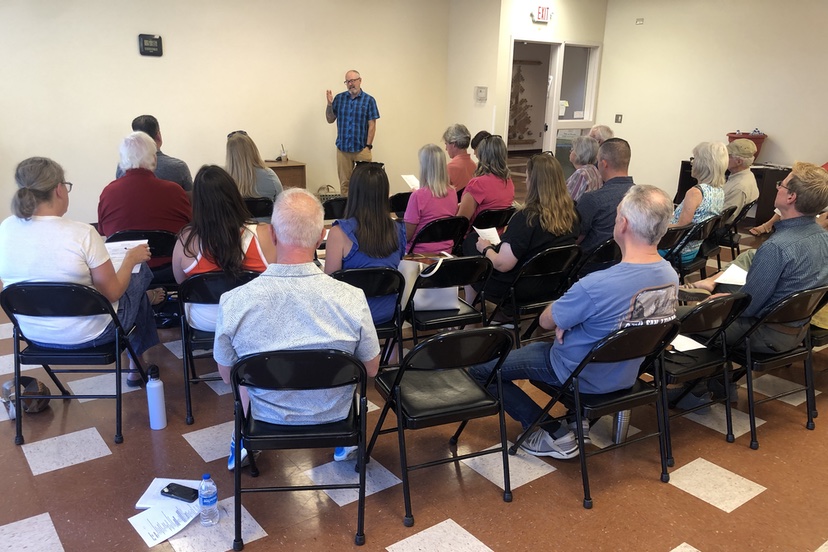
Photo: Archuleta School District Superintendent Rick Holt shares information about school facilities at the initial “Citizens for ASD” campaign meeting, August 17, 2026.
As mentioned yesterday in Part Four, a campaign meeting was held on Monday evening, August 17 at the Ross Aragon Community Center, led by local activist Lisa Scott. The meeting was lightly attended.
A few days earlier, an invitation to this meeting had been emailed to the members of the Master Plan Advisory Committee (MPAC) letting them know that the time had arrived to begin organizing, to promote a November ballot measure aimed at funding a $130 million PreK-8 facility on Vista Boulevard at the west end of town.
The meeting was originally scheduled to be held at the Middle School library. Then another email arrived, announcing a new location, at the Community Center…
…and the meeting was no longer an “MPAC” meeting but rather, a meeting for the “Citizens for ASD” campaign.
About 25 people showed up at the Community Center on Monday evening, and I recognized some of the audience as “MPAC” committee members. I also saw people in the audience who were not MPAC members.
I served on the MPAC in early 2025. That committee of 25-30 people met four times between January and April to consider the District’s facility needs, and advise the ASD Board of Education on whether to pursue a bond measure for new facilities. The meetings were led by Colorado-Springs-based RTA Architects.
It was obvious to me, from the very first meeting, that the information being provided to the MPAC was strongly biased in favor of a future bond measure. Over the next four months, the committee never seriously discussed any alternatives other than new school facilities.
I also currently serve on the Pagosa Peak Open School (PPOS) board of directors, and the ASD leadership made it clear, during those four months, that certain PPOS facility needs would be included in any future bond measure placed before the voters. I mention those facts, in the interest of transparency.
Lisa Scott kicked off the Monday evening discussion by reminding everyone that ASD staff — teachers, principals, counselors, bus drivers, etc. — could not campaign in favor of a potential bond measure during their normal work hours, but were free to promote the bond issue outside of work hours.
A few of the people in attendance were indeed ASD staff.
Ms. Scott’s comments may have been aimed at addressing legal requirements controlling how governments must handle election campaigning, and might help explain why the meeting was moved from the Middle School library, and why the meeting was no longer an “MPAC meeting” but was now a “Citizens for ASD meeting”.
Once a school board (or any other government board) decides to place a measure on the ballot, the government can no longer use taxpayer-funded resources to promote a “Yes” vote on the ballot measure. The ASD Board of Education voted on August 5 to place a measure on the November ballot, so any campaigning in favor of that measure must now be handled by an ‘independent’ campaign committee.
Any official information coming from ASD itself must be “unbiased information”, from this point on.
Ms. Scott also noted that the final ballot language has not yet been approved by the School Board. That approval will supposedly happen at the next Board meeting. As a result, we do not know exactly what the District will be proposing and how much it will cost, nor is the “campaign committee” able to begin printing flyers and posters and information packets, or buying newspaper ads, or posting on social media…
Ms. Scott suggested that the “Yes” campaign would cost around $12,000, to be funded by donations.
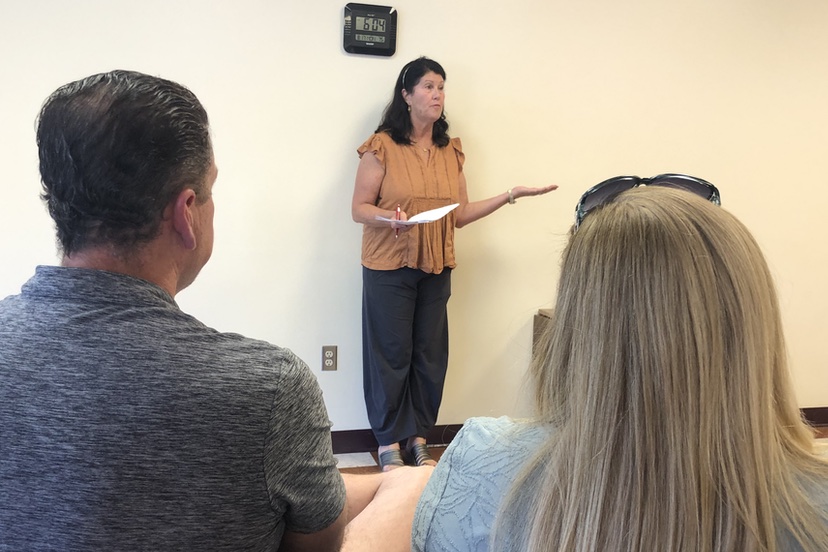
Ms. Scott then invited ASD Superintendent Rick Holt to share some information about the potential bond measure, given that certain details are yet to be decided.
It turned out that quite a bit could be shared, but most of it concerned the high cost of repairing and upgrading the current Elementary School and Middle School.
But before we get into those high costs, we can hear about the high cost of building a new facility.
Back in early 2025, the MPAC group had voted almost unanimously to recommend, to the School Board, that they place a bond measure on a future ballot for a new PreK-8 facility. RTA Architects had subsequently estimated the cost of the facility at $126 million.
About $50 million could possibly be provided by the Colorado Department of Education BEST grant program, leaving Archuleta County property owners to fund the remaining $76 million with a property tax increase. Due to the requirements in the Colorado Constitution, the District must include in the ballot language the full cost of the bonds, including the interest payments.
At the Monday meeting, Mr. Holt explained that the cost of the facility has increased by perhaps 3% since 2025 due to inflation. According to my pocket calculator, that would put the cost at $130 million. If BEST provided $50 million, then local taxpayers would need to provide about $80 million…
…but ASD also wants to provide $1.7 million to PPOS for building upgrades. So then, closer to $82 million?
…making the total property tax burden, when you include the interest payments, about $130 million.
I’m shooting in the dark here, because even the School Board doesn’t have the exact cost numbers yet.
As I mentioned already, I currently serve on the PPOS board of directors. PPOS is a charter school, but — as a tuition-free, tax-funded school — it’s officially authorized by the Archuleta School District. The promise expressed by Mr. Holt on Monday — that $1.7 million in facility upgrades at PPOS would be rolled into the November bond measure — means a great deal to the PPOS board and staff.
Nevertheless, I have been making a case to ASD board members and fellow MPAC members — since January 2025 — that the voters in our community are unlikely to pass a $130 million tax increase for a new school on Vista Boulevard, when our existing school facilities are functioning reasonably well, and could all be repaired and upgraded to better condition for perhaps $20 million, through a simple increase to the existing Mill Levy Override.
And we wouldn’t be paying millions of dollars of interest to investment bankers, on a massive new debt.
Bill Hudson began sharing his opinions in the Pagosa Daily Post in 2004 and can't seem to break the habit. He claims that, in Pagosa Springs, opinions are like pickup trucks: everybody has one.