

For nearly all of human history, the Earth has been flat, and everyone knew it was flat.
A conspiracy theory began circulating in Greece in around 300 BC, claiming that the Earth was a sphere, and gradually more and more people came to believe this theory.
The Chinese were able to securely hold on to the knowledge that the Earth was flat until about 1648.
Nowadays, it seems like 99% of Americans believe the Earth is spherical, and that it orbits the Sun.
But before the Greeks came along with their fancy new theory, 99% of people believed that the Earth was flat, and that the Sun circled the Earth. In those early, innocent times, we knew that the Earth was the center of the universe, and the Sun, Moon, and Stars existed mainly so we could calculate our horoscopes accurately.
How far we have fallen.

Luckily, a small cadre of scientifically-minded individuals from around the world have been debating the key reasons why the government wants us to believe in a spherical Earth, on the website TheFlatEarthSociety.org.
(Using the phrase “around the world” metaphorically, of course.)
The debates on the FES user forum can get heated, as you can imagine. When you know for certain that the Earth is flat, and 99% of the people around you mistakenly think it’s spherical, it’s easy to feel discouraged, and defensive, and even angry.
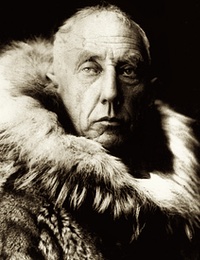
One of the more interesting debates I came across yesterday concerned Roald Amundsen, the Norwegian explorer who mistakenly believed he had reached the South Pole in 1911. But he couldn’t have reached the South Pole because a flat Earth doesn’t have a South Pole. He had actually reached the North Pole by mistake.
If you mistakenly thought the North Pole was the South Pole, and you then go looking for the North Pole, you simply fall off the edge. Which Amundsen eventually did, when trying to reach the North Pole. He disappeared mysteriously without a trace left behind.
The guy discussing this sad story about Roald Amundsen, in the FES forum, was also Norwegian and apologized for his ‘crappy’ English, which I found to be relatively coherent. He said he had spent 5 years developing his theory about why Amundsen thought he had reached the South Pole (when it was actually the North Pole) and why he disappeared when trying to reach the North Pole (which was actually not the North Pole but rather the ‘ice wall’ that keeps people from falling off the edge unless they are careless. Which Amundsen apparently was. Careless.)
We don’t have the same debate around taxes, however. It’s a different kind of debate.
Everyone knows that flat tax rates exist, with everyone paying the same percentage. Colorado’s state income tax, for example. Everyone pays 4.4% of their taxable income.
And also, everyone knows that progressive tax rates exist. Graduated tax rates, where the poorest people pay little or nothing, and rich people — who have too much money in the first place — pay a higher rate.
U.S. income taxes are progressive, for example. Which I prefer to call, “spherical”.
The world of taxation can be both flat and spherical, depending on where you’re standing.
This November, Colorado voters might be able to decide for ourselves between flat and spherical.
Activists have reportedly gathered more than 157,000 signatures in support of Initiative 195 and submitted them to the Colorado Secretary of State, as of yesterday.
To qualify for the November ballot, at least 124,238 of those signatures must represent valid Colorado voters who are still alive.
If approved for the ballot, and if approved by the voters in November, Initiative 195 would decrease Colorado income taxes slightly for about 97% of residents, but would increase the tax rate for residents earning more than $500,000 a year.
This would create a progressive income tax rate for Colorado, in line with many Democratic-leaning states.
I personally don’t have any friends who earn $500,000 a year or more, so I could vote ‘Yes’ and it wouldn’t really matter.
But there’s a catch. The Advance Colorado Institute has qualified a measure for the November ballot that specifically keeps the Colorado income tax at 4.4%.
So if Initiative 195 qualifies, we will have a choice to either keep the flat tax, or sock it to rich people. Whichever measure gets the most ‘Yes’ votes will win the election.
Whether you believe in Flat Earth or Spherical Earth, probably has no bearing on how rich you end up being.
Flat or Spherical taxes? Well, are you part of the 97% who might get a slight tax break?
I sure as heck am.
Underrated writer Louis Cannon grew up in the vast American West, although his ex-wife, given the slightest opportunity, will deny that he ever grew up at all. You can read more stories on his Substack account.