
Archuleta County continues to grow, welcoming more than 1,000 residents (roughly 9%) since 2017, with population projected to reach about 16,218 by 2035…
— online information about the Wednesday, August 12 community meeting to be hosted by Archuleta County.
The official online hub for the Archuleta County Comprehensive Plan discusses a 2026 effort to update “the community’s long-range blueprint, establishing a clear, sustainable vision for how our county evolves over the coming years.”
This plan belongs to the community. Your local knowledge and perspectives are vital to ensuring this roadmap accurately reflects the priorities of those who live and work here. Please explore the site to review project materials, view maps, and provide feedback through our digital engagement tools…

The County’s existing plan, updated in 2017, is called a “Community Plan” but the new plan will be called a “Comprehensive Plan” and will aim to meet new requirements under Colorado legislation SB24-174 and Colorado Revised Statutes § 30-28-106. Together, these require Colorado counties to update their comprehensive plans — by December 31, 2026 — to include a “Water Supply Element” developed in consultation with local water providers, and a “Strategic Growth Element”.
From the County website:
The update will:
Refresh the vision, goals, and policies of the 2017 Community Plan to reflect recent growth and current community priorities.
Add a Water Supply Element that inventories water providers, water rights, and facilities, and connects water planning with future land use.
Add a Strategic Growth Element that encourages infill, discourages sprawl, and helps guide where and how the County grows.
Link the Plan to the County’s recent Housing Needs Assessment, and the Housing Action Plan now underway.
Update maps, demographics, and data to support clear, evidence-based decisions.
It’s a bit misleading to state, however, that “Archuleta County continues to grow, welcoming more than 1,000 residents (roughly 9%) since 2017, with population projected to reach about 16,218 by 2035…”
For one thing, estimating population growth for a small town in the middle of nowhere is more an art than a science.
For another thing, the population of Archuleta County may have declined in 2024, and the possible decline is expected to continue through 2026, according to estimates by the Colorado State Demographer’s Office (SDO). Although the County cites an unidentified estimate of “16,218 by 2035” — the SDO projects a population of “15,125” by 2035.
Data through 2024 is shown in blue; later years are estimates shown in gray.
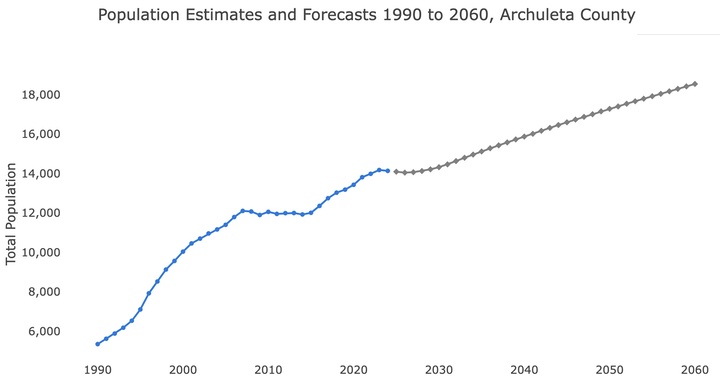
Looking at the roller coaster ride since 1990, we can safely assume that the years after 2026 will not be a steady-upward growth curve. Demographers cannot accurately predict the future, as has been thoroughly demonstrated by the SDO in the past. (And they don’t really expect to predict it accurately. Too many variables.)
Be that as it may, the County is asking citizens to participate in a brief survey to help justify the decisions to be made during the update. You can take the survey here.
I have a few problems with government surveys, in general.
One: Surveys often ask the public to express opinions about issues they only vaguely understand.
Two: The staff and elected leaders know that the public doesn’t fully understand the issues, so they typically ignore the survey results and take whatever they, themselves, believe is the right direction.
Three: The surveys are often carefully written to encourage only certain responses (that the staff and elected leaders endorse) and thus prevent transparent, unbiased results. But the public may not recognize that they are being ‘led’ into supporting certain policies, because they don’t fully understand the issues.
Four: When we’re dealing with complex social problems, who fully understands the issues, and the best solutions? Not the staff, not the elected leaders, not the media, not the public, not the consultants. In my opinion, government decision-making can be described as a process of constantly making the wrong decision and then trying to mitigate the damage.
Archuleta County spent a great deal of time and money creating their 47-page “2025-2028 Strategic Plan” (which you can download here.) That process entailed a survey of about 440 local residents, almost none of whom were under the age of 45.
From the County ‘Comprehensive Plan’ page:
Planning ahead helps ensure that as the County grows, residents keep access to a range of housing options, reliable infrastructure, a strong local economy, and the open spaces and recreation that make Archuleta County home.
Phase 1
Project Launch & Existing Conditions
Confirm the vision and goals and update the Plan’s data on population, housing, economy, land use, infrastructure, and natural hazards.
Phase 2
Community Engagement
Surveys, stakeholder conversations, and a community workshop and open house to gather input throughout the project.
ONGOING
Phase 3
Water Supply & Strategic Growth Elements
Develop the two new state-required elements, including water inventories and infill, as well as a greenfield growth analysis.
Phase 4
Draft Plan, Review & Adoption
Compile the updated Comprehensive Plan and present it to the Planning Commission and Board of County Commissioners for review and adoption.
Resources
Here are some useful documents, if you’re having trouble sleeping.
2017 Archuleta County Community Plan
2025 Regional Housing Needs Assessment
Pagosa Area Water and Sanitation District (PAWSD) Drought Management Plan
2025–2028 Archuleta County Strategic Plan
Some of these links were shared on the County’s ‘Comprehensive Plan’ web page.
I added the PAWSD documents, which I have reviewed in the past (acting as a PAWSD board member). I suspect that those two PAWSD documents contain most of the information the County’s consultants would need to complete the ‘Water Supply Element’ required by the state of Colorado, considering that PAWSD supplies drinking water and irrigation water to maybe 80% of the community.
We don’t want our government leaders paying out good money to consultants to ‘re-invent the wheel’. Right?