
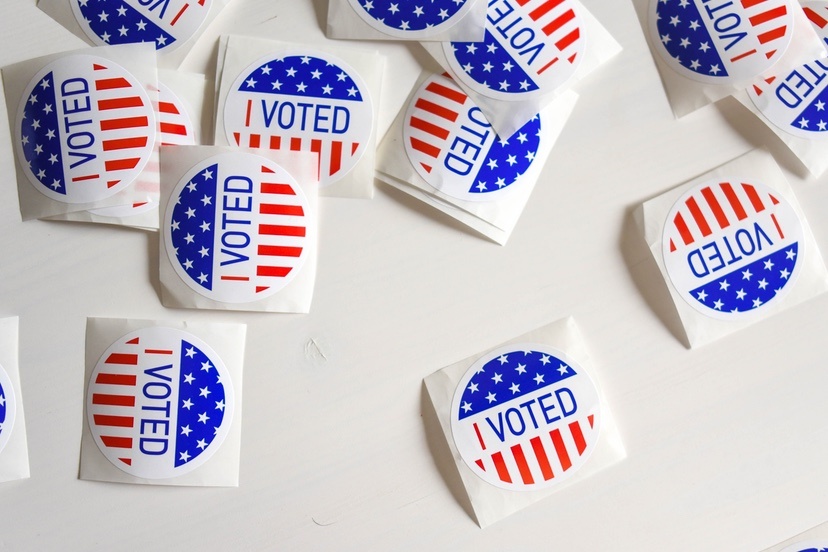
Don’t tell anyone, but I’m getting my hands on the voter registration rolls for the District of Columbia. And I can find out everyone’s name, address, birth year, political party, district and voting history…
— from “Whose Election Is It, Anyway?” by Donald F. Kettl on Governing.com, July 27, 2026.
Some of my friends have given up on the whole voting thing.
Not me. I vote every chance I get. My motto: “Vote early, and vote often.”
Ha ha. I’m joking about the “often” part. I will clearly state, for the record, (on the off chance that the Department of Justice is reading my columns) that I typically vote only once, per election.
But the question posed by journalist Donald F. Kettl yesterday, on Governing.com, made me think for a moment. Really, whose election is it?
I guess I always thought it was my election.
Mr. Kettl reminds us, however, that there’s a battle going on between the 50 state governments and the Trump administration over control of the upcoming midterm elections. I already knew about this fight, but I figured it would get sorted out, one way or the other, before November.
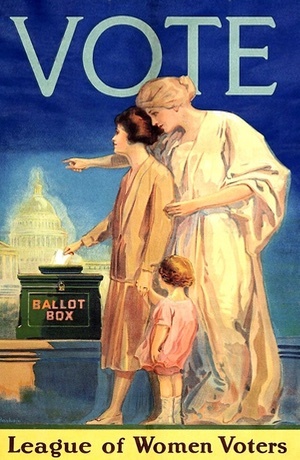
I found this League of Women Voters poster in the images archive here at the Daily Post, and I’m guessing it dates back to the first time American women were allowed to vote in a U.S. general election, which would presumably be the 1920 election, following the ratification of the 19th Amendment. That must have been something of a chores for local election clerks, because they suddenly had to print twice as many ballots.
Not twice as many were actually used, however. A lot of American women, in 1920, didn’t believe that women should vote. They thought their husbands (or boyfriends?) should make the important political decisions. I mean, who has time to pay attention to politics when you’re expected to maintain a household — preparing daily nutritious meals, cleaning, ironing, gardening, raising the children, and advising your best friend on marital issues?
A few things have to be left to the men, even though they will screw it up.
And indeed, the men had been screwing it up. And continue to do so.
As I understand it, the controversy around “whose election is it?” relates directly to the idea of a “federal government”. When the geniuses who wrote the U.S. Constitution wanted to get approval of that document, they were dealing with, essentially, 13 existing and separate state governments — run by men who thought they were pretty damned important people, having been elected to their state legislatures.
Not that I blame them. If I ever got elected to a state legislature, I would consider myself pretty damned important. I guess we all would.
At any rate, the only way the Founding Fathers were going to get the Constitution ratified by these self-important legislators was by sharply limiting the power of the federal government. In the Constitution, nearly all decision-making powers, and enforcement powers, were granted to the state governments. Basically, the federal government was in charge of handling wars. And a few other things, like tariffs, for example.
One very important point. The federal government was prohibited from directly taxing the citizens. Only states and local governments could directly tax us. Which was bad enough. But at least, without access to direct taxation — the Founding Fathers promised everyone — the federal government be unable to screw things up too badly. I mean, you can’t due much if all you’re collecting is tariffs. Right?
Among the things the federal government was not put in charge of: elections.
The Constitution, in 1788, was essentially a promise to the state legislators that they would have power over the politics in their individual states. The U.S. Congress and the U.S. President were almost, like, figureheads, with not a lot to do.
But if there’s one thing males seek, it’s the feeling that they’re in charge… of something. You can hardly expect a President to be happy when you tell him, “You really don’t need to do anything, unless maybe there’s a war or some tariffs to levy.”
Which helps explain why the U.S. has regularly had wars and tariffs.
My mother always advised me, “Louis, don’t make promises you can’t keep.” I’ve found that to be good advice, generally speaking, although I haven’t always followed it.
The Founding Fathers made a promise to the state governments. “Don’t worry, you guys are going to be in charge of almost everything. Cross our hearts, hope to die — you can safely ratify the Constitution. We’ve spelled it all out in plain English, in a written and signed document, using India ink.”
You can’t erase India ink. Believe me, I’ve tried.
But you can pretend it’s not there.
Anyway, all the state legislatures took the bait and ratified the Constitution. They didn’t think about the fact that the Founding Fathers were eventually going to die, and different men were going to take over the federal government and be, like, “Promises? What promises? We never made any promises. Those promises were made a long time ago, by guys who are all dead.”
Sure, the federal government still puts their pictures on our money, but that’s about the limit to the respect they get.
Underrated writer Louis Cannon grew up in the vast American West, although his ex-wife, given the slightest opportunity, will deny that he ever grew up at all. You can read more stories on his Substack account.