
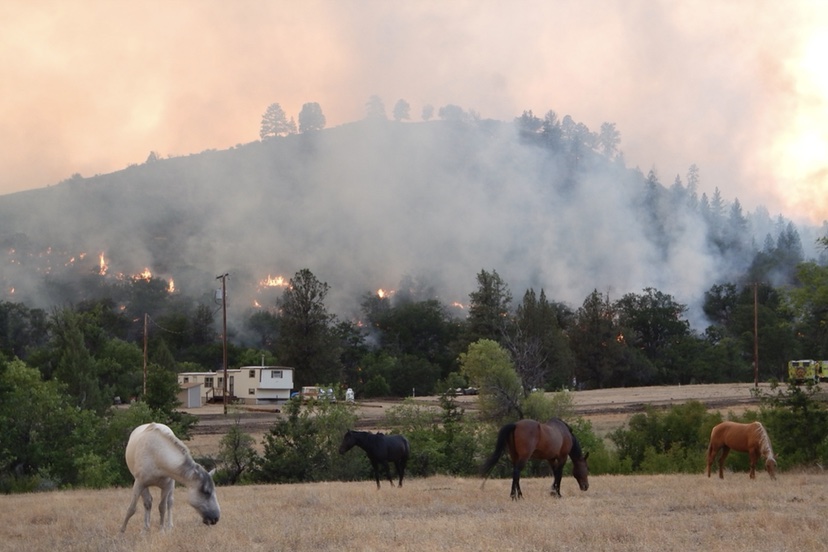
Photo: A family band of wild horses calmly graze wildfire fuels even as the deadly 2018 Klamathon Fire
approached. (William E. Simpson II, July 9, 2018)
For decades, Brazil has been rightly condemned around the world for burning vast tracts of the Amazon rainforest to create more pasture for cattle. The results have been catastrophic: massive biodiversity loss, destruction of Indigenous lands, enormous carbon releases, and the steady degradation of one of the planet’s most vital ecosystems. Cattle ranching accounts for approximately 80% of deforestation in the Amazon.
What few Americans understand is that our own federal land management agencies — the USDA Forest Service and the Department of the Interior — have been pursuing a remarkably similar strategy right here in the United States.
In 2019, I publicly challenged the Department of the Interior’s heavy reliance on prescribed burning as a primary fuel-reduction tool, noting that this approach mirrors the destructive cycle of clearing and burning forests to favor livestock production — exactly what Brazil has done at industrial scale.
The core problem is both simple and profound: invasive ruminant livestock (cattle and sheep) are among the worst species that can be introduced into a forest or wilderness ecosystem, while America’s only remaining non-ruminant native herbivore — the wild horse — is the best suited for the job. Yet current federal policy aggressively promotes the former and systematically removes the latter.
Unlike wild horses, cattle and sheep are ruminants whose digestive systems destroy most seeds. They compact fragile soils, damage riparian zones, spread invasive weeds, and overgraze vegetation that evolved under different grazing patterns. In designated wilderness areas — lands Congress set aside to remain largely natural — introducing or expanding domestic livestock represents a serious ecological mismatch.
For more than twelve years, I have lived among and studied a herd of approximately 200 free-roaming cultural-heritage wild horses using what I call the “Goodall Method.” I have documented that wild horses function as superior ecosystem engineers. As hindgut fermenters, they pass viable seeds and beneficial microbiome in their droppings, naturally reseeding wildfire-damaged landscapes, stabilizing soils, and reducing post-fire erosion that would otherwise choke mountain streams and destroy spawning gravels for trout and salmon.
In simple terms: wild horses “mow the lawn, fertilize it, and reseed it,” creating thriving conditions that benefit deer, elk, rabbits, pollinators, and countless other native species.
The current management approach is not only ecologically misguided — it is fiscally corrupt in its priorities. Analyses of U.S. Forest Service budgets show that suppression costs have consumed over 50% of the agency’s budget in recent years, while hazardous fuels reduction (prevention) receives a much smaller share. This structure creates a perverse incentive: the agency is better funded and politically supported when fires burn than when they are prevented.
In effect, wildfire has been monetized, with suppression contractors and bureaucratic overhead benefiting far more than the land or the public.
At the same time, federal policy continues its aggressive campaign against America’s wild horses — the one large-bodied herbivore perfectly adapted to function effectively in these sensitive wilderness landscapes. Through helicopter roundups, long-term off-range warehousing, and aggressive chemical fertility control, the agencies have removed tens of thousands of wild horses from the very places where they could provide the greatest benefit.
My own documentation during the 2018 Klamathon Fire proved the concept in real time. Areas grazed by wild horses created natural fuel breaks that slowed the fire’s advance, protected parts of the Cascade-Siskiyou National Monument, and helped safeguard nearby communities including the college town of Ashland, Oregon. These observations validated predictions I had made on camera two months earlier in the documentary Fuel, Fire and Wild Horses.
Instead of scaling this proven, low-cost, nature-based solution, the agencies continue to treat wild horses as a problem to be eliminated rather than the ally they truly are.
The human cost of this failed management is measured in tens of thousands of premature deaths every year from toxic wildfire smoke, hundreds of billions of dollars in annual economic damage, and the irreversible degradation of our forests, watersheds, and wildlife habitat.
A landmark UCLA study published in the journal Science Advances found that between 2008 and 2018, wildfire smoke PM2.5 caused between 52,480 and 55,710 premature deaths in California alone — an average of roughly 5,000 premature deaths per year in just one state — with an associated economic cost of $432 billion to $456 billion.
More recent research published by the American Chemical Society in December 2025 further revealed that wildland fires emit significantly more harmful organic compounds and volatile organic compounds (VOCs) than previously estimated — increasing the toxicity profile of wildfire smoke well beyond what current models account for.
This is not the result of climate change alone. It is the predictable outcome of policies that favor special interests and suppression budgets over ecological reality and public safety.
America does not need to keep repeating Brazil’s mistake. We already have the right animal for the job — the wild horse — and the real-world evidence to support its careful rewilding in appropriate wilderness areas.
What we lack is the political courage to move beyond outdated, livestock-biased management and embrace science-based, nature-aligned solutions.
The current management of America’s public forests and wilderness areas is not merely ineffective. It is ecologically illiterate, economically wasteful, and morally indefensible.
It is long past time for a fundamental course correction.
William E. Simpson II is a naturalist, author, and conservationist living in the Soda Mountain wilderness area among the wild horses that he studies. Learn more at Wild Horse Fire Brigade.