
Les Bonnets rouges de 1675 avaient des revendications sociales comparables à celles de leurs descendants du XXIe siècle…
— Le Peuple Breton magazine, October 2023.
I ran across a weird photo this past weekend.
I mean, the world is full of weird photos these days, some of which are “real” and some of which are imaginative creations that appear “real”.
It’s quite possible that the photo, above, illustrates a real sculpture that appeared in the U.S. Pavilion during the 2019 La Biennale di Venezia in Venice, Italy. Purportedly, the photo shows some actual humans looking at Big Phrygian — a sculpture created by American artist Martin Puryear. An artist I had never heard of.
I wondered why an artist I had never heard of, had been selected to represent my country at La Biennale di Venezia.
My wonderment led to the realization that, actually, I don’t know the names of any American artists — famous or non-famous — who are still alive. Jackson Pollock is gone. Andy Warhol is gone. Charles Schulz is gone.
Apparently, the U.S. has continued to produce artists, and I simply wasn’t paying attention.
For some reason, the photo of Big Phrygian — which, as noted, might be a real photo — left me feeling sad. The sculpture struck me as an abstract red blob with its head hanging in a posture of utter defeat. I had no idea that an abstract sculpture could appear so crestfallen and despondent.
Had I visited this sculpture in an art gallery, I would have immediately left the room. I don’t like to impose myself on grief-stricken individuals, even if they are just red blobs. Even looking at the photo made me feel uncomfortable. How the humans shown in the photo were able to remain in the room, standing barely an arm’s length from the suffering blob, I had no idea.
Things are not always what they seem, however.
Gratefully clicking away from the the disturbing photo, I realized that I not only knew nothing of the artist… I also knew nothing about the word “Phrygian”.
It sounded vaguely Greek. Or maybe Persian?
Turns out, it was a very popular style of hat, long ago, throughout Asian Minor… worn by Thracians, Dacians, Persians, Scythians, Trojans… and of course, by Phrygians, after whom it is named.
For example, the three wise men who visited the baby Jesus, bearing gifts, wore Phrygian caps.

Even goddesses were known to wear Phrygian caps.
Purportedly.
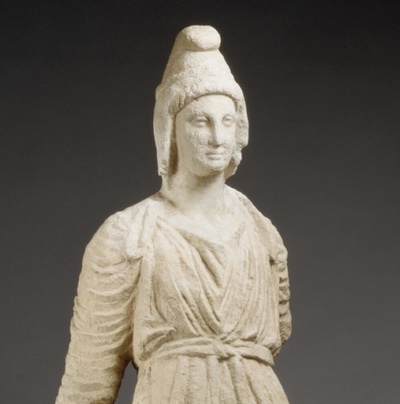
Here’s Bendis, Thracian goddess of the moon, wearing a Phrygian cap. Limestone Statue, c.350 BC.
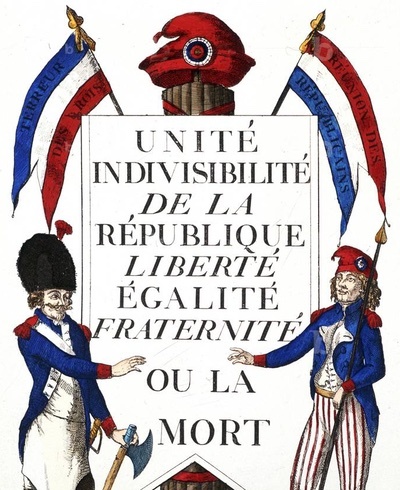
But the Phrygian cap also has a more recent history. Many of the revolutionaries who stormed the Bastille in 1789, at the beginning of the French Revolution, wore “les bonnets rouges”. Red Phrygian caps were a potent symbol of “Liberté, égalité, fraternité” — the motto of the French Republic.
Especially the “Liberté” part of the motto. Which is, after all, the most important part.
Voilà:
The Phrygian cap has made an appearance in other places. Sometimes inexplicably.
Curiously enough, a Phrygian cap appears on the seal of the United State Senate.
I will not attempt to offer an explanation.

Nor can I explain why all of the Smurfs — male and female — wear Phrygian caps.

I must assume, either the Smurfs place a high value on “Liberté” or else they originated in Asian Minor.
I’m hoping it’s the former explanation.
In closing, I will state how wonderfully relieved I feel about sculptor Martin Puryear’s installation at the 2019 La Biennale di Venezia in Venice, Italy. It wasn’t a depressed red blob, after all.
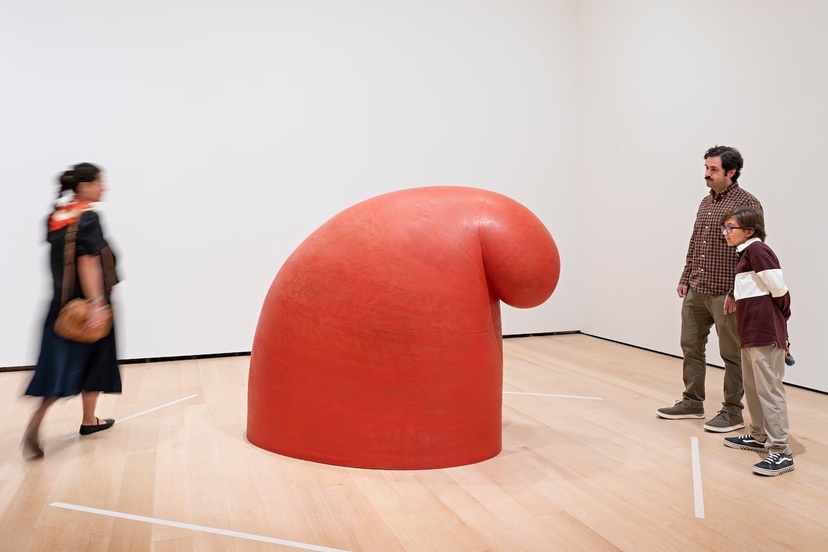
Presumably, the artist was making a symbolic appeal for “Liberté”.
For whatever reason, it appeared in the U.S. Pavilion, which might have been a mistake, considering everything. But it’s the thought that counts.
And one more closing thought. I kicked off this column with a brief quote from the October 2023 edition of Le Peuple Breton magazine:
Les Bonnets rouges de 1675 avaient des revendications sociales comparables à celles de leurs descendants du XXIe siècle…
It referred to the following photograph.

Make of it what you will.
And yet one more closing thought.
Little Phrygians.

Underrated writer Louis Cannon grew up in the vast American West, although his ex-wife, given the slightest opportunity, will deny that he ever grew up at all. You can read more stories on his Substack account.