
While researching this editorial series, I came across an interesting series of articles posted in the Daily Post in March 2021, written by Yours Truly, Bill Hudson.
Stories about where we live… our little town… as it appeared to me, five years ago.
The ten-part editorial bore the title, “A Conceptual Map of Pagosa Springs, March 2021.”
Although there are various was to map information, we typically think of “maps” as geographic representations available on our phones or computers, or in rare cases, printed on paper.
I had shared a couple of maps last week at the League of Women Voters (LWV) February meeting — during a panel discussion about the local housing crisis.
One of the maps looked like this:

What we are looking at is, basically, a topographical map of the suburban area southwest of Piedra Road and the County Airport, published by USGS in 1975. Left of center is Village Lake; at the very top is Lake Pagosa; Pinon Lake is to the right of center.
The red line is Highway 160,
The little black squares are buildings — mostly houses and a few commercial buildings. As we can see, the streets for what would soon become the residential core of Archuleta County — the Pagosa Lakes subdivisions — have been built. A 27-hole golf course would eventually occupy much of the white-colored part of the map.
In 1975, Archuleta County was home to about 3,000 people, with about half the community’s households living within the incorporated Town of Pagosa Springs, located 3 miles to the east of this area. 50 years later, the population would be about 14,500, and about 85% of the community would be living outside the town limits, with most living within the Pagosa Lakes subdivisions.
This population pattern is critical to our understanding of the current housing crisis.
Here’s another map I shared at the LWV meeting… also shared on Friday in Part Two. The large lavender-colored area — stretching from the Lake Hatcher subdivisions at the north to the Meadows subdivisions at the south — denotes the properties that belong to the Pagosa Lakes Property Owners Association (PLPOA).

The Town of Pagosa Springs, shown in orange, was once the “heart” of the community, and some people who live within the town limits truly believe that it’s still the “heart” of the community.
Although I live within the town limits, I’m not one of the true believers. 85% of the population lives outside the town, and except for motels, schools, and tourist gift shops, most of the business activity happens west of downtown, in the Pagosa Lakes area.
The housing regulations guiding development within the PLPOA — the CC&Rs (Covenants, Conditions and Restrictions) — were written in the early 1970s, with the goal of creating neighborhoods that would constantly appreciate in value, as suggested by this statement in the Pagosa Lakes Property Owners Association (PLPOA) 2020 Strategic Plan, (shared previously in Part Two):
It is critically important that owners are fully aware of the purpose of the Association and why one buys into such. The key factor is to protect property values by creating community guidelines by which all stakeholders operate. These governing criteria are what keeps communities like PLPOA aesthetically pleasing, focused on desired amenities and maintaining and enhancing property values…
How do you protect property values? For one thing, you can create CC&Rs that will prohibit most types of affordable housing within the 21-square miles of the Association. (The main exception being the Vista mobile home park, east of Vista Boulevard.)
Specifically, you can limit most of the neighborhoods to stick-built single-family homes.
In the 1970s, when the CC&Rs were being finalized, a modest stick-built single-family homes could be built for less than $100,000, and many working families bought affordable lots within the PLPOA and built reasonably affordable homes. Those homes did, indeed, appreciate in value.
Today, the value of a modest single-family house in the PLPOA is about $550,000.
For most working families in Archuleta County — if they’re new to the community, and didn’t buy a home prior to about 1999 — there are three types of housing that are relatively affordable.
RVs and tiny homes.
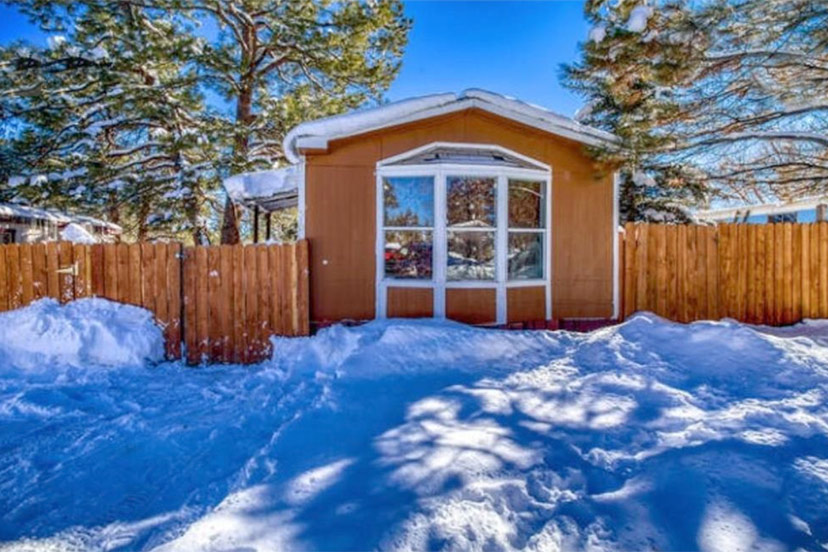
Mobile homes.
Employer-owned housing. (The Springs Resort has been buying up apartment buildings and motels, and converting them into employee housing. The catch is, if you choose to stop working for that employer, you lose your home. Good luck with that.)
Typically, apartments are not affordable, because we have a vacancy rate of about 0.5% — far below a healthy vacancy rate of about 7%. Owners of rentals can charge $2,500 a month and still be picky about who they rent to.
At the LWV panel discussion last week, County Commissioner Veronica Medina addressed the issue of RVs and tiny homes, which are allowed to be parked in rented slots in privately-owned and operated RV Parks, but which — for many many years — were prohibited as permanent dwellings on your own property.
In the midst of the COVID crisis, the Archuleta County Planning Department brought forward a resolution to the Board of County Commissioners, recognizing that hundreds of individuals and families were, in fact, living in RVs and tiny homes as their permanent dwellings, outside of permitted RV Parks — due in part to the fact that the BOCC had allowed more than 1,000 of the community’s single-family homes to be converted into vacation rentals, and also due in part to the fact that certain zoning districts did not have CC&Rs that prohibited RVs and tiny homes. Those “covenant-free” neighborhoods included Aspen Springs and Lower Blanco… two of the neighborhoods shown in bright green in this map:
The BOCC agreed that allowing people to live in RVs might be a good idea — as a “temporary measure”, in a community struggling to find workers.
As Commissioner Medina explained at the LWV meeting, it seems a violation of “private property rights” to prohibit property owners from using their property as they see fit — so long as they are not harming their neighbors.
But America has long ago determined that a family living in an RV, on Parcel A, will harm the “property value” of neighboring Parcel B.
And can we all agree that my neighbor’s “property value” is more important than a roof over my own family’s heads?