
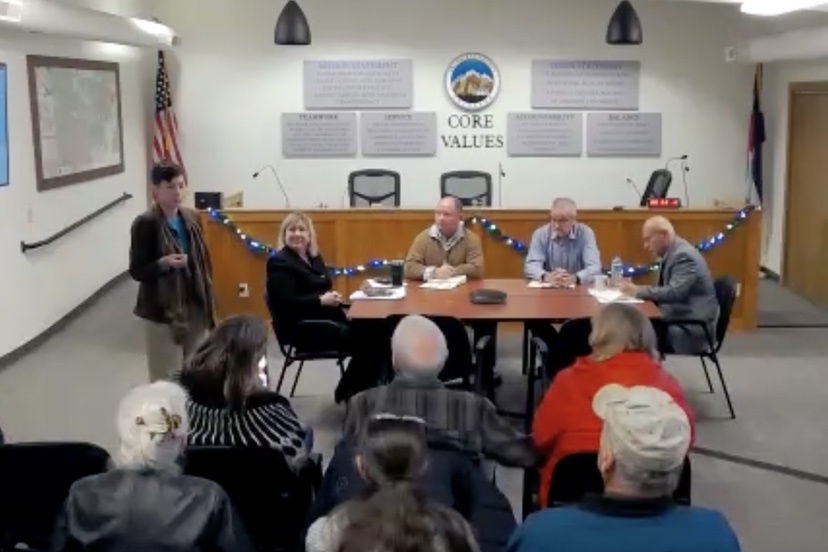
Screenshot from the December 9 Archuleta Board of County Commissioners meeting video.
At the conclusion of a three-way conversation between Archuleta County Commissioner John Ranson, La Plata Electric Association CEO Chris Hansen, and county resident Jack Barrett, County Commissioner Warren Brown invited people from the packed audience to share their thoughts on LPEA’s controversial high voltage line plans that involve Mr. Barrett’s property.
The home of Jack and Rosemary Barrett is located near the Piedra River, facing on Highway 160, and an existing LPEA high voltage power line passes very close to their house, and has been there since 1953. The home was built in 1959. LPEA plans to upgrade the power line from 69 kV (69,000 Volts) to 115 kV (115,000 Volts) to provide better service to Archuleta County.
Commissioner Ranson urged CEO Hansen and LPEA Board President Nicole Pitcher to divert the new power line across the highway onto a vacant parcel, and do so without charging the Barretts the estimated $300,000 cost for that diversion.
We then heard from the public.
The first member of the public to speak was local chiropractor Dean Sanna, who reminded the LPEA presenters that high voltage power lines are considered by many health professionals to be a health hazard.
Next to speak was Dale Schmidt.
“I have one question for La Plata. A big company. Millions and millions of dollars. My question is, what kind of profit are these guys making every year, where they’re going to come to a family and expecting them to pay for something that… if they’re making millions of dollars. So that’s what I want to know…”
Mr. Schmidt turned to Mr. Hansen and Ms. Pitcher.
“Do you know what your profit was last year?”
Mr. Hansen:
“We are a non-profit corporation. All of our profits are returned to our members.”
Mr. Schmidt:
“So, what does that mean? That we the people have to pay for that. Even though it was there in 1953. Things can be changed all the time.” He agreed with Mr. Sanna that high voltage lines should be considered a health hazard. “LPEA should figure that out. They’re a non-profit. All the members will make a little bit less.”
Just to be clear: the “members” of the LPEA cooperative are the customers: residents, schools, businesses, governments, hospitals, and so on.
We then heard from Hope Scheppelman from la Plata County. She stated she had previously lived in Archuleta County, and presented herself as a military veteran.
“I want to make sure our veterans are taken care of… When you have a big corporation that is coming in to take land from residents who have lived here for many, many years and have worked hard to keep that land, I want to ask Mr. Hansen. If this was your property, if this was your home, if this was the home where you raised your kids, if this was the home where you had your grandchildren running around, would you not fight for it?
“Would you not wonder why people are pushing against you?
“You guys are a multi-million-dollar corporation. Why don’t you put up the money?”
Commissioner Brown then allowed Kelly Hegarty to address the room via Zoom. Ms. Hegarty stated she lived in La Plata County and had a background in “oil and gas”. She urged the LPEA representatives to divert the power line at the co-op’s expense.
“Let me point out that LPEA invests time and resources into projects such as electric school buses and various community electrification programs. If we can commit staff, funding, attention to all those optional projects, those aren’t core responsibilities. A transmission line comes first. That’s where you pull your funds.
“I think we have a lot of decisions that are made by our LPEA Board and CEO that are part of broader ambitions…
“This gentleman has served his country. He deserves to stay in his home.”
Just to be clear: LPEA is willing to move the power line across the highway, but is expecting the Barretts to cover the additional costs for that relocation.
Perhaps $300,000.
LPEA Board President Nicole Pitcher, one of three Archuleta County representatives on the Board, spoke.
“Thank you all for being here. I know this is a really emotional topic.
“I just want to clarify that we’re not asking anyone to leave their home. That’s not what’s being discussed. There’s an existing power line and we’re upgrading it to a higher voltage, and that’s because, right now, Archuleta County is at the end of a cul-de-sac. We have one line [coming from Bayfield] and if a tree hits that one line, we will not have power for all our Pagosa Springs residents. We need another line to protect us from the almost inevitable [damage].
“We’re in a precarious position, strategically.
“And I want everyone to take ownership. La Plata Electric Association is us. We the People. It’s a cooperative.
“So when you say, ‘It’s taking money out of Chris Hansen’s pocket’ — no, it’s taking money out of every member’s pocket to pay for this [proposed diversion].
“That’s how we keep our rates low. You’re hearing about electricity prices going up all over the world. And we are not increasing our electric rates right now. We are not a ‘corporation’ that is responding to ‘shareholders’. We’re a cooperative that’s listening to our members.
“When you say, ‘We the People’… you are the cooperative. And when you say, who’s going to pay for it, it would be all of the members.”
Commissioner Veronica Medina, attending via Zoom, made a final appeal to LPEA to pay for the line diversion requested by the Barretts, out of the co-op’s budget.