
Photo: Chilling observations of the Boomerang Nebula captured by the Hubble Space Telescope in 2005. Credit: NASA, ESA and The Hubble Heritage Team.
Brandon Specktor, astrophysics editor at LiveScience.com, caught my attention with a scientist-verified claim that the universe is getting colder.
Everything I read or hear, coming from the Lamestream Media, warns that the world is getting warmer.
But if the entire universe is getting colder, maybe we should consider ourselves lucky.
According to Mr. Specktor — who seems like a decent kind of guy — a team of 175 researchers used temperature readings from a couple of European space telescopes to calculate the heat emitted by stardust in more than 2 million galaxies, and found that galaxies have, in general, grown slightly cooler over the past 10 billion years of cosmic history.
At the rate of cooling, the expiration date for the universe is somewhere between 33,000,000,000 years and 1,000,000,000,000,000,000,000,000,000,000,000,000,000,000,000,000,000,000,000,000,000,000,000,000,000,000 years.
I’m hoping it’s the larger number.
In related news, a different group of scientists have been studying the Boomerang Nebula, which is not only cool looking, but also might be the coolest place in the universe.
“Coolest”, as in “the coldest”.
The photos don’t make it look especially cold, but you can’t judge a nebula by its photo.
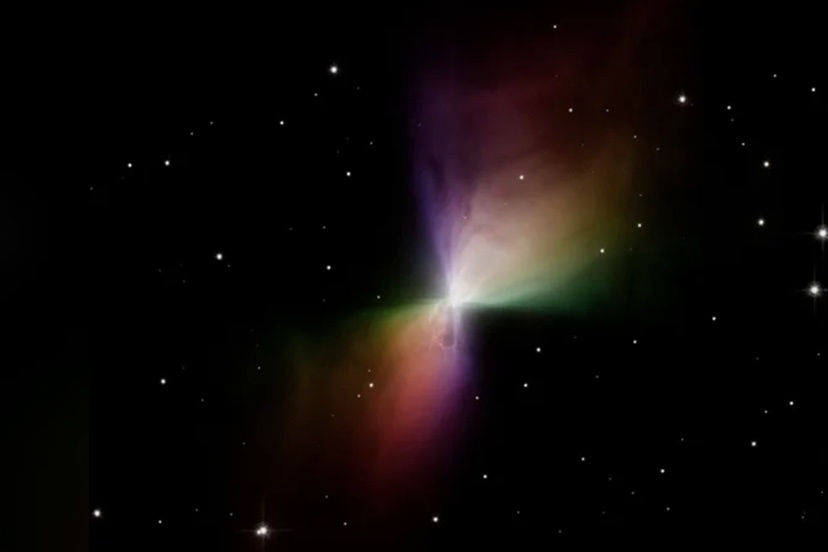
The Boomerang Nebula is located 5,000 light-years away in the constellation Centaurus. But ‘light-years’ mean very little if your telescope is big enough.
A bit of background, if you will excuse the pun.
Scientists have measured the Cosmic Microwave Background – the microwave radiation that fills all the “empty space” space in the observable universe — and have concluded that the average temperature of the universe is about -270°C. That’s quite cold, considering that nothing can ever be colder than “absolute zero”, which is −273°C.
For comparison, beer freezes at about -2°C, depending on the alcohol content.
There are some hot spots in the universe, of course. Our Sun being one of them. The temperature at the Sun’s core is 15,000,000°C, a particular level of warmth for which humanity has long been thankful, but not so much since we learned about climate change.
But we’re not talking about hot spots. The universe’s average temperature is still -270°C.
So how about the cold spots? For example, the Boomerang Nebula?
The Boomerang Nebula holds the title as the coldest place in the universe as the result of a 1995 study by astronomers Raghvendra Sahai and Lars-Åke Nyman, who used a big telescope in Chile to determine that the Nebula’s temperature is -272°C, making it just 1°C warmer than absolute zero.
Dr Sahai and his colleague Dr Nyman studied the Nebula — the result of a dying sun — and concluded that the sun is expelling mass, which is projected outwards and rapidly expanding, causing it to cool down to the extent that it is actually colder than space itself.
Which has me thinking… perhaps outside the box?
If we could somehow cause Planet Earth to expel mass that rapidly expands, maybe we could cool down this overheating world and stop sea level rise and other nuisances.
I personally can think of some mass that could be expelled, without most of us being the worse off for it, or even noticing that it’s gone.
Underrated writer Louis Cannon grew up in the vast American West, although his ex-wife, given the slightest opportunity, will deny that he ever grew up at all. You can read more stories on his Substack account.