
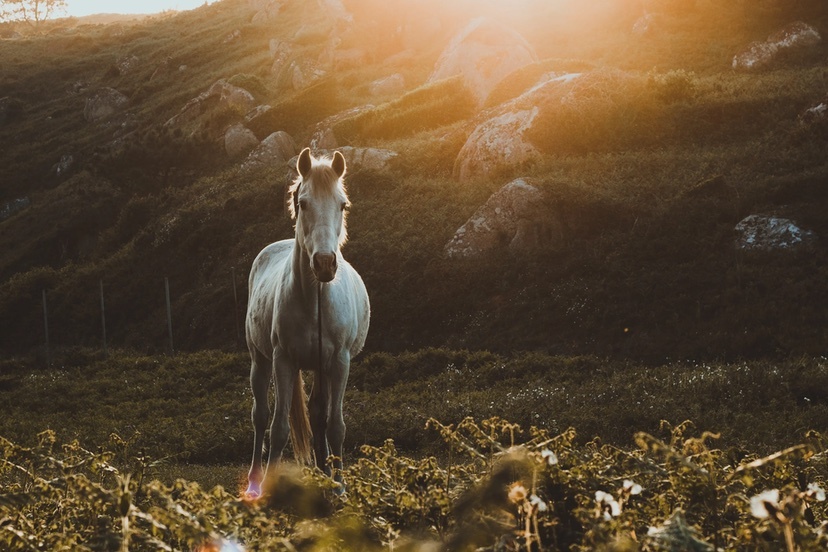
Over the weekend, I learned about chéngyǔ (成語) which are traditional Chinese expressions typically consisting of four to eight charters.
In particular, I was interested in the the chéngyǔ that’s written like this:
塞翁失馬,焉知非福
And pronounced like this:
Sài wēng shī mǎ, yān zhī fēi fú
And which can be translated this way:
Old man lost his horse, but it turned out alright
We know something about horses here in southern Colorado, although I think most of them are owned by women rather than by men. Usually, older women, with money. It’s not cheap to keep and feed a horse these days. Looks like alfalfa hay is running about $100 a bale at the moment, and a horse eats about 15 pounds of hay per day. And then you have to exercise the horse, which can be time consuming.
Horses were once work animals, but nowadays they are large pets.
Needless to say, I do not own a horse. But if I did own a horse, and it ran off, I would expect something good to come of it.
The chéngyǔ 塞翁失馬,焉知非福 references a famous Chinese parable dating back to the 2nd century BC, collected in the Huainanzi (淮南子), chapter 18. The parable’s title is sometimes translated as “Bad luck? Good luck? Who knows?”
I won’t bother sharing the Chinese version of the story — it begins with 夫禍富之 轉而相生, 其變難見也, but I suspect most of my readers can’t read Chinese. So here’s a translation:
Old Man of the Frontier Loses His Horse
Good luck and bad luck create each other and it is difficult to foresee their change.
A righteous man lived near the border. For no reason, his horse ran off into barbarian territory.
People felt sorry for him. But he said: “Who knows if that won’t bring good luck?”
Several months later, his horse came back with a group of noble barbarian horses.
People congratulated him. But he said: “Who knows if that won’t bring bad luck?”
Now his house was rich in horses, and his son loved riding. But the son fell and broke his leg.
People felt sorry for him. But he said: “Who knows if that won’t bring good luck?”
Several months later the barbarians invaded across the border. Adult men strung up their bows and went into battle.
Nine out of ten border residents were killed, but the son was not recruited because of his broken leg. Father and son both survived.
The moral: Bad luck brings good luck, and good luck brings bad luck.
This happens without end, and nobody can predict it.
In the 2nd century BC, the Chinese already knew that whatever happens depends on luck. Bad luck or good luck.
But they also knew that bad luck brings good luck, and vice versa. It’s a balancing act.
Many centuries later, some people who were not Chinese — we’re talking here about European scientists — came up with the idea that the universe functioned on the basis of immutable laws. What goes up must come down. For every action there’s an equal and opposite reaction. Positive and negative charged particles attract one another.
‘Luck’ kind of got lost in the shuffle. What was ‘luck’, anyway? Surely, everything that happened had a physical explanation behind it, if we looked hard enough. If a horse ran away, the horse had some reason for running off. Horses don’t just run off for no reason. Probably looking for a mate, if I know anything about how the world works.
To the Chinese in the 2nd century, however, horses did indeed run off for no reason. It was luck. It seemed to people like it was bad luck. But the old man knew better. Several months later, the horse returned with a bunch of good-looking friends. People thought it was good luck, but again, the old man knew better.
What we ought to notice here, is that “what seems like bad luck” turned into “what seemed like good luck” — but it took several months for the transition to take place. Bad luck doesn’t become good luck overnight. You need a measure of patience.
Like, when a certain person gets elected President. It might seem like good luck at first. (Depending on the color of your hat.) But several months later, the bad luck may arrive.
And if you thought the election was bad luck, just be patient. There’s a balancing act in progress. How long does it take for bad luck to become good luck? According to the Huainanzi, chapter 18, nobody can predict it.
But it’s guaranteed to happen. Sooner or later.
Underrated writer Louis Cannon grew up in the vast American West, although his ex-wife, given the slightest opportunity, will deny that he ever grew up at all. You can read more stories on his Substack account.