
You must understand, though the touch of your hand
Makes my pulse react
That it’s only the thrill of boy meeting girl
Opposites attract…
— ‘What’s Love Got to Do with It?’ by Graham Lyle and Terry Britten, a number one hit for Tina Turner and the second biggest single of 1984.
There were a couple of impressive things about 1984. That hit song by Tina Turner, for one. And the fact that George Orwell’s dystopian novel, 1984, had not come true.
Unlike Mr. Orwell, however, Tina Turner revealed a painful truth to us. Which seemed to be, that what we call “love” is an essentially-meaningless event, over which we have no control.
Personally, I wasn’t buying that argument in 1984, because I was deeply in love with Darlene, a woman who would later become my wife.
And who would, still later, become my ex-wife.
And who would end up with all of my record albums after the divorce, including the Tina Turner album. Maybe she needed it more than I did?
Some scientists, lately, have been willing to consider the idea that animals have not only a level of intelligence, but also feelings of compassion and even love. This is a big change from the scientific paradigm of the past couple of centuries, wherein all ‘intentional’ actions — human, animal, vegetable — are purely biological events driven the evolutionary requirements known as ‘survival’ and ‘reproduction’.
I made the claim, just a moment ago, that Tina Turner (and her songwriters, Graham Lyle and Terry Britten) had revealed a painful truth.
But that needs clarification.
What’s love got to do, got to do with it?
What’s love but a second-hand emotion?
What’s love got to do, got to do with it?
Who needs a heart when a heart can be broken?
Although on the face of it, the song seems to be making the argument that ‘love’ is a mechanical process over which we have no control… what it’s actually saying is, love is incredibly real and incredibly problematic, and we’re therefore tempted to adopt the scientific perspective: that it’s an accidental fluke resulting from millions of years of evolution.
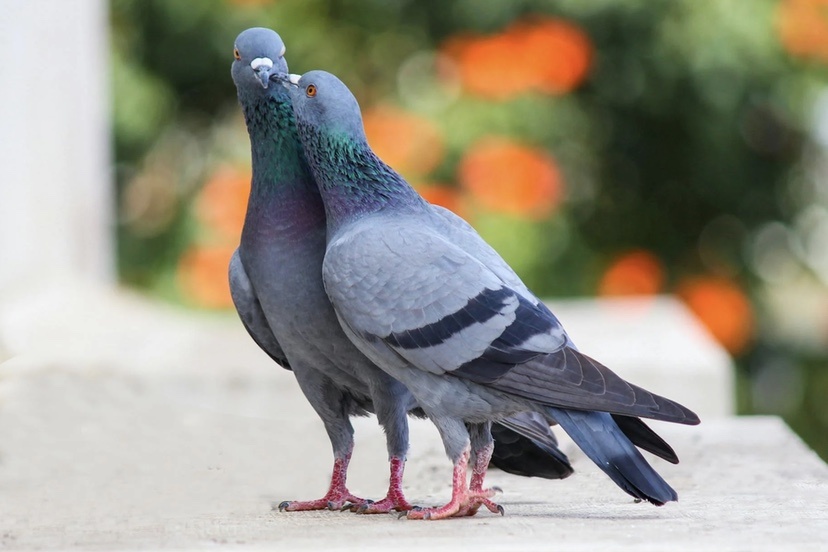
The pigeons aren’t buying that argument. As difficult as it may be for pigeons to deal with the complications of being in love, they keep doing it.
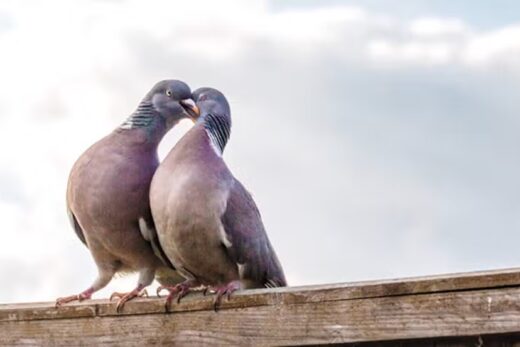
Back in 2016, journalist Brandon Keim wrote at length about pigeons in love, on Nautilus. After spending some time observing pigeons, and their romantic situations, he came to the realization that pigeons might understand love better than even Tina Turner.
Ubiquitous and unappreciated, typically ignored or regarded as dirty, annoying pests, pigeons mean something else to me now.
He wrote about Rita McMahon, the founder of the Wild Bird Fund, who discovered a pigeon with a broken leg on her deck in New York City. A veterinarian amputated the pigeon’s leg and while it recovered, it would rest on a cushion in Ms. McMahon’s apartment window.
On the other side of the window stood her mate, day after day, keeping her company until she was released and the couple rejoined.
“They were devoted to each other,” said Ms. McMahon.
Would I stay by my wife, if she had her leg amputated? Of course I would. But I would want a signed agreement that I get to keep the record albums, in the event of a divorce.
In his article, Mr. Keim concludes that — as painful as love can be — pigeons, and birds in general, experience something very similar to what we humans call “love”. Clearly, Mr. Keim is a journalist, not a scientist. But he still makes a good case.
He even suggests that birds might experience emotions beyond what humans feel.
It’s also worth considering whether pigeons might experience aspects of love that we don’t. Could a bird whose basic physiology adapts to changing seasons, who can perceive atmospheric infrasound, and see Earth’s magnetic field, have emotional capacities beyond our own? Including, perhaps, forms of love that are not merely analogues of our cherished feelings, but something unique to them?
It’s something to imagine. “Love among animals might appear as mysterious and baffling as human love has over the centuries,” writes Moussaief Masson in his book, ‘When Elephants Weep’.
Mysterious, for sure. And baffling.
Especially among humans.
Underrated writer Louis Cannon grew up in the vast American West, although his ex-wife, given the slightest opportunity, will deny that he ever grew up at all. You can read more stories on his Substack account.