
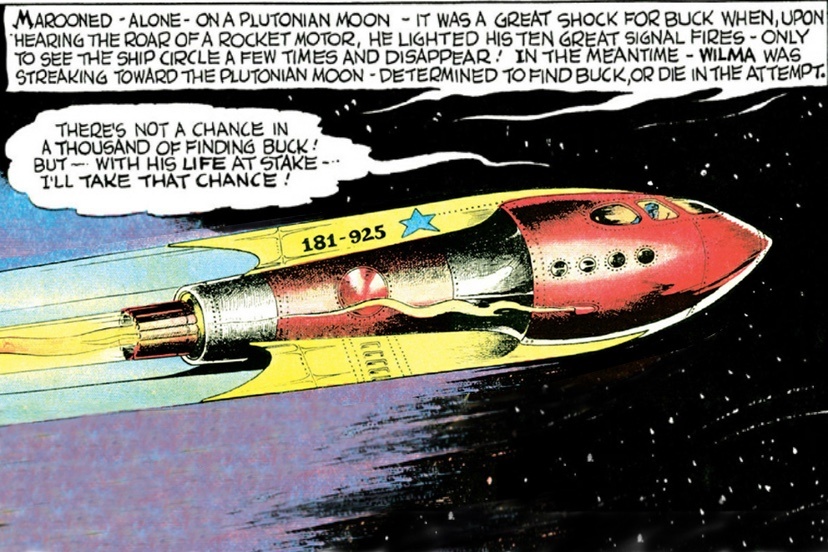
In the 25th century, noted rocketman Buck Rogers became marooned — alone — on a Plutonian moon, and his love interest Wilma Deering set off on a rescue mission to find him, or die in the attempt.
Her transport of choice was Rocket 181-925, which I imagine she had rented from Hertz Rocket Rentals.
I’m not sure how that particular mission turned out, but if I know anything about the planet Pluto — in particular, that Pluto has five moons — Wilma faced a daunting task, searching the surface of five moons for her marooned lover, before Buck ran out of oxygen.
And before her rocket ran out of gas.
When you start traveling through the solar system, the distances between planets become a much greater issue than back here in Earth, where there’s normally a gas station every 30 miles or so.
Writers of novels and comic books have been fascinated with interplanetary travel, and rockets as a form of transport, for well over a century, starting with the novel “A Trip to Mars” by Gustavus W. Pope, written in 1894.
Obviously, some of us are still dreaming of making the trip to Mars, in a large rocket. It’s fundamentally a cost per ton problem.
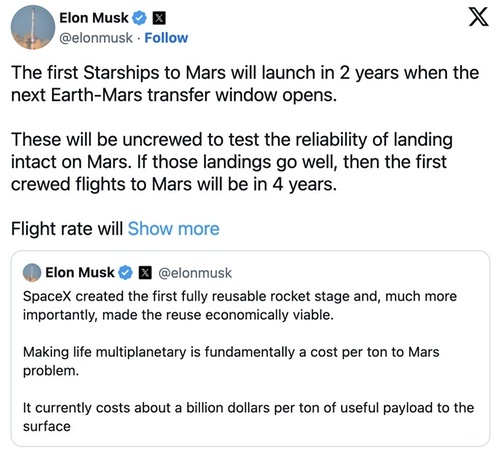
Mars occupies a special place in the imaginations of wealthy businessmen for a couple of reasons. It’s reasonably nearby, at certain times of the year; with the right type of rocket and the right type of budget, you can get there in about five months. Unmanned probes sent to Mars between 1965 and 2020 have made the trip in an average of about 200 days.
Buck’s oxygen would never last 200 days, if he were marooned on Mars. Luckily, he was marooned on a Plutonian moon instead.
Other billionaire rocket owners are not so interested in interplanetary travel, and conceive of rockets as tourist ‘cruise ships’ that can provide wealthy people with short trips — about 11 minutes, typically — above the Kármán Line. The Kármán Line is a line you can’t actually see, but is instead an internationally accept definition of where “space” begins, about 62 miles above the earth.
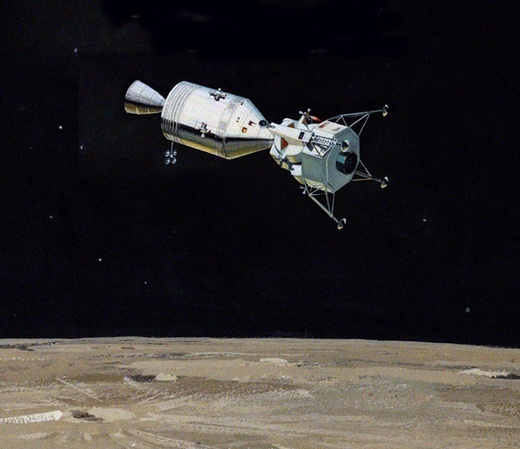
By the time I was born, in 1964, several men, and one woman, had flown rockets above the Kármán Line, and had in fact orbited the earth. By the time I was six, numerous Americans had walked on the moon in what was sort of like a Reality TV show series. They had flown there with rockets attached to their landing modules — small, unimpressive rockets, really, not nearly as cool looking as Wilma’s rocket.
All of my childhood friends, back in 1969, were looking forward to riding rockets to various planets.
Or at least, to the Moon.
Or in the worst case, spending some time in a large space station orbiting the Earth.
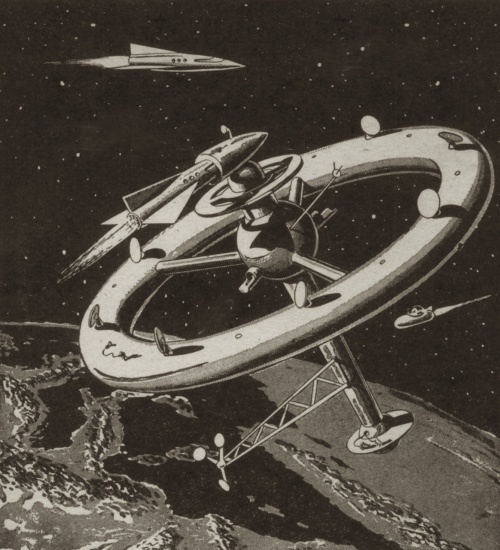
The space stations were going to be sort of like gas stations with a convenience store, but they would be built in the form of a rotating ring that would provide a form of artificial ‘gravity’ through centrifugal force. Rocketmen would park at the space station and get a cup of coffee.
And their rockets would look a lot like the one Wilma was flying in 1928.
Sadly, the first American space ships were not much more than a modified tin can, without any engines.
Something of a let-down for us kids.
Okay, that’s not really fair to call them tin cans. More like Japanese compact cars without wheels.

It’s now been 53 years since anyone rode a rocket to the Moon. But I heard on NPR yesterday, the U.S. is planning to send four people to the Moon in 2026.
That may be the last time I hear such an announcement on NPR, because… well, you know…
NASA’s Artemis Program originally scheduled the first flight to the Moon for 2019, but then moved the launch date to 2023, and then to 2025, and then to 2026. The first flight will orbit the Moon and return. Later trips will involve landings on the Moon, assuming they don’t slash the NASA budget.
From the NASA website, describing the Artemis Program:
We’re going back to the Moon for scientific discovery, economic benefits, and inspiration for a new generation of explorers: the Artemis Generation. While maintaining American leadership in exploration, we will build a global alliance and explore deep space for the benefit of all…
…Artemis missions enable a growing lunar economy by fueling new industries, supporting job growth, and furthering the demand for a skilled workforce.
Here is a picture of that proposed “skilled work force”.
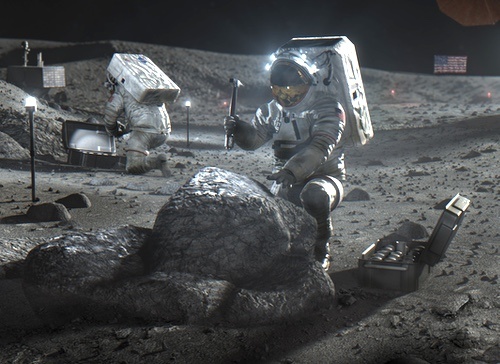
Hammering rocks in the middle of the night.
But in a skilled way. To fuel new industries.
Somehow, not quite as romantic as I imagined, as a kid.
We have to understand that… fundamentally… it’s a cost per ton problem.
Underrated writer Louis Cannon grew up in the vast American West, although his ex-wife, given the slightest opportunity, will deny that he ever grew up at all. You can read more stories on his Substack account.