
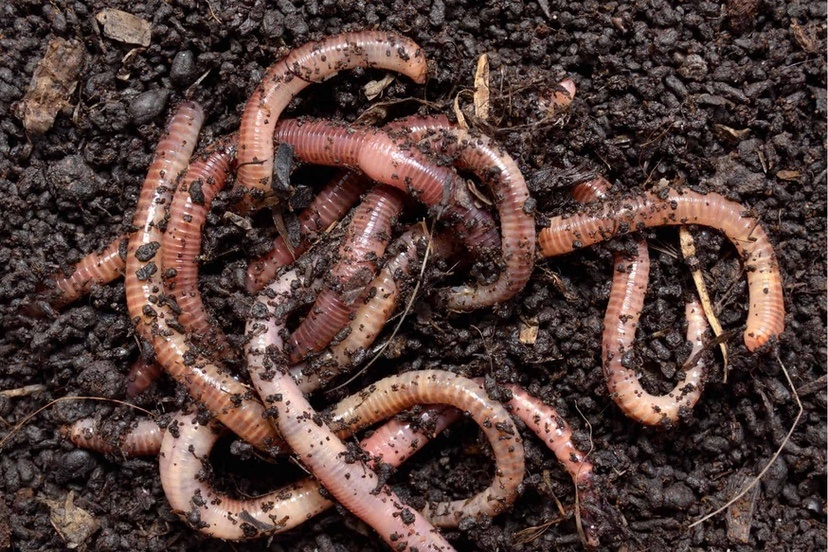
No, that’s not the name of a 1960s rock band, but I’ve come across worse band names than ‘Charles Darwin and the Earthworms’.
For example:
- Joe Lean and the Jing Jang Jong
- The Electric Prunes
- Moist Towelette
- Was (Not Was)
- Teenage Angst and the Participation Trophies
- Goldfish Don’t Bounce
As far as I know, Charles Darwin never played in a band, but he still got famous. What many people don’t know is that, in his own day, he was famous mainly for his book about earthworms.
Regular (or irregular) readers of my column are probably well aware that I don’t subscribe to Charles Darwin’s theories about evolution and natural selection, as originally published in his book, On the Origin of Species by Means of Natural Selection, or the Preservation of Favoured Races in the Struggle for Life… and not just because of the overly long title. Darwin theorized that occasional mutations among a species’ offspring — increased intelligence, for example — ultimately leads to the development of a completely new species with enhanced chances of survival.
This has obviously not been the case with the species known as Homo sapiens, when we look at what’s going on in Washington DC. No scientific theory will ever be able to explain ‘One Big Beautiful Bill’.
On the Origin of Species… was a best seller, but Darwin’s subsequent book, The Formation of Vegetable Mould through the Action of Worms with Observation on their Habits, sold even more copies, despite having a shorter title.
Darwin spent about 40 years studying earthworms, and came to the conclusion that, prior to the invention of the plow, “the land was in fact regularly plowed and still continues to be thus plowed by earthworms. It may be doubted whether there are many other animals which have played so important a part in the history of the world, as have these lowly organized creatures…”
He also observed that earthworms, as part of their housekeeping duties, make an effort to plug their burrow entrances with leaves, an activity they perform with such vigor, he wrote, that at times the rustling sound may be heard on still nights.
Whether they did this it for protection from predators or rainwater or cold air, or for food, he was not sure. But he noted that in nearly all cases, the worms inserted the leaves in the most practical manner, dependent upon the shape of each particular leaf.
Not content with studies using leaves, Darwin made a more systematic investigation of worm behavior using cut-out paper triangles of varying proportions, “rubbed with raw fat on both sides” to protect them from damp.
“We may infer,” he decided, “that worms are able by some means to judge which is the best end by which to drag triangles of paper into their burrows.”
Possibly indicating a primitive knowledge of engineering, perhaps? We have to wonder how many Washington politicians would know which end of a paper triangle would fit best into a burrow entrance.
Darwin also tested worm reactions to loud noises, by shouting at them, and discovered that, so long as he avoided directing his breath at the worms, they seemed to have no reaction to his shouting.
He didn’t experiment with playing loud rock music for the worms, of course, because it hadn’t been invented yet. But he did have his son play music on the bassoon, near a tray full of earthworms, and reportedly, the worms began to jiggle and vibrate. So we can imagine what the worms would have done if Led Zeppelin records had been available.
All these stories about Charles Darwin and his 40 years of earthworm studies — the shouting, and bassoon playing, and tiny paper triangles… I have to wonder what Darwin’s wife thought of all this.
“Charles, it’s nearly midnight. Come to bed now.”
“In a few minutes, darling. They’re dragging my paper triangles into their burrow entrances. It’s really rather amazing to watch.”
“Well, I simply ask you not to do so much shouting. It’s late, and I’m sure you’re irritating the neighbors. And your own children are trying to sleep.”
“Yes, of course you’re right, darling. I will be very quiet. You know, if you’re quiet enough, you can hear them plugging their burrows…”
“I know, dear. You’ve told me that a dozen times. I’m sure it’s a delightful sound. Be sure to wipe your feet when you come in.”
Underrated writer Louis Cannon grew up in the vast American West, although his ex-wife, given the slightest opportunity, will deny that he ever grew up at all. You can read more stories on his Substack account.