
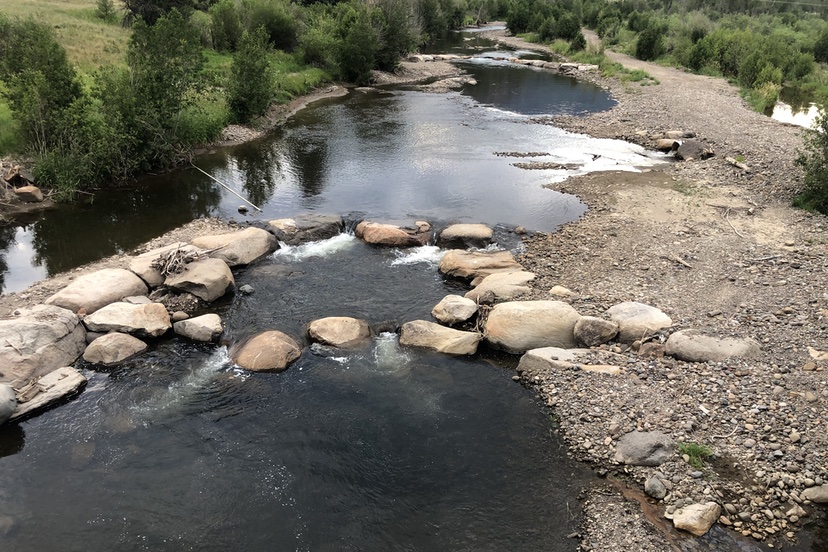
The West Fork of the San Juan River, the source of raw water for the PAWSD Snowball Water Treatment Plant. July 2026.
Archuleta County didn’t need a 16-foot flood in the San Juan River early this month, nor the flooding in tributary creeks and in the Piedra River. Yes, the excess water benefited the levels in downstream reservoirs — Navajo Lake, Lake Powell, Lake Mead — but it may be years before Pagosa Springs fully recovers from the flood.
As I mentioned in Part One, my downtown household lacked running water for about three days, immediately after the Pagosa Springs flood peaked on November 1. We also lost cell phone service for a couple of days. These were a minor inconveniences — compared to what was suffered by certain other households in Archuleta County. I was actually surprised at how minor the inconveniences were. Of course, we knew they were temporary, which always helps.
But it brought to mind a persistent question. How much water… do we need?
So we’ll take a break from discussing the recent flood events, and consider another aspect of “too much water”.
As many people are aware, Archuleta County is served by two government water districts: Pagosa Area Water and Sanitation District (PAWSD) and San Juan Water Conservancy District (SJWCD). PAWSD was formed in 1971 and provides drinking water for about 75% of the Archuleta County population, and sewer treatment for a slightly smaller population. It is funded mainly through monthly customer fees.
SJWCD was formed in 1987 with the goal of creating additional water reservoirs to facilitate population growth in Archuleta County. It’s funded almost exclusively through property taxes.
As of 2026, SJWCD has not yet created any reservoirs. It has, however, funded some short films about water, and hired consultants to study the feasibility of future reservoirs.
One of those future reservoirs — the subject of regular consultant studies for 25 years — might be located in Dry Gulch, a sloping valley about 2 miles northeast of downtown Pagosa Springs.
25 years later, the reservoir is still nothing more than a fanciful dream. But it’s a dream that has cost PAWSD and SJWCD hundreds of thousands of customer and taxpayer dollars.
Some might classify the “dream” as a “nightmare.”
Disclosure: I currently serve as a volunteer member of the PAWSD Board of Directors, but this editorial series reflects only my own opinions and not necessarily the opinions of the PAWSD Board and staff.
For two years now, the Districts have been engaged in a legal battle over the ownership of the Dry Gulch Valley — which is part of a 660-acre public holding known as the Running Iron Ranch. PAWSD owns a 89% share in the Ranch; SJWCD owns an 11% share.
In 2016, PAWSD agreed to use its customer fees to repay the money borrowed from the Colorado Water Conservation Board (CWCB) in 2008 to buy the Ranch, and also agreed — if a reservoir were not built by 2036 — to repay a $1 million grant given to SJWCD by CWCB to help fund the Ranch purchase. In exchange for this promise, PAWSD was granted the right to sell the Ranch, “at its sole discretion” so long as PAWSD made “every effort” to retain the property in the meantime.
In 2024, PAWSD received two offers from private parties to purchase the Ranch at a price that would relieve PAWSD customers of $10 million in future debt payments.
These offers struck the PAWSD Board as attractive — as you might understand — considering that the Dry Gulch Reservoir had been studied for 25 years without the slightest evidence that it could ever get built. (I do not classify “hopefulness” as “evidence”.)
The PAWSD Board shared one of these purchase offers with SJWCD, as the minority joint owner of the Ranch, and the SJWCD Board refused to consider the sale, even though the prospective purchaser had offered to help SJWCD build a reservoir in the Dry Gulch Valley.
The refusal by SJWCD to entertain an offer — an offer that struck the PAWSD Board as very attractive — has led to two years of legal wrangling and attorneys’ fees. But the wrangling has nearly all happened behind closed doors, out of public view, and with minimal public input.
Does the idea of a property sale that would relieve PAWSD customers of $10 million in future debt payments, while supporting a potential reservoir at Dry Gulch — after 25 years of zero progress — strike the public as a good idea?
We know it does not strike the SJWCD Board as a good idea. But how does the public feel? The public might want to share their feelings at the scheduled PAWSD Board meeting on Thursday, November 16.
This editorial series is titled “Too Much Water?” Of course, that phrase can directly relate to the recent flood events in southwest Colorado.
But it can also be applied to the way water resources have been developed and utilized in the American West. It’s obvious, for example, that California, Nevada and Arizona have been withdrawing “too much water” from the largest man-made water reservoir in America: Lake Mead. Lake Mead, at its peak, once held about 26 million acre-feet of water (July 24, 1983). On October 19 of this year, it stood at 7 million acre feet, and at an elevation of 1,039 feet — about 190 feet below “full”. If it drops to 950 feet, its hydroelectric turbines stop turning.
At the rate things are going, that could happen within the next ten years, unless California, Nevada and Arizona stop withdrawing “too much water.”
Does this “too much water” predicament relate to the legal argument between PAWSD and SJWCD?
For argument’s sake, let’s say that it does.
Read Part Four… tomorrow…
Bill Hudson began sharing his opinions in the Pagosa Daily Post in 2004 and can't seem to break the habit. He claims that, in Pagosa Springs, opinions are like pickup trucks: everybody has one.