
It’s probably an old saying in Tennessee.
I’ve heard it’s an old saying as in Texas, so it’s probably the same in Tennessee. And maybe also in Colorado, since people are pretty much the same everywhere.
“Fool me once, shame on you…”
The old saying goes on to discuss the unhappy circumstance of getting fooled twice… and who should be ashamed when that happens.
Most of us don’t want to be fooled twice.
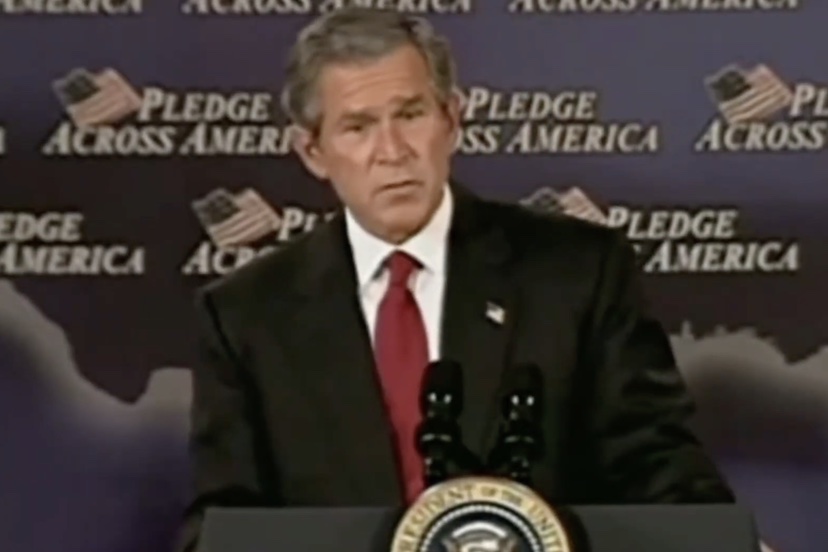
However, we did elect George W. Bush to the U.S. Presidency twice. The guy in this 17 second video.
If you fool me once, the blame and the shame is on you… even if I happen to be the President of the richest country in the world.
But if you fool me twice…
Well, that’s hopefully not going to happen. You can’t easily fool me the second time. But if it did happen — which it hopefully won’t — then, shame on me.
I’m pretty sure that’s what President Bush was trying to get across to us. Sure, go ahead and get fooled once. But don’t let it happen again.
Today is election day across the U.S. and a lot of voters are going to get fooled. The money and effort that’s been spent to fool them has been historic.
About $1.2 billion has been spent by candidates vying for 35 U.S. Senate seats.
Candidates running in the 435 U.S. House races have spent about $3.2 billion. All U.S. House seats are up for election every two years. That’s a lot of fooling, taking place on a regular basis.
Here in Colorado, a considerable amount of money has been spent fooling us about ballot measures. The ballot for Archuleta County contains a total of 16 state amendments, state propositions, and local tax measures.
Count ’em: 16 chances to get fooled.
And that’s not even counting the 38 candidates on the same ballot, all of whom would fool us at the drop of a hat, if they could. And seven judges looking to be retained, and who would certainly delight in fooling us, especially if we landed in their courtrooms.
I mailed off my ballot a couple of weeks ago. I don’t like to leave it lying around on the kitchen counter where it’s likely to get splattered with spaghetti sauce. So I mark it right away, and mail it off, before someone tries to fool me.
There’s an old saying, in Colorado — and probably also in Tennessee and Texas — that “a fool and his money are soon parted.” It’s apparently quite old, as sayings go. The precise wording of the expression has been located, for example, in Dr. John Bridges’ Defence of the Government of the Church of England, published in 1587:
If they pay a penny or two pence more for the readiness of them… let them looke to that, a foole and his money is soone parted.
Grammatically, “…are soone parted” seems more correct. But people didn’t worry about grammar in 1587.
I bring up the idea of a fool getting parted from his money, because a fair number of the measures on the November 3 ballot seem aimed at facilitating the parting of me from my money.
I can make a strong case for the proposition that I am not a fool, so long as my ex-wife is not in the vicinity to dispute my claim. But, of course, a person can be parted from his money, even if he is not technically a fool. My ex-wife knows this as well as anybody.
But even a person, who is not a fool, can be fooled at least once.
If he’s married, maybe more than once.
Underrated writer Louis Cannon grew up in the vast American West, although his ex-wife, given the slightest opportunity, will deny that he ever grew up at all. You can read more stories on his Substack account.