
The United States Constitution, America’s most important document, stands as a testament to the tenacity of Americans throughout history to maintain their liberties, freedoms and inalienable rights. And, Constitution Week is celebrated annually during the week of September 17-23 to commemorate its history, importance, and bring attention to how it serves still today…
— from the Daughters of the American Revolution website.
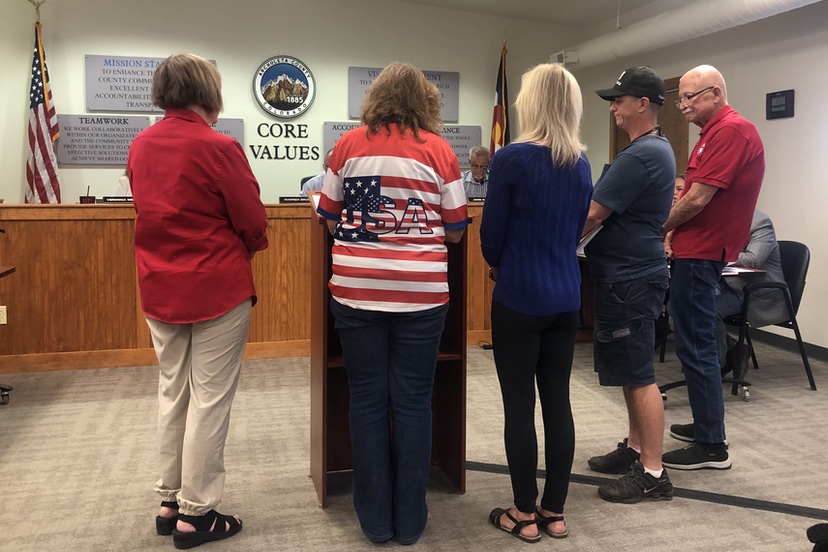
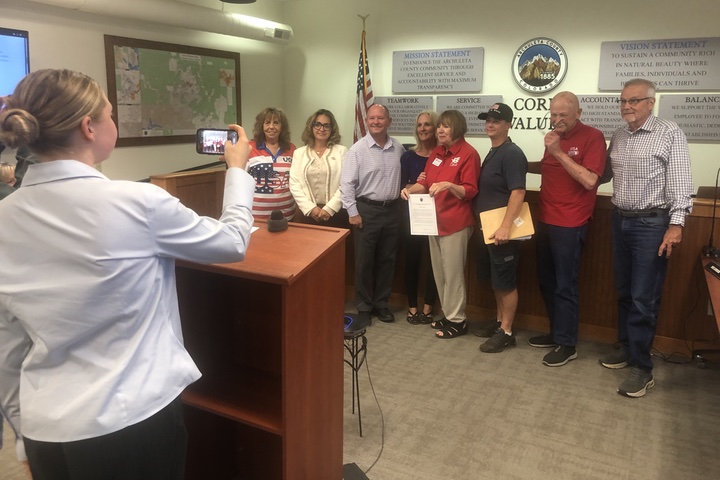
A group of concerned citizens stood before the Archuleta Board of County Commissioners on Tuesday afternoon, reading a proclamation about ‘Constitution Week’, which officially runs from September 17 through 23. One week, during which we are encouraged to study the U.S. Constitution.
A couple of excerpts from the Proclamation:
WHEREAS, it is the privilege and duty of the American people to commemorate our nation’s founding document on this, the two hundred thirty ninth anniversary of the drafting of the Constitution of the United States of America, with appropriate ceremonies and activities; and…
Citizens, leaders and officials are encouraged to conduct ceremonies and programs that bring together community members to reflect on the importance of active citizenship, recognize the enduring strength of our Constitution, and reaffirm our commitment to the rights and obligations of citizenship in this great Nation…
NOW, THEREFORE, LET IT BE PROCLAIMED by the Archuleta County Board of County Commissioners that the week of September 17-23, 2026, is hereby designated as Constitution Week in Archuleta County. We urge all citizens to study the Constitution and reflect on the privilege of being an American with all the rights and responsibilities, which that privilege involves.
The BOCC subsequently approved the resolution.
Photos were taken to document the occasion.
In 1955, the organization known as the Daughters of the American Revolution petitioned Congress to set aside September 17-23 annually to be dedicated for the observance of Constitution Week. The resolution was adopted by the U.S. Congress and signed into public law on August 2, 1956, by President Dwight D. Eisenhower.
Of course, we don’t necessarily have to wait until Constitution Week in order to study the Constitution — “America’s most important document,” according to the DAR.
You can view the Constitution on the Archuleta County website, or see an annotated version at the Library of Congress.
If it’s been a while since you last read it, you might have forgotten that it’s a relatively concise document (4,400 words) compared to, say, the Colorado State Constitution (20,000 words).
For another comparison, the Pagosa Area Water and Sanitation District (PAWSD) Drought Management Plan — which placed our community into Drought Stage 2 this summer and restricted our water use, while also making water more expensive — consists of nearly 15,000 words. Almost four times the length of the U.S. Constitution.
During the BOCC proclamation on Tuesday, we heard some brief comments from Perry Schjolin, a local resident who has offered adult classes in topics such as “Biblical Citizenship” and “Constitution Alive!”
Mr. Schjolin:
“I have a quote I want to share with you, from our first Supreme Court Justice, John Jay, who said, ‘Every member of this state ought diligently to read and study the Constitution of this country and teach the rising generation to be free.’ By knowing their rights, they will soon see when they were violated, and be better prepared to defend and assert them.’
“There are five things there. We are to read the Constitution, but not just read it — to study it.
“And once we have done those two, we can then share them with the ‘rising generation’, so that they may continue to be free.
“And once we have done those, we can then defend the rights — which is defensive — and assert them — which is an offensive position where we actually carry forward, we stand up for those rights, as well as accept those responsibilities.”
Since Mr. Schjolin has taught adult classes on the topic of the U.S. Constitution, I assume that he knows a lot more about that important document than I do.
But a couple of things are obvious to anyone taking the time to study the Constitution.
For one thing, the authors, in 1789, assumed that the American colonists generally subscribed to certain philosophical and social beliefs, and therefore left certain passages “vague” by modern standards. (Compare for example, the PAWSD Drought Plan.)
For example, in Article I, Section 9:
The Migration or Importation of such Persons as any of the States now existing shall think proper to admit, shall not be prohibited by the Congress prior to the Year one thousand eight hundred and eight, but a Tax or duty may be imposed on such Importation, not exceeding ten dollars for each Person.
The phrase “such Persons” here meant “Slaves”, but the framers could not, for some reason, bring themselves to actually use the word “Slaves”. And it’s pretty obvious that the States — not the federal government — had the sole legal right to allow or prohibit the importation of slaves until at least the year 1808.
If this paragraph had not been successfully negotiated by the authors of the Constitution, it’s quite probable that none of the southern states would have ratified the Constitution, since the growth of their economies depended on the importation of (mainly African) slaves.
This decision by the authors to kick the problem of slavery down the road did one thing very well — it put off the emancipation of (mainly African) slaves for 75 years, until the end of a bloody, five-year civil war.
But it did something else as well. It codified, and made specifically legal in “America’s most important document”, the concept of white superiority.
We would expect this from the framers of the Constitution, because they lived in a different time and with different beliefs. In 1789, the only persons allowed to vote in most of the U.S. states were white males who owned property. That is to say, “equality” meant equal rights for plantation owners, landlords and capitalists. These were the only persons who could truly be considered “free citizens”.
Not included: women, Indians, Blacks, Asians, and people working for an employer.
How far have we come?