
NOW, THEREFORE, LET IT BE PROCLAIMED by the Archuleta County Board of County Commissioners that the week of September 17-23, 2026, is hereby designated as Constitution Week in Archuleta County. We urge all citizens to study the Constitution and reflect on the privilege of being an American with all the rights and responsibilities, which that privilege involves.
— from the resolution approved by the Archuleta Board of County Commissioners on Tuesday, September 15, 2026.
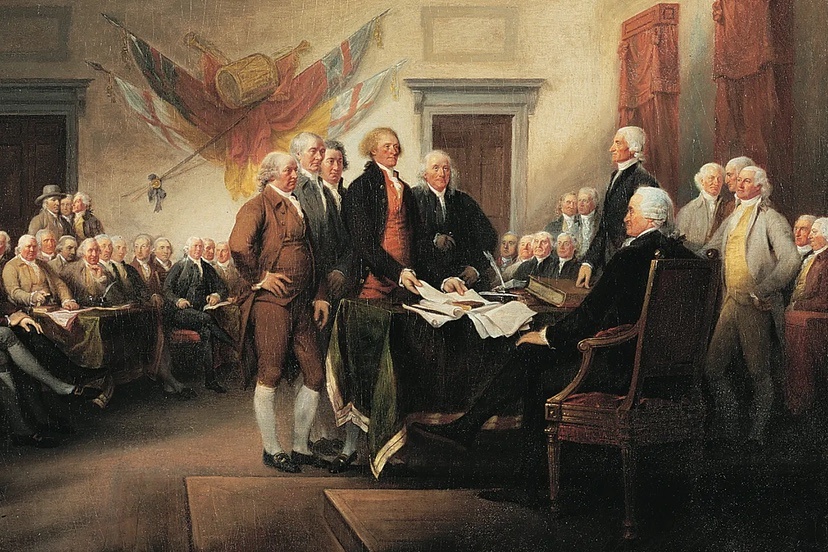
I believe the painting shown above illustrates the signing of the Declaration of Independence in 1776, but it was mostly the same group of people who wrote the U.S. Constitution in 1788.
Our County Commissioners have officially urged us to study the Constitution during Constitution Week, and to reflect on our rights and responsibilities…
…Two of those rights being ‘freedom of the press’ and ‘freedom of speech’ — included in the ‘Bill of Rights’ and ratified in 1791 to satisfy the Anti-Federalists. Those two guaranteed rights are near and dear to any journalist’s heart.
Not all of the framers of the Constitution thought the ‘Bill of Rights’ was a good idea. Some, including James Madison (who actually ended up authoring the Bill of Rights) argued that, by creating a list of people’s rights, then anything not on the list could be considered not protected. Madison and the others believed that we have ‘natural rights’ too numerous to list, so writing a limited list would be, in their view, counterproductive.
These critics also argued that the federal government was severely limited in its powers by the original wording of the Constitution, and any powers not specifically mentioned as belonging to the federal government were therefore reserved to the states and the citizens. (This idea was confirmed by the 10th Amendment.)
As it turned out, the Bill of Rights were indeed amended to the original document, and then over the years, another 17 amendments were added.
I indicated yesterday, in Part One, that the word “slavery” does not appear in the original Constitution, but that Article I, Section 9 specifically prohibited the federal government from limiting that practice until 1808, using the phrase “such persons”. Slavery was protected further by the “Three-Fifths Compromise”, which allowed states to count three-fifths of their slaves as part of their populations, for the purpose of representation in the federal government, and by requiring the return of escaped slaves to their owners, even if captured in states where slavery had been abolished.
I suggested that, in essence, the Constitution codified white male supremacy… as we would expect given the general beliefs of the American colonists at the time.
But times change.
One of the later amendments — the 13th Amendment, ratified in 1865 — made slavery and involuntary servitude illegal, except as punishment for a crime. But it did not guarantee the rights of citizenship for former slaves. That happened three years later with the 14th Amendment.
Several important things happened when the 14th Amendment was ratified in 1868. Some might view this amendment as the most important amendment in “America’s most important document”.
The 14th Amendment’s first section includes the Citizenship Clause, Privileges or Immunities Clause, Due Process Clause, and Equal Protection Clause.
The Citizenship Clause broadly defines citizenship, overturning the Supreme Court’s decision in Dred Scott v. Sandford (1857), which held that Americans descended from African slaves could not become American citizens.
The Privileges or Immunities Clause was interpreted in the Slaughter-House Cases (1873) as preventing states from impeding federal rights, such as the freedom of movement.
The Due Process Clause builds on the Fifth Amendment to prohibit all levels of government from depriving people of life, liberty, or property without substantive and procedural due process. Additionally, the Due Process Clause supports the “incorporation doctrine”, by which portions of the Bill of Rights also apply to the states.
The Equal Protection Clause requires each state to provide equal protection under the law to all people, including non-citizens, within its jurisdiction.
With this amendment, the Constitution finally started coming into alignment with the famous phrase from the Declaration of Independence, “that all men are created equal, that they are endowed by their Creator with certain unalienable Rights, that among these are Life, Liberty and the pursuit of Happiness.”
But at this point, only “men” were created equal, at least in theory. Women would have to wait for more than a century.
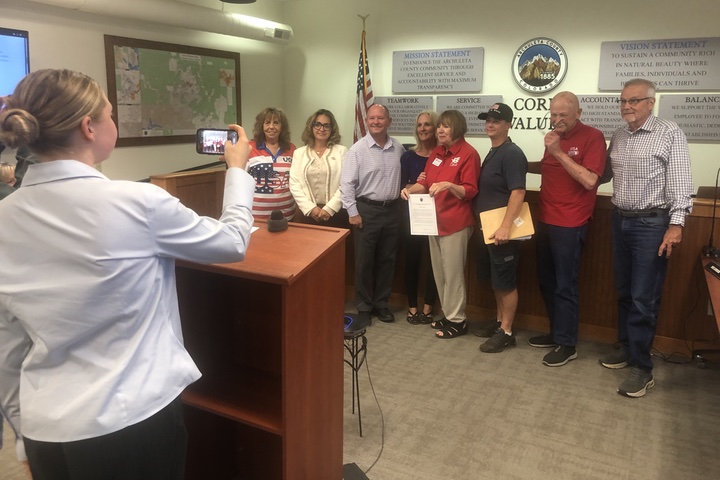
In Part One, I shared a photo taken at the September xx Board of County Commissioners’ meeting, with our three commissioners posing with the ‘Constitution Week’ advocates who represented the Daughters of the American Revolution, the Archuleta Republican Party, and the local Vets 4 Vets organization.
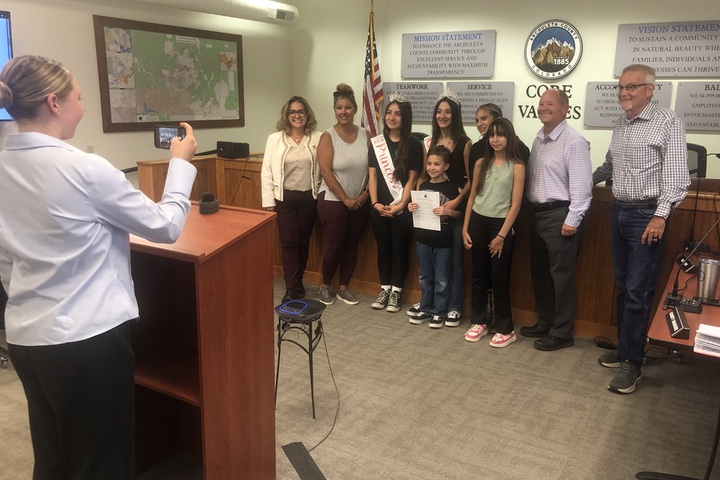
Shortly after this photo was taken, a different group stepped up to the podium to present another proclamation for possible BOCC approval. Most of the group were young ‘Spanish Fiesta’ royalty.
An excerpt from the proclamation:
National Hispanic Heritage Month 2026
WHEREAS, During National Hispanic Heritage Month, we recognize the extraordinary contributions of Hispanic American citizens past and present, and we honor their vibrant spirit, unyielding resilience, and inspiring commitment to our shared American values; and
WHEREAS, Hispanic American patriots have served on the front lines of our military, law enforcement, other first response, and in public service. They have enlivened our communities and enthusiastically embodied our national promise — defending our sovereignty, protecting our flag, and living out the eternal values of faith, family, and freedom; and
WHEREAS, as we celebrate National Hispanic Heritage Month, we recognize the resounding strength and success of the Hispanic American community. We honor their tremendous contributions to our culture, economy, and future…
The American tradition of discrimination against people of Hispanic heritage began in earnest shortly after the end of the Mexican-American War in 1848. The Treaty of Guadalupe Hidalgo saw the United States acquire a vast swath of formerly Mexican territory and the residents residing in those territories legally become American citizens.
Unfortunately, the transition was met with hostility from many of the non-Hispanics living in these newly ceded areas, as a wave of immigrants sought economic opportunities in the U.S. The influx of Mexican labor was essential for burgeoning industries, yet it fueled a backlash as non-Hispanics began to associate Mexican populations with the loss of jobs and with cultural dilution.
The history of violence that ensued is not pleasant to read, or study. Nor has the violence ceased in the U.S., as we can read every day in the news.
But here in Archuleta County — here, at least — we can appreciate cultural differences and live together without murders, lynchings, and federal detention facilities.
Yes, the BOCC approved the National Hispanic Heritage Month 2026 proclamation.