
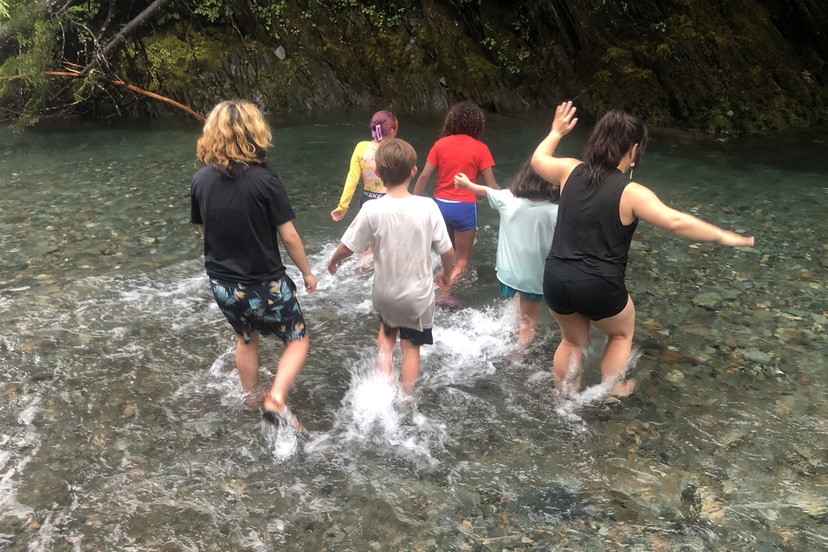
The final day of the Hudson-Haas-Hope-Kalman-Salas family reunion in Juneau, Alaska, included a cold plunge in icy Gold Creek, a few blocks from the Kalman clan’s vacation rental…
… followed by a big family dinner of homemade sushi… and then group Karaoke sing-along. Many of the songs chosen by the family’s younger members were unfamiliar to me. Obviously, I need to spend more time, prior to our next reunion, getting acquainted with the latest music.
I concluded Part Two, yesterday, with a brief mention of the 1971 Alaska Native Claims Settlement Act (ANCSA), whereby the U.S. government acknowledged the indigenous ownership of 44 million acres of land — about 12% of Alaska’s 586,000 square miles.
The indigenous tribes of Alaska had struggled to hold on to their ancient cultural and spiritual traditions, as people of European ancestry arrived to commercialize the land’s resources in the quest for private profit… beginning with gold, timber, furs, fish and seafood… and later, as larger corporations arrived, tourism and oil.
ANCSA created 12 regional Native corporations and 200 village corporations to hold, protect, and profit from those 44 million acres using a ‘corporate-shareholder’ model. That model brought about a couple of interesting changes to Alaskan Native culture. What had been largely a subsistence lifestyle based on hunting and fishing transitioned into capitalistic, money-based regional economies with a new emphasis on higher education, hospitals, technology, mining, timber sales, and — notably — a revival of social and linguistic traditions that had been suppressed by the dominant European-based culture for 100 years.
As husband to Clarissa — a woman of Tlingit Indian lineage — I had a front row spectator seat to these changes. But Clarissa and our three children — Kahlil, Lily, and Ursala — benefited directly from this new ‘shareholder’ support system. Thanks to a combination of scholarships, grants, and culturally significant purchases, the four of them developed into noted professional artists.
Simply stated, ANCSA provided wonderful opportunities for the people in my immediate family, due to their Native ancestry.
Clarissa passed away in 2016, shortly after receiving a lifetime achievement award from the National Endowment for the Arts — this, on top of numerous other awards for her artwork.
Her three children continued the family tradition of artistic achievement. Kahlil is an award-winning documentary filmmaker and a professor at the Institute of American Indian Arts in Santa Fe. Lily and Ursala are both nationally recognized makers of Tlingit-influenced ceremonial regalia that often ends up in museum collections — carrying on the weaving tradition established by their mother. Lily and Ursala also create other types of traditional and non-traditional art, and teach weaving workshops and art classes.
We didn’t see as much of Lily as we might have, because she was demonstrating weaving at the Sealaska Heritage Institute (SHI) in downtown Juneau. SHI is one of the ‘cultural renewal’ organizations that arose out of the Alaska Native Claims Settlement Act; it promotes the revival of the Tlingit language and traditional arts and crafts — carving, weaving, basket making, storytelling, canoe making, singing, dancing — through events, classes and ceremonies. The institute also publishes books documenting historical, and current, elements of Native culture.
When I stopped by SHI to see Lily’s weaving-in-progress, a Native production company was presenting a panel discussion about a new piece of performance art: an opera to be performed in the Tlingit language, about an historical battle between Tlingit villagers and Russian invaders.
As mentioned in Part Two, the passage of ANCSA by the U.S. Congress, and the signing by President Nixon in 1971, was directly related to the proposal by Atlantic-Richfield and its corporate partners to build the 800-mile Trans-Alaska Pipeline from the North Slope oil fields to the shipping terminal in Valdez. Following the drilling of successful oil wells in Prudhoe Bay, orders worth $100 million, for 800 miles of 48″ diameter pipe, were placed with Japanese steel companies, with plans to begin building the pipeline in September 1969.
But the planned pipeline passed through lands traditionally used by Alaska Native tribes.
Between 1968 and 1971, a succession of bills were introduced into Congress to address statewide Native claims. The earliest bill offered $7 million in compensation, but was flatly rejected.
The Alaska Federation of Natives, created in 1966, hired former United States Supreme Court justice Arthur Goldberg, who suggested that a settlement should include 40 million acres of land and a payment of $500 million. The issue remained unresolved until the Alyeska Pipeline Service Company began lobbying in favor of a Native claims act in Congress in order to lift a legal injunction against pipeline construction.
The final Act awarded 44 million acres plus $963 million to newly-formed Native corporations, thus instantly converting a traditionally-subsistence population into corporate-capitalist land barons.
In around 1972 — I don’t recall the exact year — Clarissa’s family members began receiving shareholder dividends of around $1,000 a year. The corporations funneled additional funding into college scholarships, with the belief that encouraging higher education among Native youths ought to be a corporate priority.
As I was writing the above essay, my plane from Seattle back to Colorado was flying over an agricultural area somewhere… maybe Utah? We could see, below, a patchwork of rectangular and circular fields — some dark green, obviously well irrigated.
But the majority were the yellowish color of dry grass. Ripe corn, perhaps? Or ripe wheat fields? Hard to tell from 30,000 feet.
I wouldn’t be surprised, however, of some of the fields were fallowed, considering the ongoing drought in the American West. Utah is one of the seven states served by the Colorado River and its tributaries, and as we’ve discussed occasionally here in the Daily Post, around 80%-90% of the water diverted from that river system goes into agriculture.
Did I mention that it rained nearly the entire week I was in Juneau? Continuous rain. All day and all night. It’s enough to drive a guy crazy.
Bill Hudson began sharing his opinions in the Pagosa Daily Post in 2004 and can't seem to break the habit. He claims that, in Pagosa Springs, opinions are like pickup trucks: everybody has one.