

As a friend said to me yesterday, the word “satisfied” can be applied a vast number of different circumstances. The particular condition that this editorial series has focused on is: “satisfied with the amount of wealth that I have at the moment, and not necessarily trying to acquire more.”
Not an unusual condition, perhaps, as I look around at my friends and neighbors in this isolated rural community.
We recognize, meanwhile, that the concept of “wealth” has changed over time, historically speaking.
There was a time, for instance, when the average person’s wealth was measured not in dollars, but in their number of children.
From a lengthy 2025 essay by Khalil Babilli, “The Role of Children in History: From Asset to Liability” on Substack:
Throughout most of human history, children were perceived as assets, representing labor, security, and continuity. They were not just a source of emotional fulfillment but also contributors to household productivity and future caretakers.
However, as societies progressed through industrialization, urbanization, and economic modernization, this perception underwent a significant shift.
Today, children are often viewed in strictly financial terms as liabilities, necessitating substantial financial and emotional investment with no guaranteed return. This transformation mirrors broader changes in economic systems, social norms, and cultural values, contributing to declining birth rates and reshaping the structure of families worldwide…
Prior to the Industrial Revolution, when societies revolved around planting and harvesting food, families benefited from having many hands to till the fields, tend to the livestock, and perform other essential tasks. A large family was not just desirable; it was practical. Children began contributing to household work at a young age, and their economic value typically exceeded the cost of raising them.
If we look to the Book of Genesis, we note that God — after creating humans — gave them some initial instructions. To wit:
“Be fruitful and increase in number; fill the earth and subdue it…”
That was the very first job given to humanity. “Produce children”.
Presumably, God could have given different instructions to those first humans.
“Get a college education,” for example.
“Cover the earth with pavement and build gas stations at convenient locations.”
“Invest in the stock market, or real estate.”
If we assume that God knew what He was talking about, then having a big family should have been high on everyone’s list of priorities. Amassing money? Not so important.
And for the first 300,000 years, humans did as they were instructed. They produced large families, whenever feasible. Then along came corporate capitalism, and the priorities changed. Gradually, children became a problem to be dealt with, rather than humanity’s raison d’être. They had to be educated, for instance. And as child labor laws were passed, children stopped contributing to the economic vitality of the community.
“Be fruitful” now seems to mean “earn a lot of money so you can afford a nice car and a house and the latest electronic devices.”
In such a world, one child is more than enough. But it’s not enough to replenish the population.
From Mr. Babilli’s essay:
Interestingly, the perception of children as liabilities is not universally accepted. In many developing countries, particularly those with subsistence economies, children are still viewed as assets. Large families remain common, and children contribute significantly to household labor. However, even in these contexts, the forces of globalization and modernization are beginning to alter traditional norms…

…The economic implications of raising children in the present day are staggering. Studies reveal that raising a child in many developed countries costs hundreds of thousands of dollars over 18 years, excluding higher education. Beyond these direct costs, modern parenting often involves intangible demands: time, emotional engagement, and the pressure to provide not just basic needs but opportunities for enrichment and success…
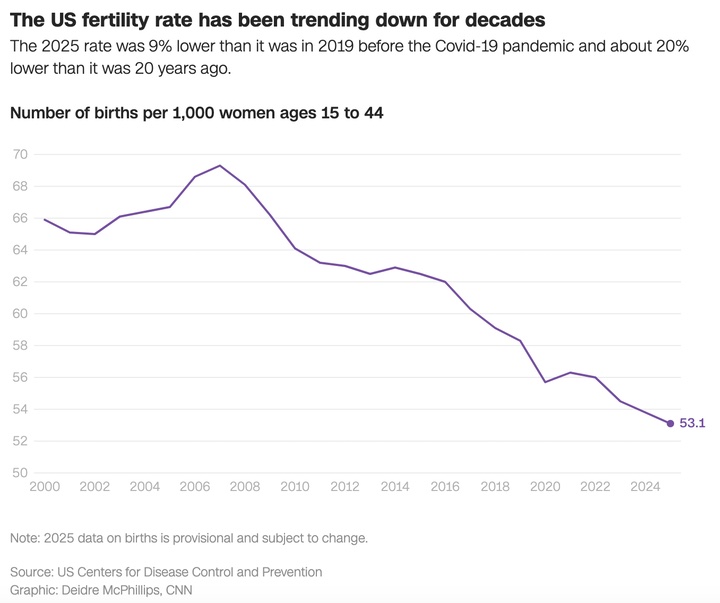
According to a CNN article from April 2026, written by Deidre McPhillips, Alicia Wallace and Tami Luhby, the fertility rate in the United States has been trending down for decades, and data shows that another drop last year brought the rate down to the lowest on record.
The U.S. Centers for Disease Control and Prevention estimated about 53 births for every 1,000 women of reproductive age, in 2025. That rate is about 1% lower than in 2024, and nearly 20% lower than it was two decades ago.
My late parents, Bob and Shirley Hudson, were modestly fruitful, bringing forth two offspring: my sister Cecilie and myself. They both wanted to have more children, but couldn’t, for medical reasons.
As of 2026, their parenting effort has resulted in a total of ten great-grandchildren, most of whom they got to know before they passed. I assume that’s going to be the final total.
If all goes well, those ten great-grandchildren will be in attendance at a family ‘reunion’ next month in Juneau, Alaska. It’s been about ten years since the family was assembled, and many of the kids are now teenagers, with two heading off to college this year.
No great-great-grandchildren for Bob and Shirley yet. And way things are looking these days, in our American culture, I have to wonder if my sister and I will see any great-grandchildren of our own?
The song that inspired this week’s editorial series — “A Satisfied Mind” — and the performance of that song in my living room by folk singer Bryan Bowers during a ‘house concert’ two decades ago, focused on the inability of “money” to produce a satisfied mind.
How many times have you heard someone say
If I had his money, I’d do things my way?
How little they know, it’s so hard to find
One rich man in ten with a satisfied mind…
Speaking for myself, I definitely cannot claim to have a satisfied mind. Writing about my community of Pagosa Springs, and sharing those stories with my readers, brings a certain kind of satisfaction, however. So there are moments.
Bill Hudson began sharing his opinions in the Pagosa Daily Post in 2004 and can't seem to break the habit. He claims that, in Pagosa Springs, opinions are like pickup trucks: everybody has one.