
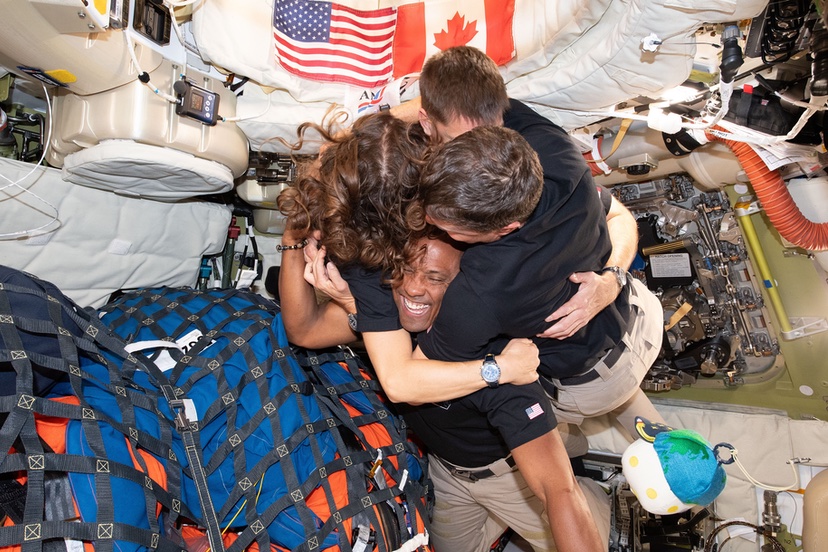
When you’re in that tiny spacecraft with four people, you’re all over each other… Everything that is easy becomes hard. Just making lunch: How do four people all make their food? If one person is exercising, nothing else can happen in the cabin…
– from an interview with astronaut Reid Wiseman following his trip around the Moon and back, published in The New Yorker, May 24, 2026.
Earlier this month, a writer for The New Yorker, David W. Brown, interviewed Reid Wiseman, commander of the $100 billion Artemis II space flight. Commander Wiseman led a crew of four astronauts who traveled farther from Planet Earth than anyone has been known to travel.
And more expensively, as well.
Among the four crew members, Victor Glover became the first person of color, Christina Koch the first woman, Canadian Space Agency astronaut Jeremy Hansen the first non-U.S. citizen, and Reid Wiseman the oldest person to travel around the Moon.
The New Yorker interview did not address the photo shown above, but we understand that the crew had been training together for three years and had obviously developed an appreciation for one another. Perhaps even, a certain kind of affection. This photo of their group hug — taken as they began the return trip to Earth — must have been snapped via remote control, because all four crew members are shown in the photo. (Unless NASA had actually added a photographer to the crew and never told us.)
Some news reports about the flight pegged the cost of the trip at about $4 billion. But I think we should include all the planning and preparation and testing and trials and re-testing that NASA did to prepare for this flight, since the trip was first imagined in 2004. So, more like $100 billion. Give or take. (I did in fact find that $100 billion number in certain news reports.)
$100 billion. To send four people on a 10-day round trip. And it wasn’t even a honeymoon for any of them.
From Commander Wiseman’s interview:
We were not always friends. We were not always aligned. But those differences actually helped us out. We have a team of operational psychologists here at the Johnson Space Center… Almost every other week, we would have a four-hour session with them. They would go through team-building exercises. What is going on in your own brain? Where are you? How are you showing up for your crew?
Those were some of the most difficult conversations I’ve had. Usually, I’d have to leave and go for a walk because they’re so exhausting. But, by the end, we knew each other…
Sounds to me a bit like marriage counseling. Which, speaking for myself, often required leaving and going on a long walk.
In the end — even after those painful counseling session — Darlene and I didn’t really know each other. And we had a big advantage over the Artemis crew. We weren’t stuck in a 214-square-foot metal capsule with only tiny windows and no front porch. And zero gravity.
But of course, the Artemis crew lived like this for only 10 days. If I knew I would be married to Darlene for only 10 days, things could have turned out a lot better for us.
Darlene and I could have shared a big hug, knowing that the ordeal was nearly over.
On the next-to-last day in space, the Artemis crew had a full-on fire emergency.
It was a false alarm, but that stopped everything: all the electrical power, all the ventilation. We were just sitting there with an emergency tone going off with a completely stagnant spacecraft—no airflow, and it was heating up. You’re human, so there are moments of terror…
Sort of reminds me of the time a frying pan caught fire, when Darlene was trying to sauté some Brussels sprouts. Not a “full-on” emergency, but still, a moment of terror. I slapped a lid on the pan, and put the fire out. Darlene gave me a hug.
I didn’t find out, from the Wiseman interview, what exactly the astronauts did about their false-alarm fire emergency, but I bet it brought them closer together. Just like our frying pan fire.
Moments of terror will do that sometimes: bring people closer together.
Which is why I have hope for America.
Underrated writer Louis Cannon grew up in the vast American West, although his ex-wife, given the slightest opportunity, will deny that he ever grew up at all. You can read more stories on his Substack account.