
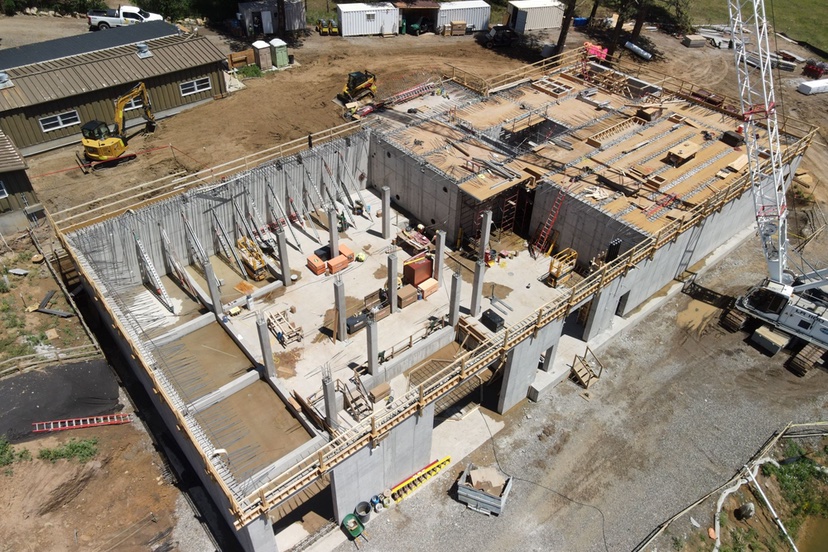
Photo: The new Snowball water treatment plant under construction.
From my limited perspective, I would suggest our current revenue miss is not merely a seasonal fluctuation, but it represents a potential shift in our revenue base…
— from a financial report to the Pagosa Area Water and Sanitation District (PAWSD) board of directors, May 14.
The photo above shows the $44 million Snowball Water Treatment Plant under construction, two years ago. The plant — which had been in the planning stages for at least the past 10 years — is now operational. PAWSD borrowed most of the money to build it, at a decent interest rate, and I believe one or two grants were involved.
It still ended up costing about twice what the original estimates were, a few years ago.
The replacement facility now serves the eastern part of the PAWSD district, and will increase PAWSD’s capacity from about 1 million gallons per day (MGD) to 3 MGD at full capacity.
In the top left corner of the photo you can see an Army green building — the old Snowball plant, originally constructed in the 1960s using a Vietnam War military surplus building. The old plant was still functional, but used old technology, wasted a lot of water, and would someday be unable to handle Pagosa’s population growth.
Assuming of course, that Pagosa’s population does grow.
Disclosure: I currently serve as a volunteer on the PAWSD Board of Directors, but this editorial reflects only my own opinions, and not necessarily the opinions of the PAWSD Board and staff.
I quoted some comments from PAWSD comptroller Jack Dossett in Part One, noting the very modest collection of Capital Investment Fees during the first three months of 2026. The PAWSD budget assumed over $1 million in CIF fees would be collected this year, from new construction projects — residential and commercial projects — but only $170,795 was actually collected during Q1.
If collections continue to be below budget, it puts PAWSD’s Debt Service Coverage Ratio (DSCR) — the ratio of revenue and expenses as compared to loan payment obligations — at risk. Lenders want to make sure that PAWSD always collects enough money to make its loan payments. Of course.
On Friday, I wrote about a May 14 decision by the PAWSD board of directors to reclassify an ongoing construction project — the Aspen House group home for adults with developmental disabilities — from “multifamily commercial” to “residential”. This reclassification will reduce the project fees owed to PAWSD by about $50,000.
This is not the first time in recent years that the PAWSD board has waived or reduced CIF fees for housing projects. In 2024, for example, PAWSD waived more than $800,000 in CIF fees for affordable housing projects.
Typically, a government cannot charge fees to “this person” and waive fees for “that person”. But affordable housing is specifically called out in state law as an area where normal fees can be waived by a government board. Fees are often waived, as well, for projects that have an obvious “community benefit.”
In his May 14 report, Mr. Dossett wrote about the possible effects of fee waivers on the PAWSD budget and on the DSCR.
Affordable housing impact: No one is arguing the importance of affordable housing in our market, that said it is also important to understand unbudgeted affordable housing assistance has created a $70,191 revenue deficit YTD. Every waived fee is a permanent loss of revenue. When CIFs are waived, the cost of that capacity is subsidized by existing ratepayers, placing a heavier burden on our current customer base.
Debt Service Coverage Ratio (DSCR):
The PAWSD 2026 budget was already thin, leaving little room for any budget shortfalls. The impact of the CIF revenue miss directly erodes our DSCR. Maintaining this ratio is a legal and financial commitment.
I shared, in Part One, some evidence that Pagosa Springs may be headed for an economic downturn similar to what the community experienced between 2009 and 2012, when our local population decreased, property values took a tumble, and tourism visits dropped off. The reasons for the downturn may not be the same — although who knows what, exactly, awaits us this year, and the next several years?
To get through a downturn gracefully, families and businesses typically cut back on expenses.
Is PAWSD willing to cut back? In a serious way?
A water district… upon which most of the community depends for drinking water and wastewater services… can such a district actually cut expenses?
From Mr. Dossett’s report:
Expense Monitoring:
We are seeing pressure in several line items, and it is early in the year. I believe these expense pressures can be absorbed by tightening other ‘buckets’ within the budget:
• Capital Connections: currently outpacing budget, primarily on the water side.
• Energy: Fuel and utility expenses are trending high, and we will likely exceed budget barring a significant shift in market rates.
• Insurance – General: while we have already paid the largest portion our annual premiums in Q1, we are seeing across multiple line items we were a little short on budget.
Unfortunately, these four sentences do not give us a clear picture of which “other buckets” can be tightened. Does PAWSD have maintenance issues that can be deferred if revenues come in below expectations? Can staffing be “streamlined”? Can other efficiencies be implemented?
Will future affordable housing projects be required to pay the rather exorbitant CIFs? Even if the current housing crisis is worsening?
At the May 14 meeting, board member Glenn Walsh proposed a method for temporarily increasing monthly fees to ensure that DSCR promises are met.
One more thought about expenses. PAWSD long ago determined that a reservoir on the publicly-owned Running Iron Ranch is not feasible and is not needed. PAWSD makes loan payments on that Ranch purchase of $260,000 a year, and adds additional district debt each year on deferred loan payments. So it is costing PAWSD customers about $500,000 a year to hold on to the Ranch.
The PAWSD board voted, two years ago, to sell the Ranch and get its customers out from under that debt burden. But the San Juan Water Conservancy Board filed legal actions to prevent the sale. Two years later, PAWSD continues to make useless debt payments — because of the actions of a separate government district.
How beneficial it would be, to PAWSD customers, to escape that $500,000 annual debt burden!