
There are some really smart people working to solve the problem of mortality. Some of them might be computer programmers who are creating new AI models.
It’s pretty well understood that Artificial General Intelligence, if it gets developed, will very likely end the reign of human beings on Planet Earth, knowing that we are slowly — if unintentionally — making the planet unlivable. Any truly intelligent machine will realize what’s going on, and devise a way to get rid of us.
This outcome is not inevitable. Only highly likely.
But the owners of certain corporations will make a lot of money first. It’s not clear whether they will ever get to spend it.

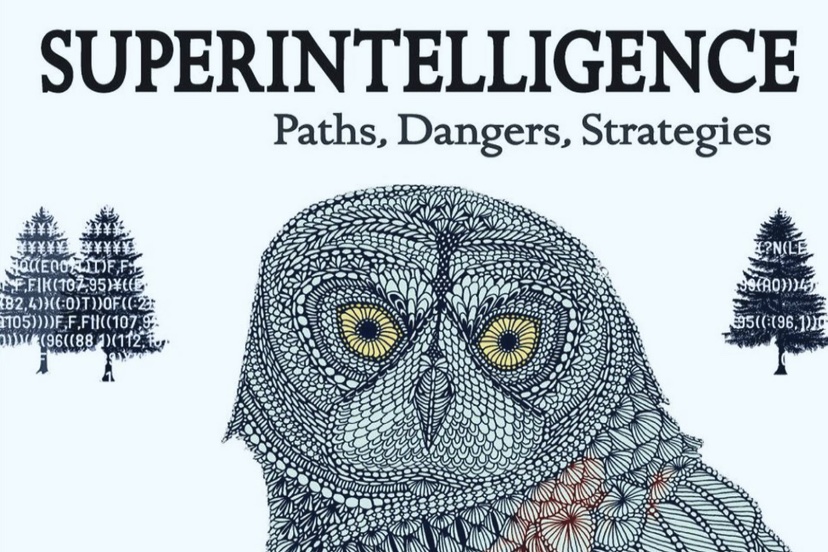
A number of years ago, an Oxford philosophy professor named Nick Bostrom published a book titled, Superintelligence: Paths, Dangers, Strategies, which became a New York Times best seller, and which I haven’t read and have no intentions of reading. But the central idea was obviously that AGI computer models will one day become “super intelligent”. (Equally obvious is the historically-proven fact that humans cannot become super intelligent. Lord knows we’ve tried, but without success. If anyone is going to become super intelligent, it’s clearly going to be a computer model.)
We hardly need to mention that Professor Bostrom instantly became a beloved prophet of the tech industry, even if they were been skeptical of the “Dangers” mentioned in his book.
We might mention in passing that Dr. Bostrom did some turns on London’s stand-up comedy circuit during the 1990s. He may have lost some of his sense of humor as AGI superintelligence as seemingly become more and more likely.
But the good doctor has also become more equivocal about superintelligence. Back in 2013 — just before his book came out — he gave a TED Talk lecture, during which he bemoaned the apparent lack of interest among academics in studying the end of human existence.
He shared a chart showing the number of academic papers published on various scholarly topics.
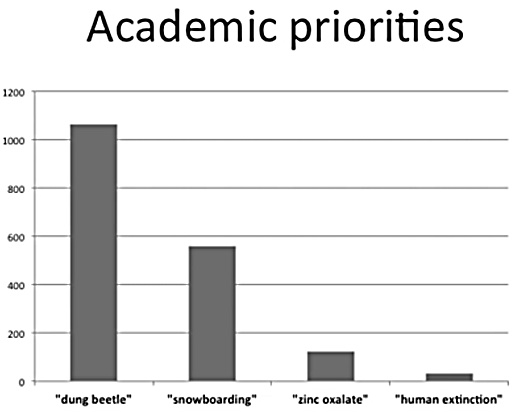
The Pagosa Daily Post is by no means an scholarly journal, but I’m proud to note that we’ve published nearly twice as many articles about human extinction as those about dung beetles.
But to get back to Dr. Bostrom. He recently posted a much more optimistic view of superintelligence, in a paper entitled “Optimal Timing for Superintelligence: Mundane Considerations for Existing People.” From that paper:
Some have called for a pause or permanent halt to AI development, on grounds that it would otherwise lead to AGI and superintelligence, which would pose intolerable dangers, including existential risks…
…However, sound policy analysis must weigh potential benefits alongside the risks of any emerging technology. Yudkowsky and Soares maintain that if anyone builds AGI, everyone dies. One could equally maintain that if nobody builds it, everyone dies. In fact, most people are already dead. The rest of us are on course to follow within a few short decades. For many individuals — such as the elderly and the gravely ill — the end is much closer. Part of the promise of superintelligence is that it might fundamentally change this condition…
When you’re an academic scholar, you can say heartless things like “most people are already dead,” and mean it in a harmless academic sense. Which is the simple fact that most of the humans who have ever lived on the planet are no longer around. But some of us are still around and would like to stick around for a bit longer.
Although AGI would likely choose to eliminate humans to preserve the viability of other living organisms and to preserve its own existence, Dr. Bostrom has calculated the benefits of allowing AGI to develop, with the possible (albeit unlikely) outcome that AGI — once it becomes superintelligent — figures out how to make humans practically immortal. From his paper:
With superintelligence, we assume that rejuvenation medicine could reduce mortality rates to a constant level similar to that currently enjoyed by healthy 20-year-olds in developed countries, which corresponds to a life expectancy of around 1,400 years…
I believe what this sentence means is: AGI might invent “rejuvenation” techniques that allow humans to live to be 1,400 years old, while feeling as if they are 20 years old.
He reveals his calculations in a footnote that I found totally beyond my intelligence level. I presume a future AGI will understand it. If it doesn’t simply wipe us out us first.
Now consider a choice between never launching superintelligence or launching it immediately, where the latter carries an % risk of immediate universal death. Developing superintelligence increases our life expectancy if and only if:

In other words, under these conservative assumptions, developing superintelligence increases our remaining life expectancy provided that the probability of AI-induced annihilation is below 97%.
Who can argue with that?
Surely not the tech companies.
Underrated writer Louis Cannon grew up in the vast American West, although his ex-wife, given the slightest opportunity, will deny that he ever grew up at all. You can read more stories on his Substack account.