

A few days ago, reporter Alan Ehrenhalt began an article about urban transportation in Governing magazine, with this little joke.
Some years ago, the urban planner Andres Duany was given a tour of a new roadway by a traffic engineer. “You know,” the engineer boasted, “we can move thousands of cars a day through this baby.”
“That’s what we’ve come to,” Duany responded. “We’re moving cars through babies.”
Not a terribly funny joke.
But like almost any joke, the humor depends on the “truth” hidden inside an otherwise uncomfortable statement. America kills pedestrians, including mothers pushing baby strollers, at a somewhat remarkable rate, mainly because our streets and highways are purposely designed to get us from A to B at what engineers consider to be the fastest acceptable speed. Time is, after all, money.
Or, if time is not money, it’s at least an additional amount added to my credit card debt.
So we’re considering bicycles, and speed.
I rode a bicycle many times, when I was still a kid, but that was a long time ago. So some of the following comments should be taken with a grain of salt.
For example, back when I was riding a bike, you had to actually push the pedals. Seems like these days, the people I see around town are all riding electric bikes. And they generally look overweight. I’m not saying there’s a correlation, but there might be.
Not only are bicycles getting electrified, but bicycle riding is also becoming more and more dangerous.
How did we get here?
Archaeological evidence suggests that ‘wheeled vehicles’ were in use in 3100 BC. Maybe earlier. But these were, like, horse-drawn chariots and carriages.
We had to wait until 1817 for Baron Karl von Drais Sauerbronn to invent his Laufmaschine (“running machine”) — the first commercially successful two-wheeled, steerable, human-propelled machine. It didn’t have pedals or a chain mechanism; you propelled it by running.
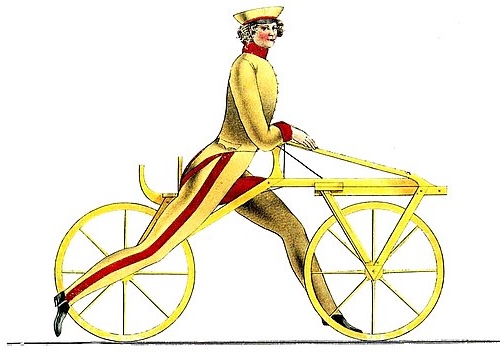
Hans-Erhard Lessing — the Baron’s biographer — reported that Drais’s interest in finding an alternative to the horse was the starvation and death of horses, caused by a disastrous crop failure in Germany in 1816 — the ‘Year Without a Summer’ following the volcanic eruption of Tambora in 1815 and the global cooling that resulted from the atmospheric pollution..
On his first reported ride from Mannheim on June 12, 1817, he covered eight miles in less than an hour. I wonder if the surviving horses in Germany could see what was coming?
Bicycle manufacturers soon determined that a very large front wheel with pedals attached, and a very small rear wheel, greatly increased the speed that could be attained by the cyclist.
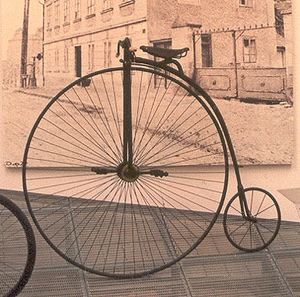
Later, they noticed a greatly increased number of emergency room visits that could be attained.
It took another 15 years before inventor John Kemp Starley produced the first successful “safety bicycle” — the “Rover” — in 1885, which featured a steerable front wheel, equally sized wheels and a pedal-driven chain drive to the rear wheel.
That’s pretty much the bicycle I owned as a kid in the 1970s. But a “safety bicycle” is only as safe as the streets it rides on, and the brain capacity of the cyclist.
Between 1975 and about 2010, the U.S. saw a general decline in the number of cyclist fatalities. But the fatalities since 2010 have been on a frightening upward trajectory, hitting 1,166 in 2024.
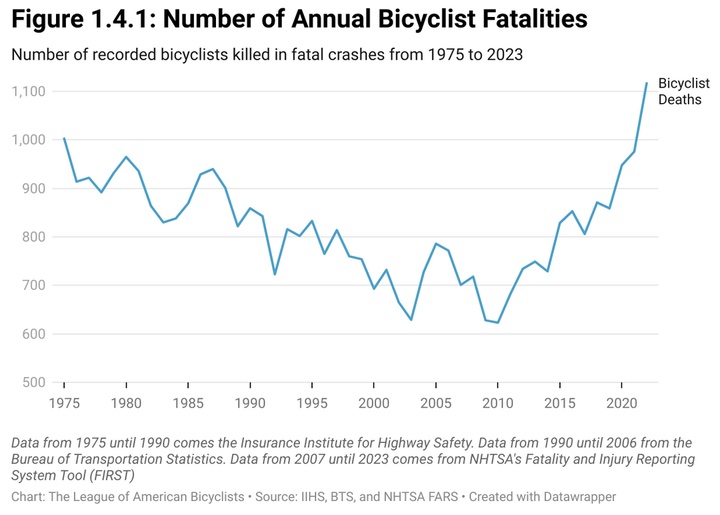
The first thing I think about is the explosion of cell phone use since 2010. But that’s not what the League of American Bicyclists are thinking about. They are thinking about who, exactly, is behind the effort to move thousands of cars a day through which babies.
While our federal government owns few roads, they provide funding, design guidance, and environmental review for over 80 percent of the roads where bicyclists are killed.
Need we say more?
Underrated writer Louis Cannon grew up in the vast American West, although his ex-wife, given the slightest opportunity, will deny that he ever grew up at all. You can read more stories on his Substack account.