
As mentioned in Part One, the Archuleta Board of County Commissioners invited Bill Trimarco, Pagosa agent for Wildfire Adaptive Partnership, to present a report on ways that property owners or neighborhoods could seek an exemption from the Colorado Wildfire Resiliency Code (CWRC), which was created by the state of Colorado and adopted by the Archuleta BOCC earlier this year as required by state law.
You can view or download the 2025 CWRC here.
From that Code:
The purpose of this code is to establish minimum regulations for the safeguarding of life and for property protection. Regulations in this code are intended to mitigate the risk to life and structures from intrusion of fire from wildland fire exposures and fire exposures from adjacent structures and to mitigate structure fires from spreading to wildland fuels. The extent of this regulation is intended to be tiered commensurate with the relative level of hazard present.
The unrestricted use of property in wildland-urban interface areas is a potential threat to life and property from fire and resulting erosion. Safeguards to prevent the occurrence of fires and to provide adequate fire protection facilities to control the spread of fire in wildland-urban interface areas shall be in accordance with this code. This code shall supplement the jurisdiction’s building and fire codes, if such codes have been adopted, to provide for special regulations to mitigate the fire- and life-safety hazards of the wildland-urban interface areas.
We can summarize the three goals stated here.
To prevent structures from catching fire during wildfire events.
To prevent structure fires from spreading and causing wildland fire events.
To prevent structure fires from spreading to neighboring structures — as we saw happen during the 2021 Marshal Fire in Boulder County, and in Los Angeles last summer.
During the April 21 presentation by Mr. Trimarco, the BOCC heard that individual properties or neighborhoods can be exempted from the CWRC requirements through two avenues. But they are two complicated avenues.
The central question from the BOCC being… is everyone now stuck with the CWRC? Or is there a way to escape?
But… do we really want to escape? Escape from science-supported regulations that purport make the whole community safer?
Back in March, Archuleta County Building Official Randy Betts had shared some of the CWRC requirements and some possible financial impacts to the construction industry and the property owners they serve.
The CWRC applies only to new construction and to major exterior expansion and repairs, including new siding and new roofing when more than 25% of the siding or roofing is being replaced. The code does not apply to interior remodeling, unless the building’s square footage will increase by 500 square feet or more.
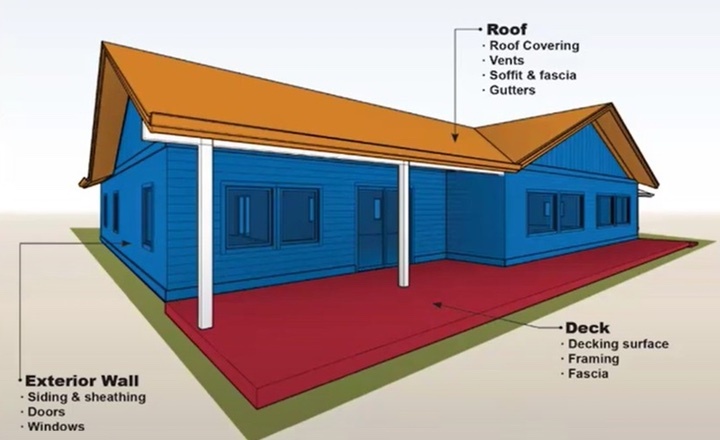
HUD-certified mobile homes — more affectionately known, these days, as “manufactured homes” — will not need to meet the new code. However, “modular homes” that arrive by truck to be placed on a permanent foundation, will need to meet the code. The code also regulates the landscaping around the home.
According to Mr. Trimarco, a property or neighborhood can become exempt from CWRC requirements by creating a “local hazard map”. The state of Colorado has an existing hazard map for every county, created by state experts and bureaucrats, and our map essentially shows the entirety of Archuleta County as “orange or red”. That is, having a high risk of burning, based on local weather patterns, types of fuels in the area, tree canopies, topography and past fire events.
Archuleta County could theoretically create its own map, to define the high risk areas differently from how the state experts defined our community.
Bill Trimarco:
“If you want to change the map, you have to go through a series of steps…
“… We have been told that, if we want to change the map, it would really help if we had a different map in our CWPP [Community Wildfire Protection Plan]…
Archuleta County’s CWPP was created collaboratively by Wildfire Adapted Partnership, the San Juan Forest Health Partnership, the Archuleta County Sheriff’s Office, the U.S. Forest Service, and other agencies. You can view or download the CWPP here.
As Mr. Trimarco explained, the CWPP does not use a different map; it uses the existing state map.
“So if we want to go the ‘map route’ we have to develop a whole new map. And from what I understand, this would cost between $800,000 and $1 million, and would need to be updated every three years.
“So that’s an option. Doesn’t sound like a very good one to me…”
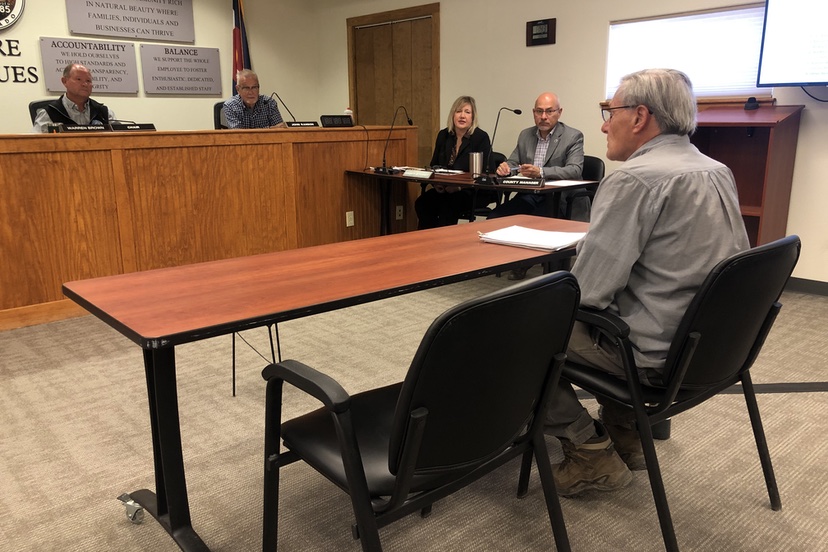
The second option for seeking exemptions from the CWRC regulations is by creating “local exemption zones”.
“These would be on a parcel-by-parcel basis. This is what they are calling the ‘ground-truthing’ process… They will be looking at the vegetative fuels — what is there that can burn — and you have to prove that, for some reason or another, you’ve got a situation that is ‘better’ than what is shown on the [CWRC] map.”
Mr. Trimarco mentioned that the “real tricky” part of this process is that not only does the entire parcel have to meet certain requirements, there also has to be a 300-foot “buffer” around the parcel, meaning that neighboring properties would have to meet the requirements as well.
“Any of the places I’ve seen in this county would have a real hard time meeting that low requirement.”
Commissioner John Ranson asked if one of these parcel-level ‘ground-truthing’ reports might help property owners in getting insurance. Mr. Trimarco felt that a “clean bill of health” for a single parcel doesn’t seem to make a big difference to insurance companies at this point, and that’s part of the of the reason why the community-wide Code is being pushed by the state.
Mr. Trimarco noted that a community event on this topic, “Be Prepared for an Emergency Workshop”, will be held tomorrow, Saturday May 9 at 9am at the CSU Extension building, 344 U.S. 84. The promotional information suggests that we will “Learn how to prepare for emergencies and protect your land.”
Another workshop will be held on Tuesday May 12 at 5pm at the CSU Extension Office on Highway 84, hosted by Wildfire Adapted Partnership, the Archuleta County Sheriff, and the Pagosa Fire Protection District.
Commissioner Veronica Medina commented that the new regulations are “definitely a hot topic,” and that people are reaching out with questions and wanting more information.
“I don’t think the state really understands what it is they implemented…”